I present to you: Bride of the Creature from the Black Lagoon.

Happy Halloween, everybody!
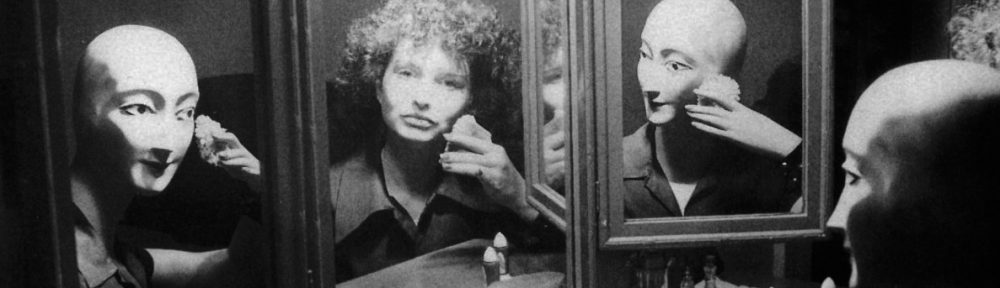
I present to you: Bride of the Creature from the Black Lagoon.
Happy Halloween, everybody!
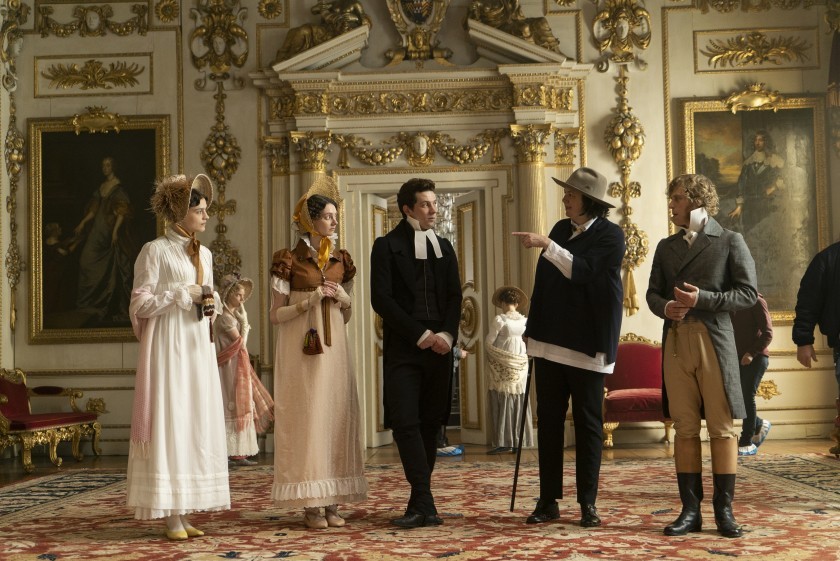
Director Autumn de Wilde (second from r.) and actors (l-r) Amber Anderson, Tanya Reynolds, Josh O’Connor and Johnny Flynn on the set of Emma., 2019. (Photo: Liam Daniel/Focus Features, Los Angeles Times)
Better late than never: Here are twenty-one new movies due to be released in theaters or via other viewing platforms this February, all of which have been directed and/or photographed by women. These titles are sure to intrigue cinephiles and also provoke meaningful discussions on the film world, as well as the world in general.
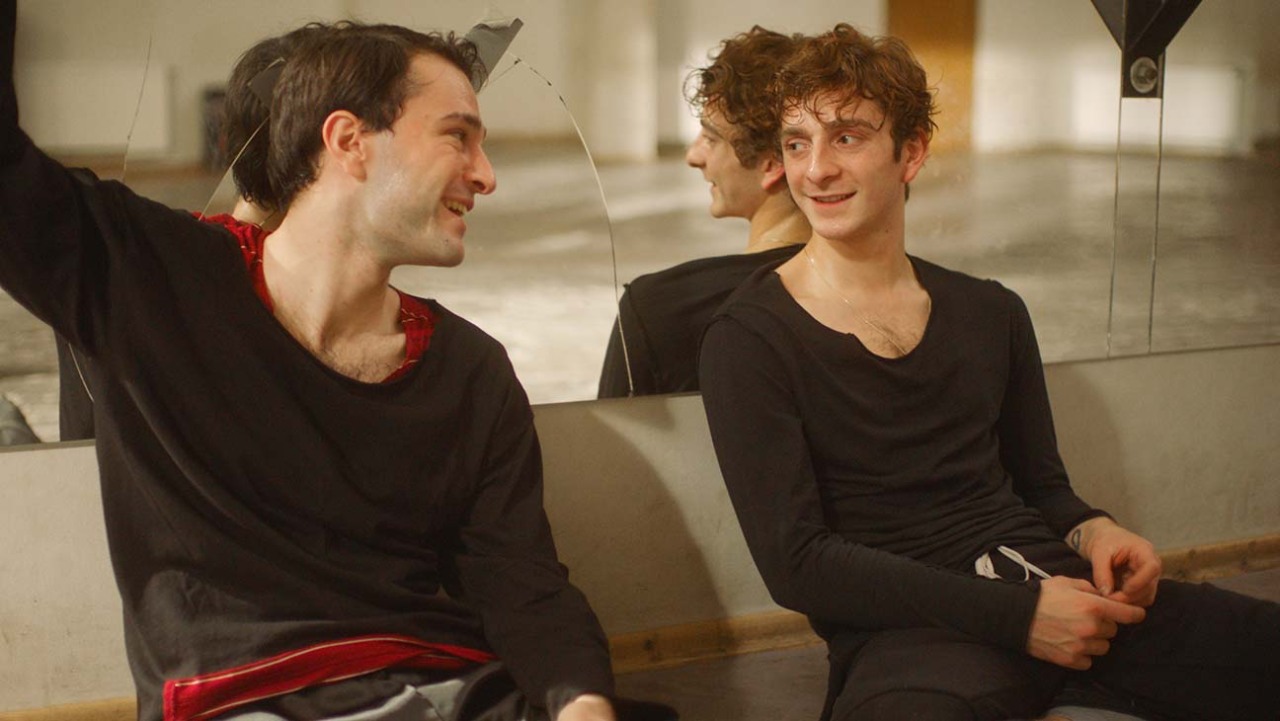
FEBRUARY 7: And Then We Danced (dir. Levan Akin) (DP: Lisabi Fridell) – The Landmark at 57 West synopsis: “A passionate tale of love and liberation set amidst the ultraconservative confines of modern Georgian society, And Then We Danced follows Merab (charismatic Levan Gelbakhiani), a talented and devoted dancer, frustrated by the rigid restrictions of his dance coach, who proclaims that there is no room for softness in a dance that ‘honors the spirit of the nation.’ Sensitive and headstrong, Merab has been training for years with his partner and best friend Mary (Ana Javakishvili) for a coveted spot in the National Georgian Ensemble, a potential escape from poverty and gateway to fame. The arrival of another male dancer, handsome Irakli (Bachi Valishvili)—gifted with perfect form and equipped with a rebellious streak—throws Merab off balance, sparking both an intense rivalry and a forbidden desire that may cause him to risk his future in dance as well as his relationships with Mary and his family. Sensual and romantic, And Then We Danced features spectacular, exciting dance sequences, as well as an unforgettable love story.”
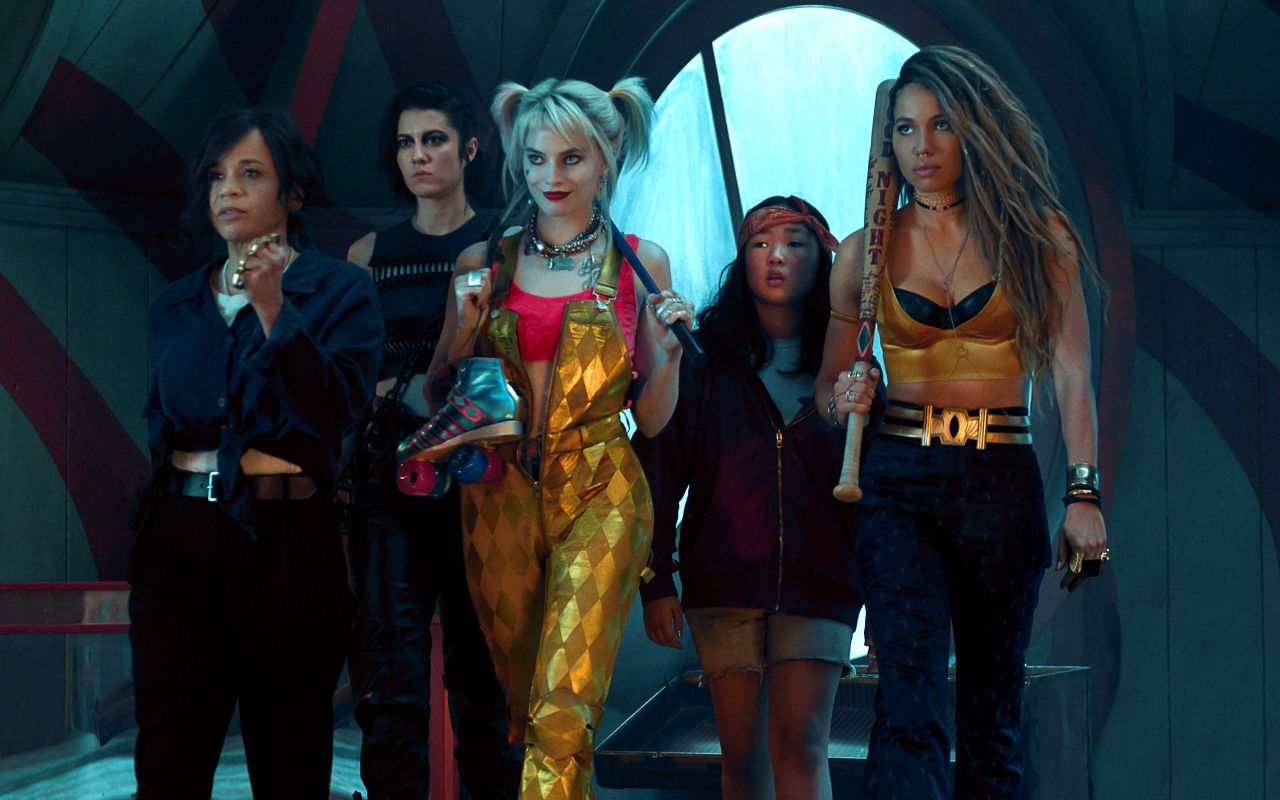
FEBRUARY 7: Birds of Prey (And the Fantabulous Emancipation of One Harley Quinn) (aka Harley Quinn: Birds of Prey) (dir. Cathy Yan) – Salon review by Mary Elizabeth Williams: “The patriarchy will be dismantled with hand grenades and hair ties. At least, that’s the impression I have after watching the campy, ultraviolent, and feminist AF Birds of Prey (and the Fantabulous Emancipation of One Harley Quinn). Sounds like a practical plan.
“As Harley (Margot Robbie) explains in the film’s opening moments, the volatile former Dr. Harleen Frances Quinzel has recently broken up with her on-again, off-again supervillain boyfriend, Joker. She’s currently running through all the stages of relationship grief — crying, cutting her own hair, eating spray cheese, getting a hyena, feeding a pervert to the hyena, blowing up a chemical plant — you know, typical girl stuff. But she soon learns the dangers of no longer having a murdering, manipulative, emotionally abusive man around to protect her, and the power of women collaborating to unleash havoc.
“Four years ago, Robbie’s gleefully unhinged performance as Harley in Suicide Squad made her an immediate fan favorite, even if critics were less charitable about the film itself. Now, Gotham City is still teeming with antiheroes who posses potent combinations of brains, combat skills and total disregard for humanity. But there’s nobody else who, like Harley, understands that a foe’s list of grievances against them may include ‘has a vagina.’ Nor is there another who might let a sadistic goon reach into her pocket . . . and pull out a tampon. Or one who, in a climactic battle, will hand a fellow combatant a welcome hair thingy to pull back her tresses. You know how Ginger Rogers did everything Fred Astaire did, but backwards and in high heels? In case nobody every told you before, it was actually backwards, in high heels, menstruating, and with sweat-drenched hair flying in her face. And it’s pretty great to see that acknowledged, anywhere.
“Directed by Cathy Yan (Dead Pigs) and written by Christina Hodson (Bumblebee), “Birds of Prey” is at once a relatively formulaic, poop jokes and car chases-strewn comic book movie and a sophisticated exploration of contemporary feminist issues. Come for the ass kicking, stay for the takedown of rape culture.
“The villain this time around is crime lord/rich creep Roman Sionis (Ewan MacGregor, making some unusual accent choices), a sadistic nightclub owner trying to get his hands on a legendary diamond that holds a secret. When nimble young pickpocket Cassandra Cain (Ella Jay Basco) gets it first, Harley’s path inevitably crosses with that of the girl, as well as world-weary cop Renee Montoya (Rosie Perez, her dancer’s energy still gloriously full throttle), nightclub singer Dinah (Jurnee Smollett-Bell) and a mysterious vigilante known as the crossbow killer (Mary Elizabeth Winstead). Again and again, the message is clear — no dark knight in shining armor or maniac in clown makeup is coming to save any of them. Women, you’re on your own. But you’re stronger when you work together. And although the ladies are far from natural allies, they must eventually join forces to save their own lives, forming a kind of Gotham City Spice Girls.
“It’s uncanny how, in many ways, this technicolor popcorn opus traverses so much of the same ground Robbie’s recent Bombshell does. It also fits neatly into the growing pantheon of other post #MeToo stories, like this month’s The Assistant and the upcoming A Promising Young Woman (the latter of which Robbie is a producer on). It airlifts the audience out of the tired, convenient ideology around what a victim is supposed to look and act like. It demands you understand that a woman can be unsympathetic in many regards and still neither invite nor deserve harassment, abuse, and assault. Harley is at once a vicious, destructive lunatic and a traumatized survivor or a toxic relationship. She does terrible things. She is a violent criminal. She is vulnerable. (She’s also a professed Bernie voter, and if Harley Quinn can take time out of her chaotic day to register to vote, you can too.) This is not a story of her redemption, but her liberation.
“The film is pointed in its insistence on this point. In a pivotal early scene, Dinah notices a drunk Harley kissing a patron in the club’s alleyway and walks away, but when she realizes an incapacitated Harley is being lured into a van, she doubles back to intervene. Because if you can’t consent, it’s not consent. And in a moment chillingly reminiscent of a similar one in Bombshell, a powerful man demands a puzzled, then terrified, woman disrobe for him. Stung by a recent setback, Roman spies a club patron simply enjoying a night out and laughing with her friends. Goaded by his chief flunky, he flies into a rage, assuming the woman is laughing at him. As punishment, he makes her stand on a table in view of the whole audience, and orders her male companion take off her dress. It’s a shocking — and effective — interpretation of Margaret Atwood’s famed quote that men ‘are afraid women will laugh at them’ and women ‘are afraid of being killed.’ At the fan screening where I viewed the movie, the audience gasped at the scene, in part, I suspect, because director Yan entirely avoided making it sexual or exploitive. Think of every movie where a woman’s clothing has involuntarily come off, and how often it’s been played for laughs or thrills or smug comeuppance. (There are lists out there, but I’d rather not.) This is a middle finger to all that.
“While Birds of Prey doesn’t have the consistent whimsy of say, Deadpool, it is no two-hour downer. (It also doesn’t have T.J. Miller, thanks.) Plenty of the film’s tone is light, funny, and subtly paradigm-subverting — women complimenting other women for how well they fight in tight pants! Taking a beat to admire how well they kill bad guys! Shine theory, yo! Frankly, after months now of exhausting hot Joker takes and white male rage, a little feminine mayhem feels welcome right about now. Go see it and judge for yourself. Bring a friend. And don’t forget to pack a few extra hair bands for the revolution.”
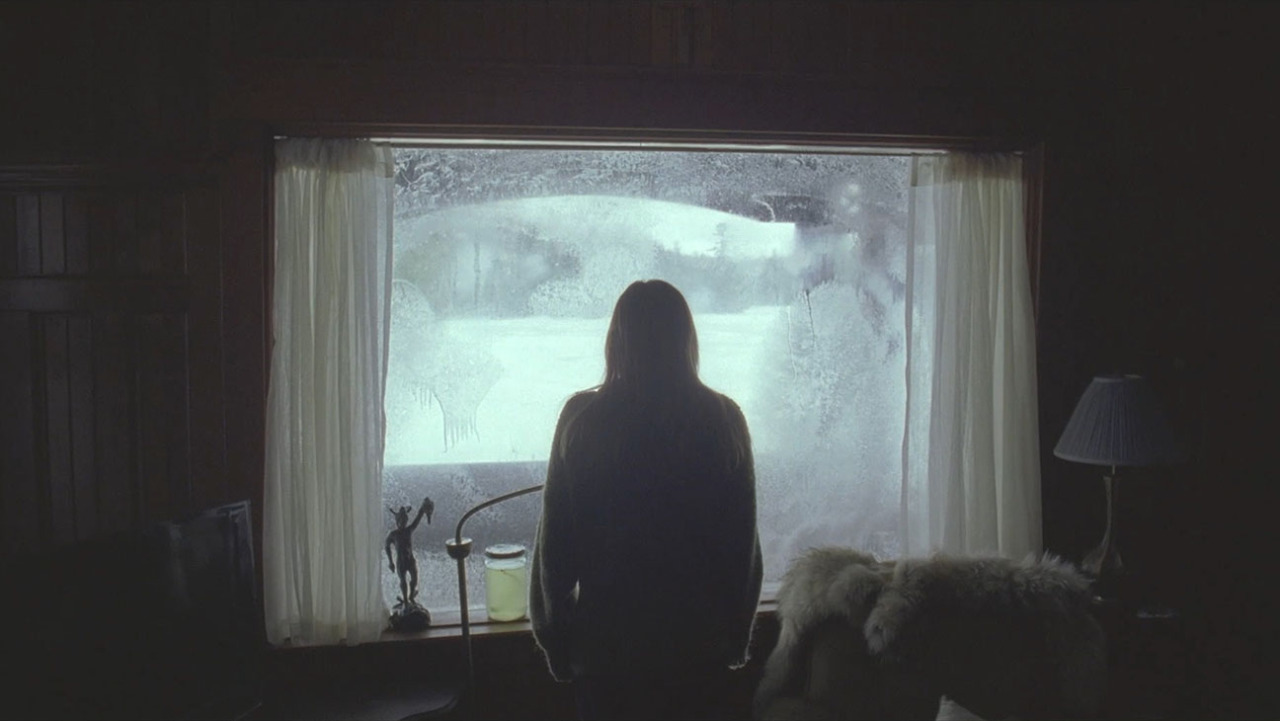
FEBRUARY 7: The Lodge (dirs. Severin Fiala and Veronika Franz) – Vulture’s Sundance Film Festival review by Emily Yoshida: “In The Lodge, faith is a kind of Chekhov’s gun, a potentially game-changing tool just lying there, waiting to be picked up by the wrong person. The faith in this case is of the Christian variety, and two mother figures — one straight-laced Catholic, the other a survivor of an Evangelical death cult — battle for control over it in the minds of their children. (It certainly adds to the tension that there is an actual gun in the scene as well.) As a psychological down-is-up horror movie, The Lodge has a few solid tricks up its sleeve. But when the smoke and mirrors clear, it’s ultimately a story about trauma, and a rather bleak one at that.
“Your heart kind of sinks for writer-directors Veronika Franz and Severin Fiala (Goodnight Mommy) in the opening moments of The Lodge, which include an empty interior that turns out to be a dollhouse, a frantic mother, and a head stuck out a car window. The eerie rhythms of the universe that gave us Deep Impact and Armageddon, Antz and A Bug’s Life, and Fyre and Fyre Fraud have conspired to make The Lodge exist in Hereditary’s shadow, but while some tonal and iconographic similarities exist, the two films jump off their shared diving board into very different corners of the psycho-mom pool.
“After a horrific opening gotcha to make sure you’re awake and paying attention, the film picks up with brother and sister Aidan (Jaeden Lieberher) and Mia (Lia McHugh) grieving the death of their mother Laura (Alicia Silverstone) and stubbornly refusing to meet their father Richard’s (Richard Armitage) girlfriend. They blame Grace (Riley Keough) for their mother’s suicide; she and their father had been separated for several years, but Laura killed herself the day he announced that he intended to remarry. Laura had an ardent Catholic faith, and the children hang on to her memory with equal fervor; Mia’s doll becomes a talisman of sorts for her memory. But, being children, they are eventually forced to spend Christmas at the family’s mountain lodge with their father and stepmom-to-be. We see them pack, all the essentials — sweaters, long johns … candles? Sea monkeys? — and hit the road.
“They have extra reason to be worried about Grace, especially after Googling her. Grace was made famous in the news as an adolescent, having been the only survivor of a cult suicide, and meant to spread the group’s apocalyptic message to the world. She seems perfectly nice in person, and even has a cute little dog that she brings along, but when we see her alone with Richard, she exhibits some signs of anxiety, and depends on a bottle of pills to keep her mental state regulated. She seems especially uneasy around the crosses left around the house by the late Laura, and a painting of the Virgin Mary in the dining room. Then Richard is called back to the city for work, and Grace and the children are left alone in the middle of nowhere, as a blizzard hits and snows them in.
“You may think you can guess where this film is going based on that description, but the interesting trick Fiala and Franz pull lies in a subtle shift in perspective. There’s no one moment in which it happens, but once we’re at the lodge, we soon realize that we’re watching things unfold from Grace’s point of view, and the children are the hostile forces with her in the house. When the power goes out and their belongings and provisions disappear, it doesn’t take long for some people’s grip on reality — including ours — to start slipping. As both the closest thing we have to a surrogate, and someone we’re not sure if we can trust ourselves, Keough’s performance walks a tricky line skillfully.
“The Lodge’s final reveal may feel like a bit of a deflation after all of the ominous elements it’s thrown together. Without giving away too much, it does feel as if Grace’s and Laura’s religion is a mere spooky prop for Fiala and Franz, an aesthetic theme to add mood and atmosphere to the increasingly desperate conditions in the house. But take away the religious themes and you still have an effectively chilling tale about how past experiences stay buried within us, and can never fully be defused.”
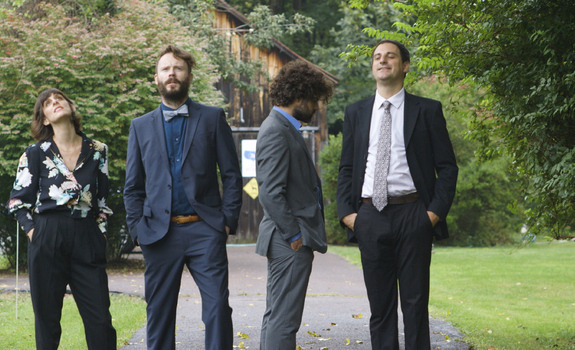
FEBRUARY 11 (on VOD): Senior Escort Service (dir. Shaina Feinberg) – Blu-ray.com synopsis: “Completely distraught after the sudden loss of her dad, filmmaker Shaina Feinberg will do anything she can to connect to him again. She catalogues her dad’s belongings – a calculator, a clock, a basket of lozenges. She forces her friends to wear his clothes and mimic his gestures. She takes a stab at making a webseries he’d always wanted to make – the name of which is ‘Senior Escort Service.’ And she combs through his journal, where she finds out about a process of dealing with grief that was invented by the grandchildren of Nazis. The process is called Familienaufstellung, which means Family Constellation, and it requires people to reenact their traumas as a means of making peace with it. This inspires Shaina to gather a group of women in a loft where they play out her trauma for her. Finally, in the hopes of singing her dad one last song, Shaina goes on a journey to his grave. On the journey, she recollects her dad’s love of acronyms, singing and ‘South Park,’ ultimately learning to live with his absence.”
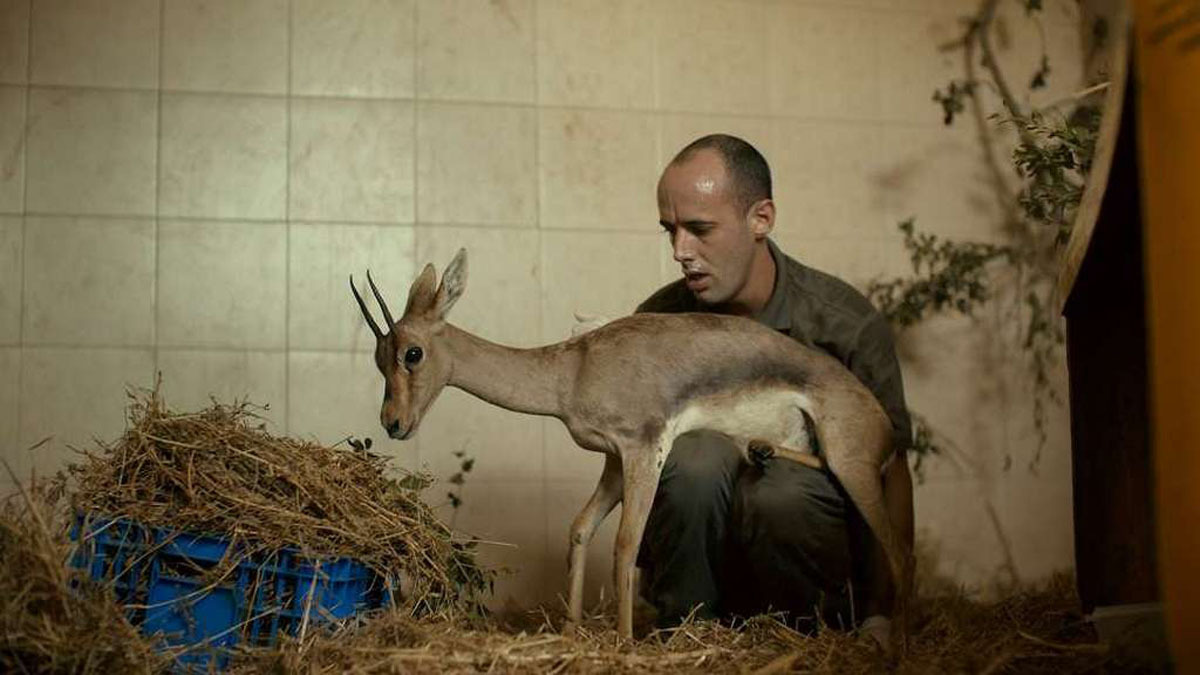
FEBRUARY 12: Wild: Life, Death and Love in a Wildlife Hospital (dirs. Danel Elpeleg and Uriel Sinai) – Docaviv International Documentary Film Festival synopsis: “Patient-doctor relationships are always complex, but when the patient cannot talk or make decisions for himself it becomes particularly complicated. This is the everyday reality for the protagonists of this film: Ariella, a veterinarian, and Shmulik, the chief caretaker of a wildlife hospital. A parallel universe with its own questions and rules. Through love and Sisyphean labor they try to treat their patients, as they are confronted with issues that are also applicable to life outside the clinic walls. Is every life a life worth living? When does help ultimately prolong the suffering? And most of all, when is the right moment to let go?”
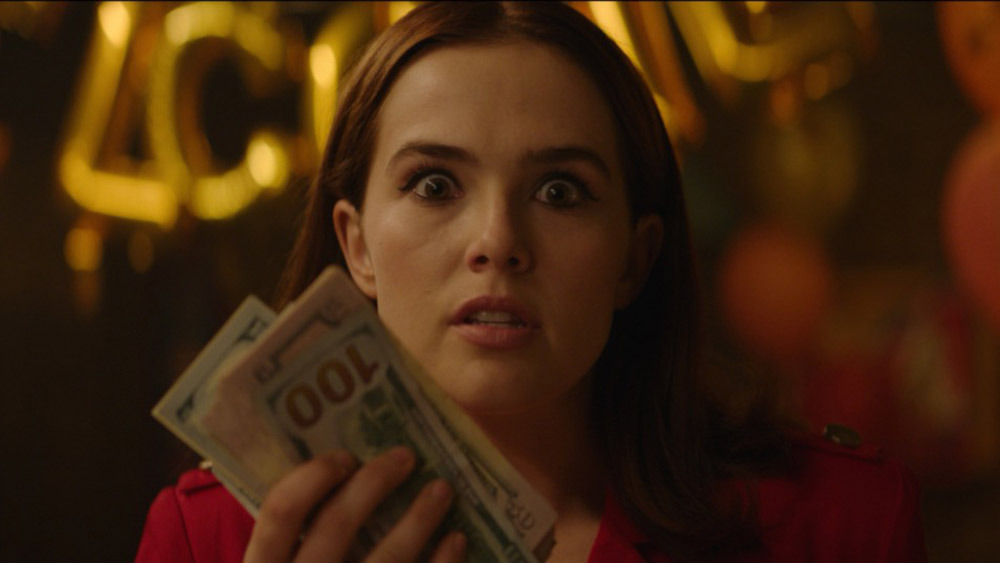
FEBRUARY 14 (in theaters & on VOD): Buffaloed (dir. Tanya Wexler) – Quad Cinema synopsis: “Director Tanya Wexler returns with a raucous comedy starring Judy Greer, Jai Courtney, Jermaine Fowler and Zoey Deutch (in a go-for-broke performance) that tracks one woman’s journey to finding her ethically dubious calling. As a young girl obsessed with making enough cash to get out of her blue-collar existence, Peg Dahl (Deutch) is betting on her sharp mind (and even sharper tongue) to get her into an Ivy League university. But a scalping scheme, brief stint in prison, and chance phone conversation with a debt collector change everything. As much an ode to the city of Buffalo as it is to the millions of Americans struggling with a seemingly dead-end economic existence, Buffaloed wrings hearty laughs out of a particularly timely and honest reality.”
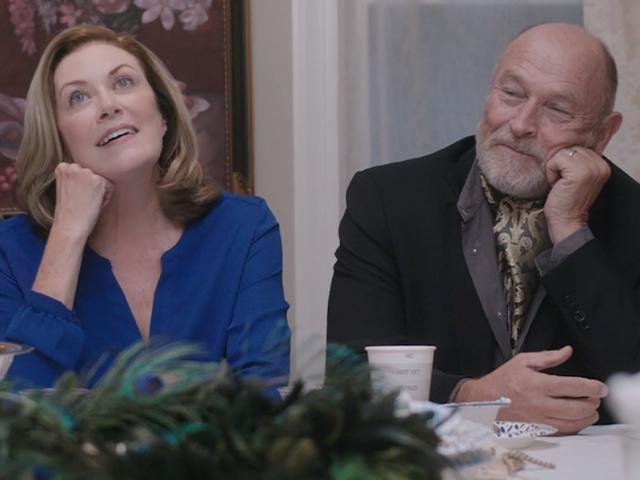
FEBRUARY 14: First Lady (dir. Nina May) – Synopsis from the film’s official website: “First Lady is a romantic comedy about a woman, not married to the president, who runs for the office of First Lady. However, she winds up getting a much better proposal than she ever expected. She is torn between a promise and her calling.
“In this modern day fairytale, when President Morales (Joel King) dies in office, his widow, Kate (Nancy Stafford), agrees to help the VP, Taylor Brooks (Benjamin Dane), in his bid for the presidency. She must stop Mallory (Tanya Christiansen), the ditzy wife of their competitor, from destroying the dignity of the position. Kate and Taylor win, but their agendas butt heads and baby boomers clash with millennials while Mallory is determined to destroy Kate. Max (Corbin Bernsen), the prince of her youth, now, literally a King, comes back into her life, disguised as a bodyguard, making her a better offer than First Lady.
“First Lady is a modern fairytale for the whole family about an autumn romance with a twist. Nina May has written and directed a classic style romantic comedy that harkens back to a genre we all love. The story shows what could happen when two people lead successful lives apart and reunite later in life to find their happily ever after.”
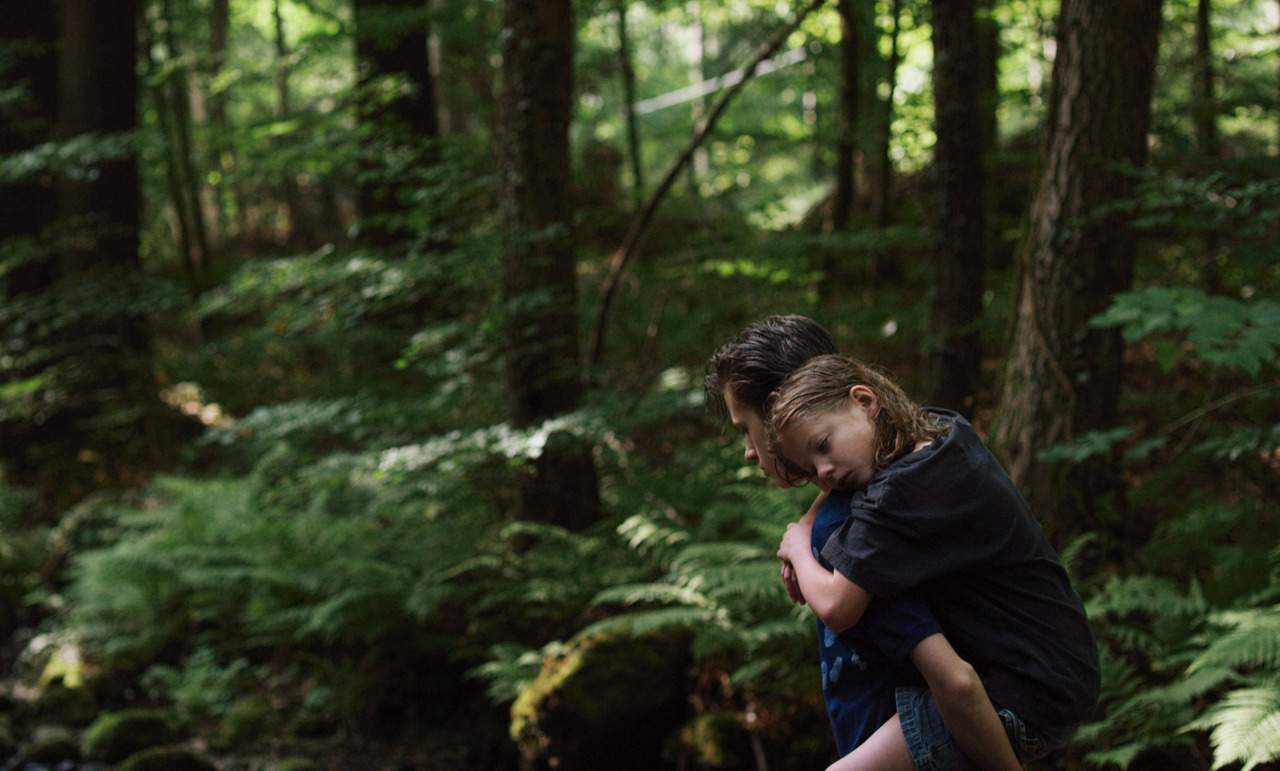
FEBRUARY 14: I Was at Home, But… (dir. Angela Schanelec) – Film at Lincoln Center synopsis: “An elliptical yet emotionally lucid variation on the domestic drama, Schanelec’s latest film — which won her the Best Director prize at the 2019 Berlinale—intricately navigates the psychological contours of a Berlin family in crisis: Astrid—played with barely concealed fury by Maren Eggert—is trying to hold herself and her fragile teenage son and young daughter together following the death of their father two years earlier. Yet as in all her films, Schanelec develops her story and characters in highly unexpected ways, shooting in exquisite, fragmented tableaux and leaving much to the viewer’s imagination, hinting at a spiritual grace lurking beneath the unsettled surface of every scene.”
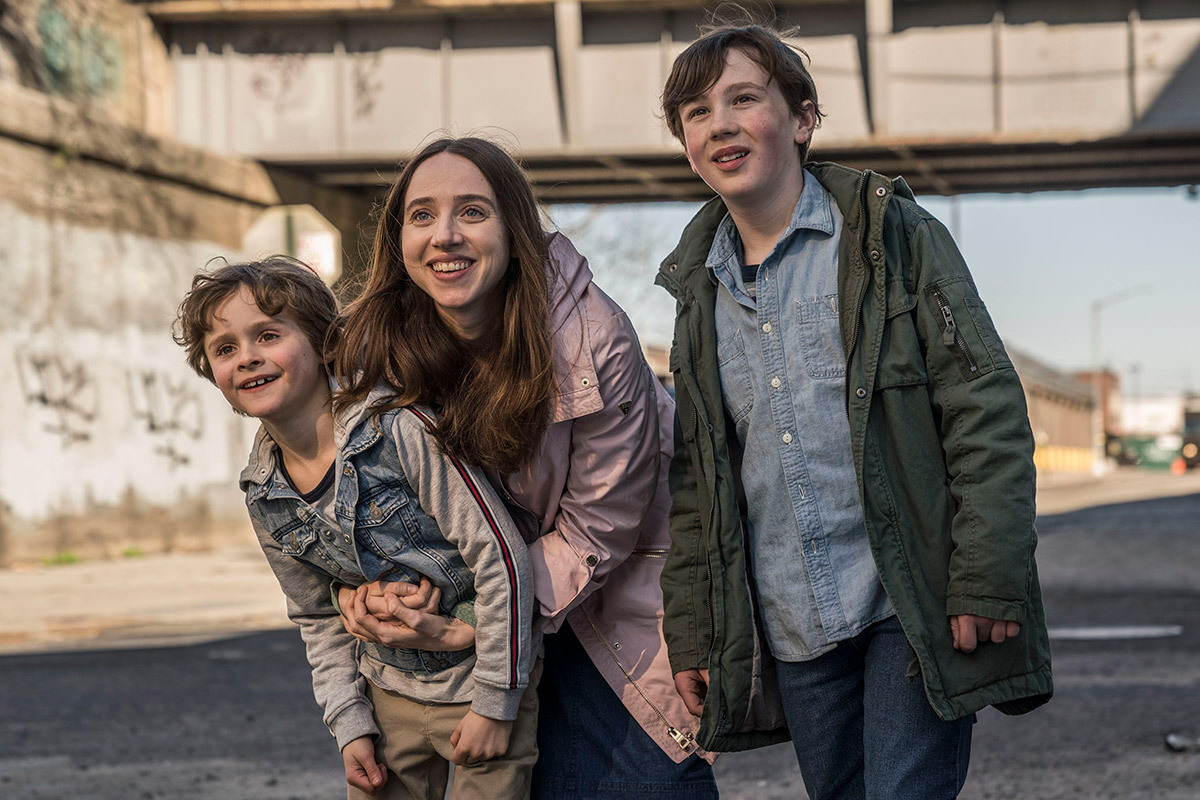
FEBRUARY 14 (in theaters & on VOD): The Kindness of Strangers (dir. Lone Scherfig) – Berlin International Film Festival synopsis: “Clara (Zoe Kazan) arrives in wintry New York with her two sons on the back seat of her car. The journey, which she has disguised as an adventure for her children’s sake, is soon revealed to be an escape from an abusive husband and father. He is a cop, and Clara is desperately trying to elude his attempts to pursue her. The three have little more than their car, and when this is towed away, they are left penniless on the street. But the big cold city shows mercy: in their search for refuge, the family meets a selfless nurse named Alice (Andrea Riseborough) who arranges beds for them at an emergency shelter. While stealing food at a Russian restaurant called ‘Winter Palace,’ Clara meets an ex-con, Marc (Tahar Rahim), who has been given the chance to help the old eatery regain its former glory. The ‘Winter Palace’ soon becomes a place of unexpected encounters between people who are all undergoing some sort of crisis and whom fate has now brought together. With a keen eye for character, Lone Scherfig explores human behaviour in extreme conditions. She depicts the harshness of life in the urban jungle, but she also demonstrates what can grow when strangers approach each other in friendship and with an open heart.”
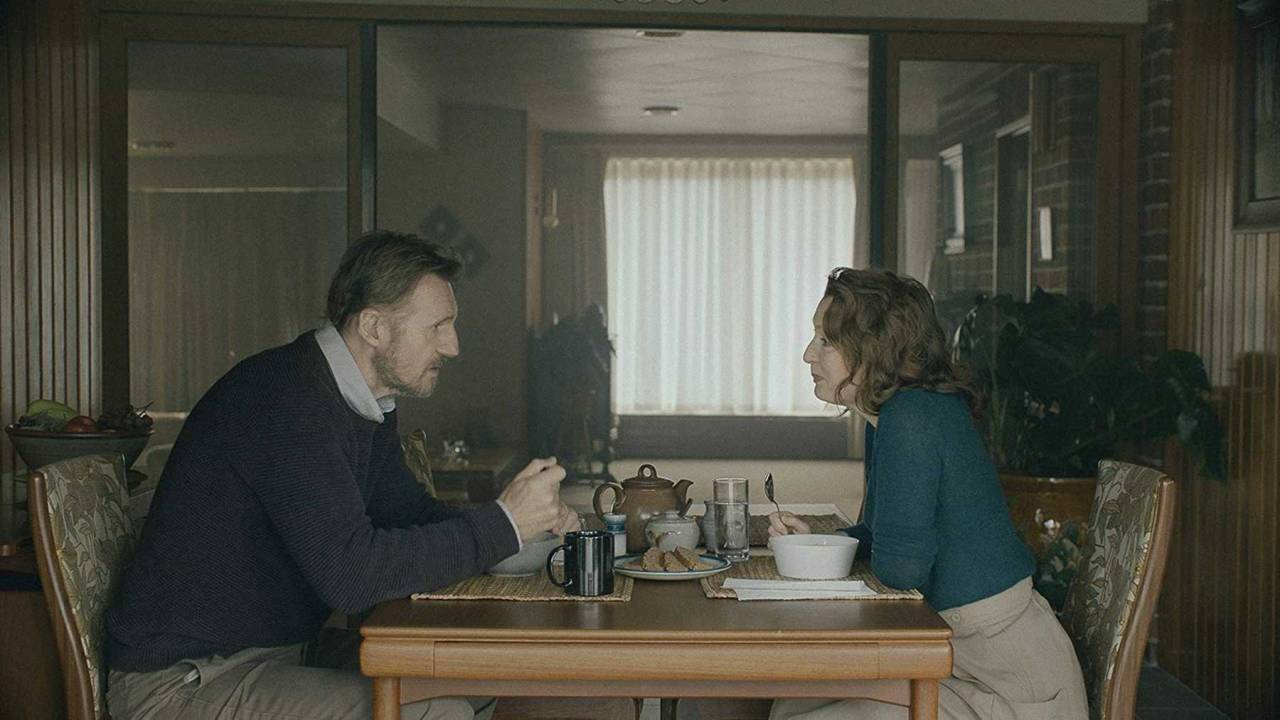
FEBRUARY 14: Ordinary Love (dirs. Lisa Barros D’Sa and Glenn Leyburn) – Angelika Film Center synopsis: “Joan (Lesley Manville) and Tom (Liam Neeson) have been married for many years. There is an ease to their relationship which only comes from spending a life time together and a depth of love which expresses itself through tenderness and humour in equal part. When Joan is unexpectedly diagnosed with breast cancer, the course of her treatment shines a light on their relationship as they are faced with the challenges that lie ahead and the prospect of what might happen if something were to happen to Joan. Ordinary Love is a story about love, survival and the epic questions life throws at each and every one of us.”
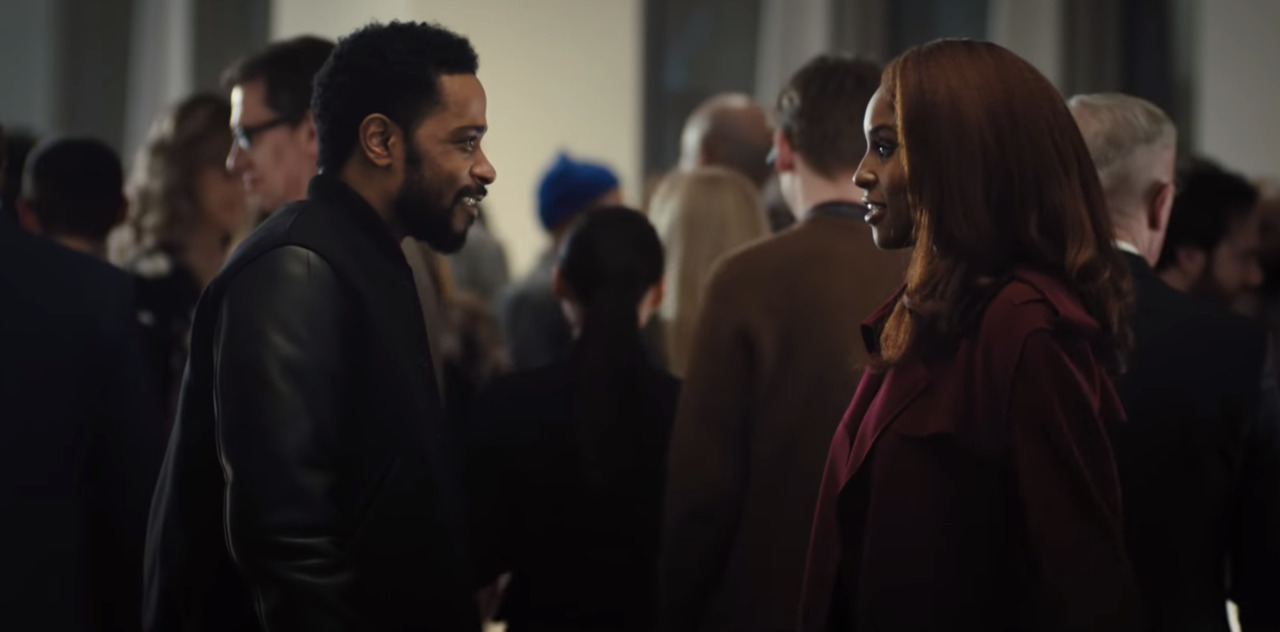
FEBRUARY 14: The Photograph (dir. Stella Meghie) – Time review by Stephanie Zacharek: “Writer-director Stella Meghie’s romantic drama The Photograph is a lovely ghost of a movie, the kind of thing we used to call, in the days before the ascent of the superhero film, a popular entertainment. We get so few love stories today that it’s easy to forget they used to be a staple of the movie-release schedule; sometimes all you want is a chance to watch beautiful people meet, fall in love and break apart, only to be reunited (or not) in a way that feels gratifying. That’s what Meghie—whose credits include the comedies Jean of the Joneses (2016) and The Weekend (2018)—gives us here. The Photograph, both thoughtful and entertaining, with a pleasurably laid-back vibe, belongs to a class of movie that barely exists anymore on the big screen. It’s also a reminder that appealing actors are sometimes the best spectacle of all.
“The Photograph is really two entwined love stories, one set in the present, the other in the late 1980s. Lakeith Stanfield plays Michael, a reporter for a New York-based magazine. On assignment in New Orleans, reporting on the lingering effects of Hurricane Katrina and the Deepwater Horizon oil spill on the area’s communities, he meets Isaac (Rob Morgan, in a fine, understated performance), a longtime resident with tales to tell. Isaac shows Michael a photograph of a woman he once loved, taken some 30 years earlier: This woman lounges in a regular kitchen chair, gazing at the camera’s lens, at us, with an uneasy mix of discontent and defiance. The subject of the photograph is a photographer herself, Christina (played, with radiant gravity, by Chanté Adams), who left Lousiana—and Isaac—for New York to pursue a dream career. Intrigued by the photograph, Michael sets out to learn more about Christina, and in the process meets her daughter, Mae (Issa Rae), a sophisticated museum curator. Mae isn’t sure she’ll ever be ready to commit to a guy, but we can see she’s as taken with Michael as he is with her. Shortly after their first meeting, he shows up at a museum event she hasn’t invited him to; their eyes meet, and the crowd of fancy-looking people milling about is virtually vaporized by the electricity between them. They flirt and share a first kiss. Later, weathering a Hurricane Sandy-like storm, they end up in bed. Both have their doubts about committing—Michael is still processing a recent breakup—but they also sense that the whatever-it-is that’s happening between them is worth exploring.
“There will, of course, be an event that drives them apart, as well as the revelation of a secret. Nothing in The Photograph will really surprise you. But surprise isn’t the point. Meghie is alive to the appeal of her actors and the easy chemistry between them. Rae, a marvelous comic actress, is somewhat restrained here, but she captures the essence of what it’s like to be a woman in the city, with a solid career, who sometimes just can’t turn off her BS detector. She gazes at Michael, with his liquid eyes and defense-melting earnestness, as if she can hardly believe he’s real. He seems to be presenting his soul to her in the smallest words and gestures, like the way he says, ‘I’m sorry’ when he learns her mother has recently passed away—Stanfield makes it all feel believable. The duo’s scenes together have an easy, loping rhythm. When Michael visits Mae’s apartment for the first time, and puts on the Al Green LP they’ve plucked from her mother’s things, your first impulse may be to roll your eyes at the obviousness of it all. But Meghie shapes the moment into a luxurious swoon. This is just how we want things to be, the way we’ve so often seen them in the movies. The Photograph captures the way people fall in love without meaning to, when they’re on their way to doing other things.
“It also features some terrific second bananas, among them Lil Rel Howrey as Michael’s brother, who’s not wrong when he says that stormy weather is the best ‘do-it’ weather. There are a few sex scenes in The Photograph, but they’re tender and discreet. Viewers are advised, however, that the movie pulls out the stops when it comes to fashion and New York City real-estate porn: Mae’s apartment is an urban palace with mile-high windows and a kitchen worthy of a cooking show. And the first time we see her, she’s wearing a voluminous trench coat in a black, white and brown graphic print, the kind of chic, daring gear you might dream of buying if you happen to land that important high-profile job—and if you don’t have to ride the subway ever again.
“Meghie takes pleasure in presenting that fantasy for us, the reverie of what it would be like to have great clothes, a cool job and a massive, gorgeous apartment. But she presents all of those things in movie language, not the vocabulary of a sterile Instagram feed. At times The Photograph feels like a modern version of a ‘30s Hollywood romance, where the heroine might live unapologetically in an all-white art deco apartment and wear marabou slippers while lounging. In other words, the trappings of Mae’s life feel earned, lived in and enjoyed, not presented solely to stoke envy and prove that she’s living her #bestlife. The boyfriend who loves her, almost instantly, for who she is—even while she’s still figuring out who she is—is also part of that fantasy. The Photograph is a story about the people we dream of being, people who find happiness despite mistakes they make along the way. It’s harder than it looks in the movies—but then, that’s why we need the movies. Vive the love story! And its power to make us believe, if only for a few hours, that maybe that could be us, too.”
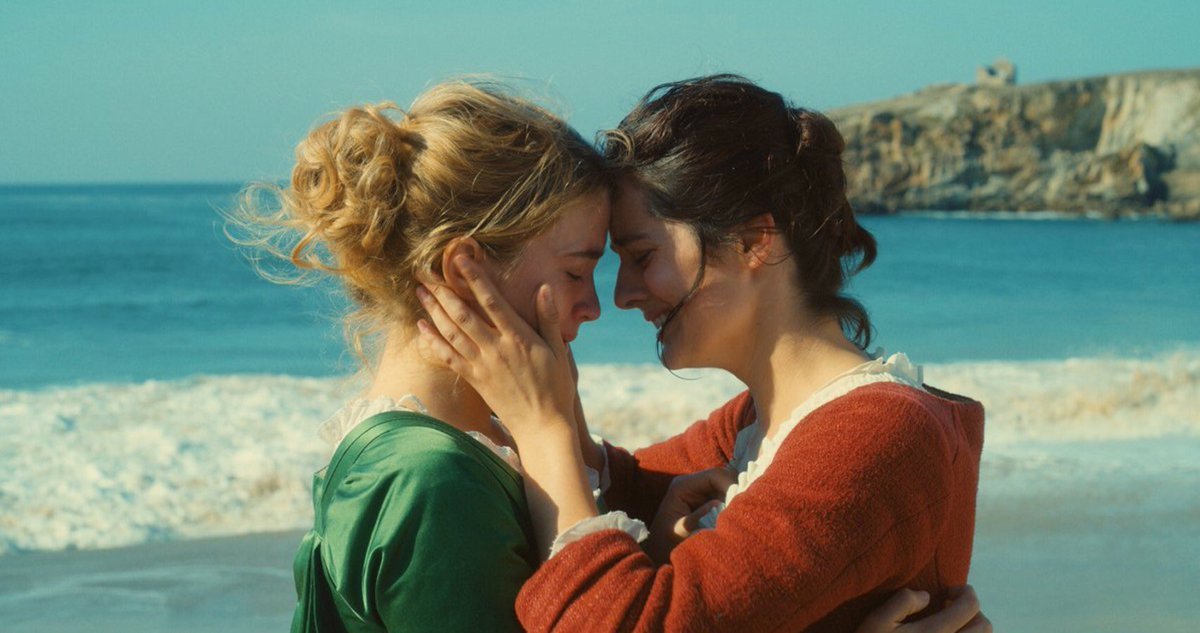
FEBRUARY 14: Portrait of a Lady on Fire (dir. Céline Sciamma) (DP: Claire Mathon) – Slate review by Dana Stevens: “Why, Héloïse wants to know, does the portrait look so little like its subject? ‘There are rules. Conventions. Ideas,’ explains Marianne, unconvincingly. The face in the painting, Marianne’s first attempt at a portrait of Héloïse, is placid, rosy, and conventionally feminine in its inoffensive prettiness; the real Héloïse (Adèle Haenel), though even more beautiful, has an intimidatingly direct gaze and a serious, even somber demeanor. But given the purpose of the portrait—Heloïse’s mother plans to present it as a gift to the Italian nobleman whom Héloïse is to marry, sight unseen—it’s understandable why Marianne (Noémie Merlant) would soften Héloïse’s features and blunt the severity of her expression. In Céline Sciamma’s austere yet sensuous fourth feature Portrait of a Lady on Fire (which opens Friday in New York and Los Angeles before a wide release in February), this frequently altered painting becomes an index of the changing relationship between the two young women: At first distant, proper and ladylike, it slowly turns into something passionate, truthful, and almost unbearably intimate.
“Of course, another reason the portrait might not resemble Héloïse at first is because she never posed for it. Furious at her powerlessness to escape the arranged marriage, she walked out midsitting on the last artist who tried to paint her, leading him to destroy his work. Now her mother (Valeria Golino) tells Héloïse that Marianne has been brought in to be her companion on her daily cliffside walks; Marianne must soak in as much about Héloïse as she can on those walks, squirrel away sketches, and work on the portrait in private. There’s more backstory, but the information needed for the film’s stark setup is simple to grasp: two women, a canvas on an easel, a secret, the sea.
“The year, according to the production notes, is 1770, but no on-screen legend or other temporal marker clues us in to that date other than the women’s corseted floor-length dresses. The location is equally indeterminate: an isolated house on a high cliff by the ocean. (The film was shot on location on the coast of Brittany.) In the early scenes especially, the story seems to take place in a timeless, almost abstract space, like the films Ingmar Bergman shot with only a handful of actors on the Swedish island of Fårö. Though men appear, namelessly and briefly, at the beginning and end, Portrait of a Lady on Fire takes place almost completely in a world made up of women: the two leads, Heloïse’s mother, the young house servant Sophie (Luàna Bajrami), and in one scene a group of village women who sing a haunting a cappella song around a bonfire. But it’s the off-screen men who call all the shots in these women’s lives; those rules, conventions, and ideas that govern Marianne’s painting of an upper-class bride-to-be are the same ones responsible for Héloïse’s desperate sense of entrapment.
“To give away any more than the fact that the two women fall madly in love would be to deprive the viewer of Portrait of a Lady on Fire’s greatest pleasures: the stolen glances on cliffside walks, the conversations that end just as the truth is about to be spoken, the quiet contests of will over the content and meaning of that ever-changing canvas. Again and again Sciamma finds ways to deliver meaning cinematically rather than in words, whether through the placement of faces in the frame or a detail revealed obliquely in a mirror. In addition to being a swoon-worthy romance—a bodice-ripper in which corsets are not torn but slowly, lovingly unlaced—this is a meditation on feminism, art, and feminist art, as embodied by the portrait of the title but also by the embroidery being stitched by Sophie the housemaid—and, late in the film, by an extraordinary artistic collaboration the three young women undertake together. Without ever needing to spell it out, Sciamma makes clear that the weight of patriarchy means that this idyll by the sea may be these young women’s one chance to experience anything like real passion or freedom. That knowledge, on both the audience’s part and the lovers’, lends every moment of their time together—a fragment of music Marianne plays for Héloïse on the harpsichord, a shared reading of Ovid’s Metamorphoses—a kind of desperate poignancy.
“Adèle Haenel, the fierce-eyed, dark-browed beauty who plays Héloïse, may be familiar to audiences from her roles as an uncompromising AIDS activist in the 2017 French drama BPM or a young Belgian doctor in the Dardenne brothers’ The Unknown Girl. She’s also Sciamma’s romantic partner in real life and has already played the object of desire in the director’s debut film, Water Lilies. That real-life connection, whether you go in knowing about it or not, adds another layer to what’s on screen: the story of one woman attempting to render her love for another, not only with a paintbrush but with a camera. As Marianne, Noémie Merlant is also extraordinary: As she stands at the easel her huge dark eyes take in every detail of her beloved’s face, and though she didn’t do the painting herself (the portraits in the film are by the artist Hélène Delmaire), you completely believe she could have.
“Portrait of a Lady on Fire is that rare movie in which every choice feels thought through, meaningful, and right, from the costumes by Dorothée Guiraud to the cinematography by Claire Mathon. (When it comes to collaborating on feminist art, Sciamma walks the walk.) When the musical passage Marianne plays for Héloïse early in the film—the ‘Summer’ section of Vivaldi’s Four Seasons—returns at the end in its full orchestral glory, there’s a sense of inevitable, if tragic, completeness. Just like the short time the lovers have together, Portrait of a Lady on Fire is minimal but perfect, without an image, a glance, or a brushstroke to spare.”
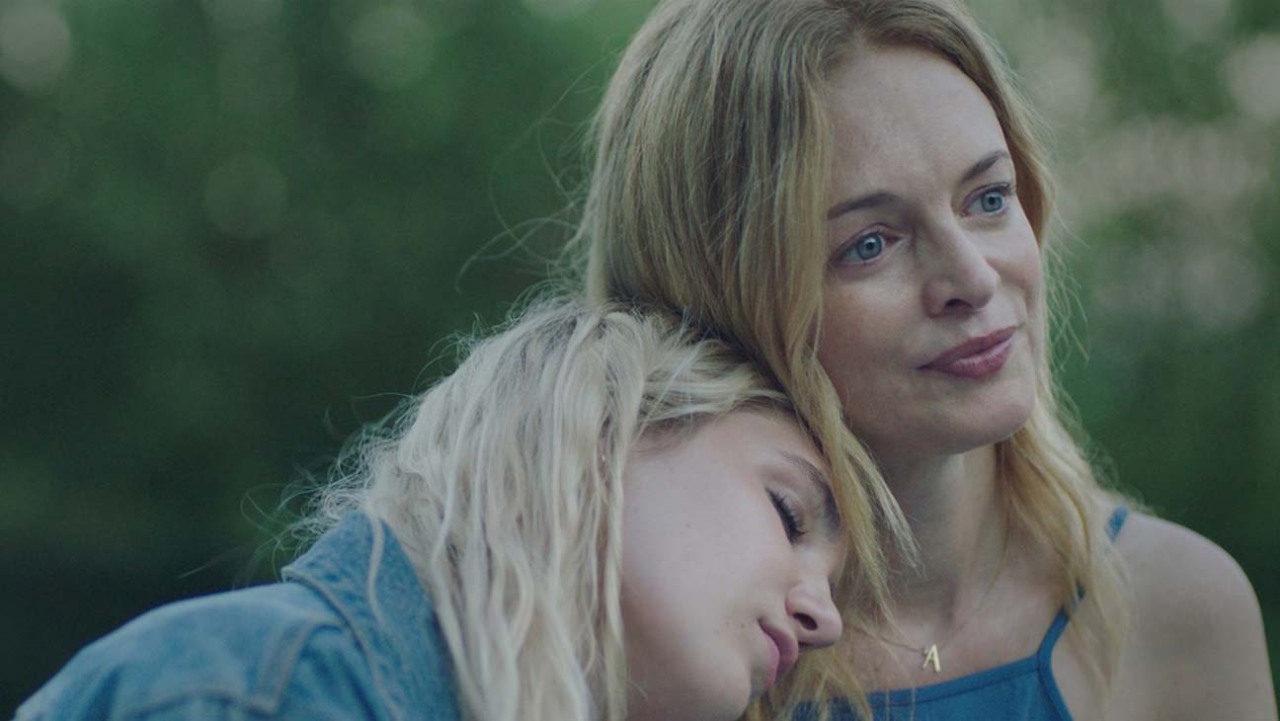
FEBRUARY 14 (in theaters & on VOD): The Rest of Us (dir. Aisling Chin-Yee) – Toronto International Film Festival synopsis by Steve Gravestock: “Director Aisling Chin-Yee and screenwriter Alanna Francis make their mutual feature debut with this generous, slyly funny, and at times heartbreaking paean to a most unlikely female friendship. Cami (Heather Graham) is a children’s book author and illustrator who has been raising her surly and combative teenage daughter, Aster (2016 TIFF Rising Star Sophie Nélisse), on her own ever since her ex, Craig, abandoned them to start a new life with Rachel (Jodi Balfour). When an unforeseeable tragedy leaves Rachel and Tallulah (Abigail Pniowsky), the daughter she had with Craig, evicted and with no place to go, Cami steps in and offers to put them up in her rundown camper.
“Perhaps unsurprisingly, Cami and Rachel’s path to friendship is a rough one, what with years of simmering resentment constantly threatening to spill over. Those old tensions are exacerbated when both mothers hit it off with the other’s daughter, each offering quantities of understanding that the birth parent can’t. This already tenuous situation is even further complicated by the secrets that all concerned are hiding, even the outwardly saintly Cami.
“As unpredictable and recognizable as real life, The Rest of Us is propelled by a compassion for all of its characters (even when they behave badly), following them as they learn how to embrace life, how to be loyal, and how to forgive one another and themselves.”
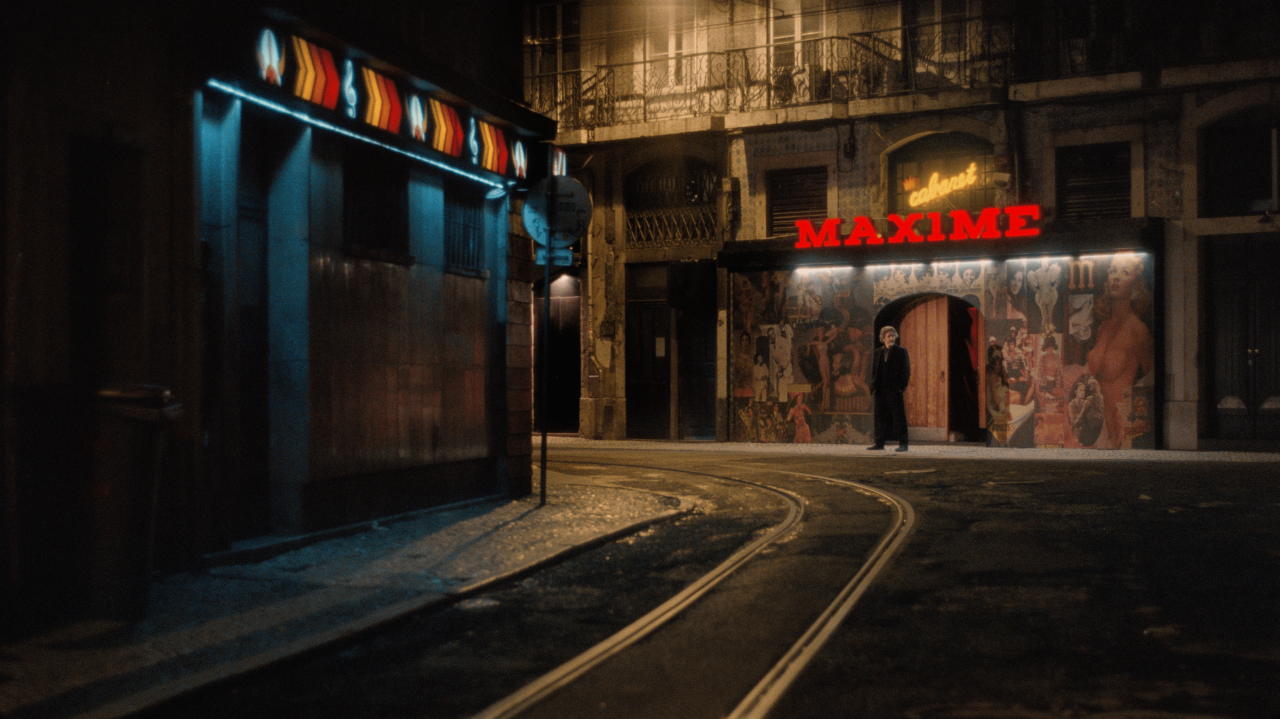
FEBRUARY 21: Cabaret Maxime (dir. Bruno de Almeida) (DP: Lisa Rinzler) – Metrograph synopsis: “Michael Imperioli plays Bennie Gaza, the owner of Cabaret Maxime, a nightclub specializing in burlesque and striptease located in an old red-light district. Bennie is old school. He runs his business like a family operation, struggling to balance the individual needs of his performers with those of his manic-depressive wife—but the forces overseeing the gradual gentrification of the neighborhood are trying to squeeze him out, not stopping at the threat of violence. A finely shaded, character- driven thriller from Portuguese filmmaker de Almeida, providing Imperioli one of his richest film roles to date.”
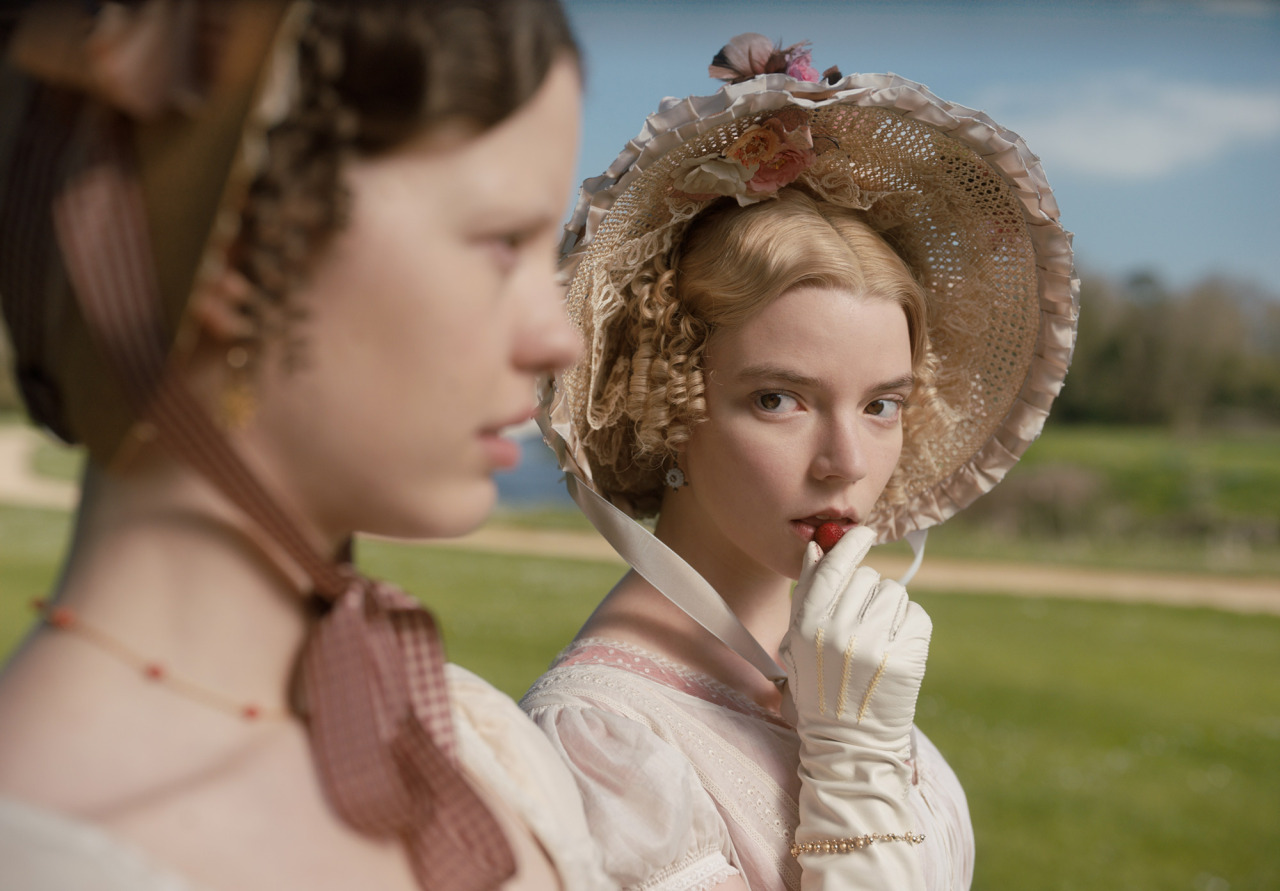
FEBRUARY 21: Emma. (dir. Autumn de Wilde) – NPR review by Justin Chang: “The latest adaptation of Jane Austen’s Emma is as handsome, clever and rich as its famous heroine — and I mean ‘rich’ in the caloric sense, as well. I wanted to snack on every pastel-hued surface of Kave Quinn’s production design, which suggests nothing less than a frosted cupcake come to life — a feast of lace bonnets and high collars, gilded frames and glass chandeliers.
“Happily, all this decorative excess serves a purpose. This is the first feature from the photographer and music-video director Autumn de Wilde, and while she has an obvious eye for beauty, she has an equally sharp eye for the absurd. There’s a touch of Wes Anderson archness to her aesthetic, the way her camera both flatters and mocks the cavernous drawing rooms and sunny meadows of the 19th-century English village of Highbury. De Wilde knows that something as simple as a symmetrically framed shot of her characters can serve as a silent punchline. Her style is an ideal marriage of visual extravagance and satirical distance.
“Speaking of ideal marriages: Emma Woodhouse, the 21-year-old queen bee of Highbury, remains as irrepressible a matchmaker as ever. Anya Taylor-Joy, the actress with the piercing gaze who came to prominence in horror movies like The Witch, plays her as a somewhat chillier, more aloof heroine than, say, Gwyneth Paltrow did in 1996. But if anything, that only makes it all the more moving to see Emma’s porcelain-like facade crack as she realizes that her instincts as a judge of character were not as shrewd as she thought.
“Fortunately, her longtime family friend Mr. Knightley is there to scold and correct her at every turn. The actor and musician Johnny Flynn, so memorable in the psychological thriller Beast, brings a scruffy rock-star edge to the role of this impeccably well-mannered gentleman. The two of them spar furiously over the matter of Emma’s friend Harriet Smith, whom she’s trying to match up with the local vicar, Mr. Elton — a very funny Josh O’Connor, whom you may recognize as Prince Charles on The Crown. But Emma’s plans have a way of backfiring: Too late she realizes that the foolish Mr. Elton has fallen in love with her, not Harriet.
“The late English mystery writer P.D. James once wrote an essay championing Emma as not just a great piece of literature but also a great detective story — a series of deceptions and misunderstandings so cunningly crafted that both Emma and the reader are led up the garden path. By the end, order is happily restored and the truth is shown to have been hiding in plain sight, as Emma realizes how badly she misjudged everyone’s romantic motivations, including her own.
“If you’ve read the book or seen an earlier adaptation, you won’t be surprised by any of these revelations. The script, by the Booker Prize-winning novelist Eleanor Catton, is fairly faithful to the story and no less satisfying for it. This Emma isn’t an audacious reinterpretation like Greta Gerwig’s Little Women, which took significant liberties with a similarly beloved novel.
“OK, so some Austen purists might take issue with the early shot of Mr. Knightley’s naked backside as a servant helps him dress, or a later scene when Emma briefly lifts her skirt to warm her rear end by the fireplace. But I liked these moments of earthy humor. It’s de Wilde’s way of puncturing her characters’ pretensions, as if to remind us that they’re flesh-and-blood human beings beneath all that stately diction and period finery.
“After the effervescent comedy of the movie’s first half, the second is basically one emotional knockout punch after another, aided by a musical score that deftly balances whimsy and melancholy. It helps that de Wilde’s actors are so good at finding fresh nuances even in this timeless material. I loved every hilarious moment of Miranda Hart’s performance as Miss Bates, the village chatterbox whose stories bore Emma to no end — but who turns out to have the biggest heart in Highbury. Mia Goth is especially lovely as the naive, eager-to-please Harriet. And it should come as no surprise that the great Bill Nighy steals his every scene as Emma’s endearing hypochondriac of a father. He’s a perfect mascot for the movie — impeccably dressed, knowingly ridiculous and awfully hard to resist.”
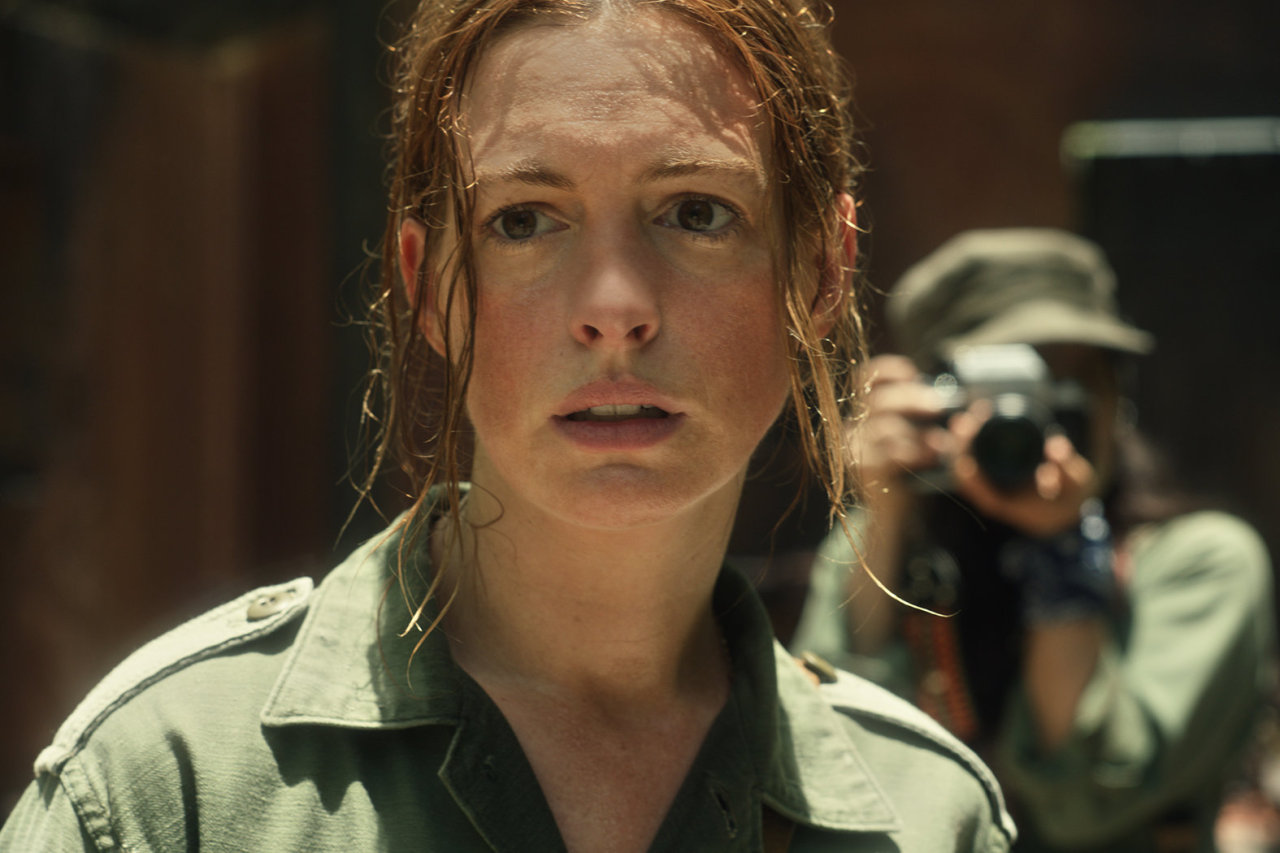
FEBRUARY 21 (streaming on Netflix): The Last Thing He Wanted (dir. Dee Rees) – Sundance Institute synopsis: “Journalist and single mother Elena McMahon (Anne Hathaway) has rigorously investigated Contra activity in Central America for years. Frustrated when her coverage is censored, relief comes in an unexpected package: her acerbic father (Willem Dafoe) falls ill and leaves her a series of unfinished and unsavory arms deals in that very region. Now a pawn in a risky and unfamiliar game, surrounded by live ammunition in more ways than one, and alongside a U.S. state official (Ben Affleck) with whom she has a checkered past, Elena needs to parse her own story to survive. With her disenchanting life awaiting her back home, she is forced to consider what she really wants.
“Director Dee Rees (Pariah, Mudbound) is a Sundance Institute Vanguard Award winner and a lab fellow several times over, and she returns to the Sundance Film Festival with this adaptation of Joan Didion’s novel by the same name. Seasoned performances by Hathaway, Affleck, and Dafoe match the sobriety of the subject matter and convey the questionable intentions, inscrutable connections, and bitter fates of these complex characters.”

FEBRUARY 21 (on VOD): Manou the Swift (aka Birds of a Feather or Swift) (dirs. Andrea Block and Christian Haas) – Sola Media synopsis: “Manou (Josh Keaton) grows up believing he is a seagull like his parents (Kate Winslet, Willem Dafoe). He strives to swim, fish and fly like them but seems not very gifted. At Summer race he discovers Why. To his great shock he finds out he was adopted as an offspring of the much-hated Swifts. His family still stands by him, claiming he is a bird like them. Especially his seagull brother Luc (Mike Kelly) admires him wildly. One night Manou fails to guard the eggs and surrenders one to the rats. The seagulls are outraged and Manou is expelled from home. Utterly disappointed he retreats and stumbles across Percival (David Shaughnessy), a funny Guinea Fowl who cannot fly but turns out to be a deep-rooted pal. Manou checks out the swifts‘ way with his new buddies Yusuf (Yaron Mesika) and Poncho (Arif S. Kinchen) when he bumps into Kalifa, a stunning lady swift. Suddenly he is struck by an entangling flirt on top of all other troubles. Stakes are high as Rats hijack Swift eggs and a big Storm threatens the Seagulls. Manou is committed to save them both – courageous like a seagull and inventive like a swift.”
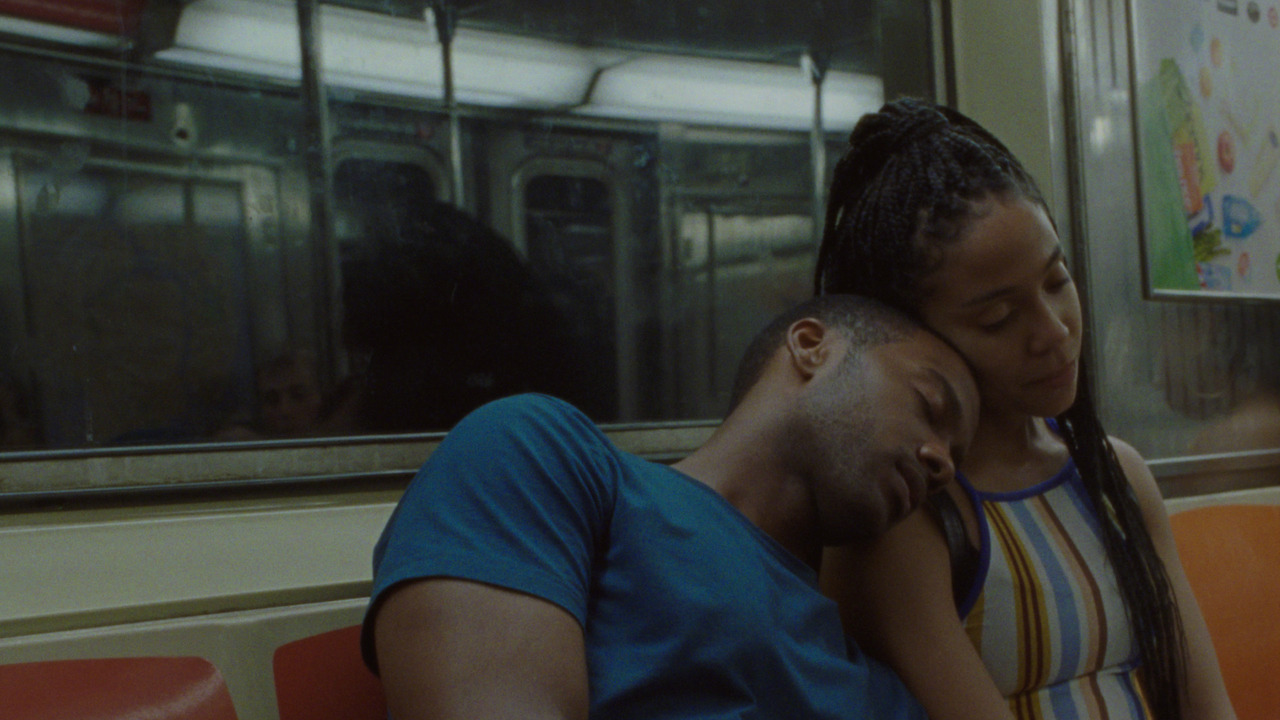
FEBRUARY 21 (in theaters & on VOD): Premature (dir. Rashaad Ernesto Green) (DP: Laura Valladao) – IFC Center synopsis: “On a summer night in Harlem during her last months at home before starting college, seventeen-year-old poet Ayanna (Zora Howard) meets Isaiah (Joshua Boone), a charming music producer who has just moved to the city. It’s not long before these two artistic souls are drawn together in a passionate summer romance. But as the highs of young love give way to jealousy, suspicion, and all-too-real consequences, Ayanna must confront the complexities of the adult world—whether she is ready or not.
“Emotionally raw, intimate, and honest, Premature is at once timeless and bracingly contemporary in its portrait of a young woman navigating the difficult choices that can shape a life.”

FEBRUARY 21 (streaming on Netflix): System Crasher (dir. Nora Fingscheidt) – Berlin International Film Festival synopsis: “Bernadette (Helena Zengel), or Benni as she prefers to be known, is a delicate-looking girl with unbridled energy. She is a ‘system crasher.’ This term is used to describe children who break every single rule; children who refuse to accept any kind of structure and who gradually fall through the cracks in Germany’s child and welfare services. No matter where this nine-year-old is taken in, she is booted out again after a short time. And that is exactly what she is after, because all she wants is to be able to live with her mother (Lisa Hagmeister) again: a woman who is totally unable to cope with her daughter’s incalculable behaviour.
“Made from her own multi-award-winning script, Nora Fingscheidt has created an intense drama about one child’s overwhelming need for love and security and the potential for violence that this engenders. At the same time, the film depicts the tireless attempts of educators and psychologists who use respect, trust and confidence to create a way forward for children who threaten to destroy others and themselves as a result of their unpredictable outbursts.”

FEBRUARY 28 (in theaters & on VOD): Disappearance at Clifton Hill (aka Clifton Hill) (dir. Albert Shin) (DP: Catherine Lutes) – Toronto International Film Festival synopsis by Ravi Srinivasan: “When Abby (Tuppence Middleton) returns to her hometown of Niagara Falls after her mother dies, she becomes obsessed with a fragmented memory from her childhood — a kidnapping she believes she was witness to. She is reunited with her estranged younger sister, Laure (Hannah Gross), and they attempt to settle their mother’s estate involving the sale of the family motel, but Abby’s compulsive desire to reconcile her past grows increasingly out of control.
“Clifton Hill is the highly anticipated third feature from Albert Shin, whose In Her Place was named to TIFF’s 2014 Canada’s Top Ten. Shin’s latest is an intense and taut psychological thriller that exposes the seedy underbelly of structural systems through the point of view of its dynamic female protagonists. Middleton delivers a stellar and complex performance as a woman obsessed with her troubled past while trying to uncover a crime to which she’s convinced she was an accomplice. Shin and co-writer James Schultz craft a sharp, suspenseful drama, equipped with twists and turns, culminating with a climax that will leave you thinking for days.
“Aided by an all-star cast — including an unforgettable appearance from David Cronenberg — Shin looks behind an idyllic tourist town and finds a questionable community with a history as sordid as the characters who inhabit it.”
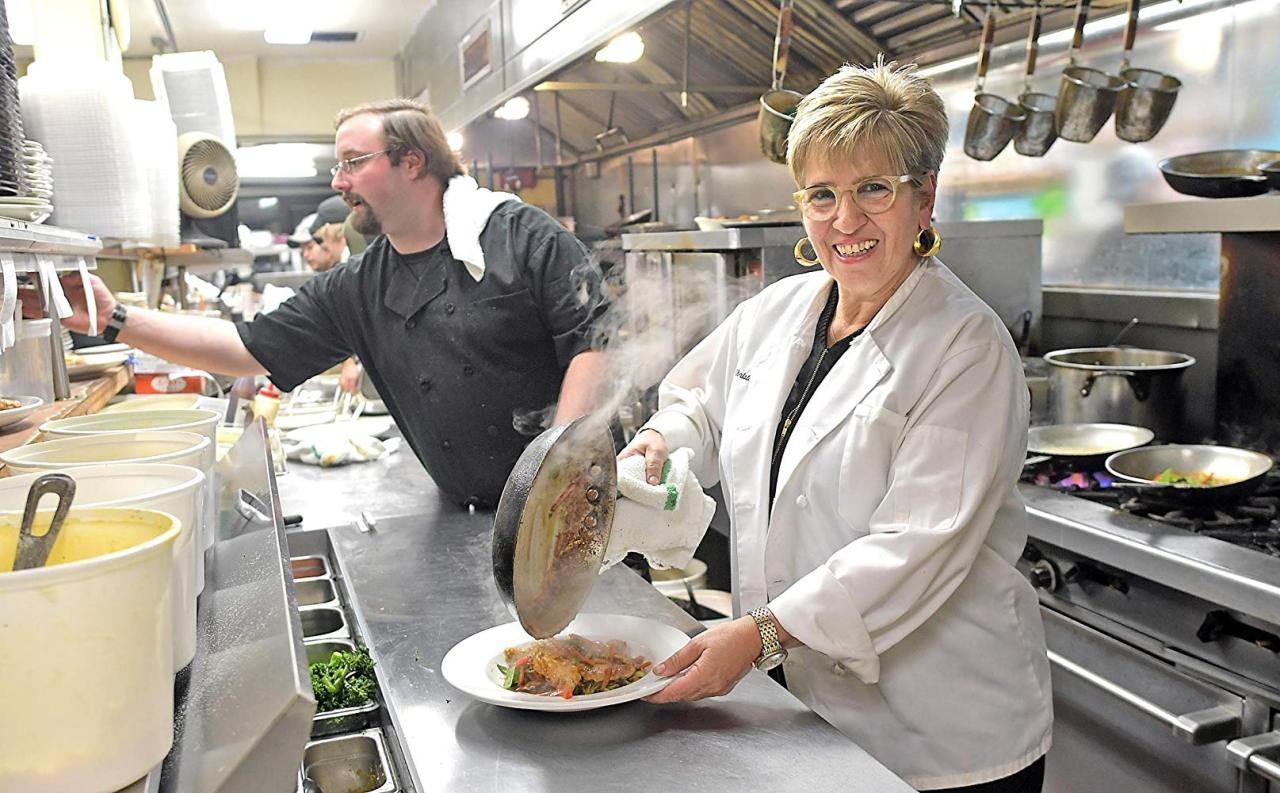
FEBRUARY 28: A Fine Line (dir. Joanna James) – Cinema Village synopsis: “A Fine Line is an award winning documentary that explores why less than 7% of head chefs and restaurant owners are women hearing candid insights from world-renowned female chefs, including: first and only Three Michelin Star chef in the U.S. Dominique Crenn, Emmy Award winning TV host Lidia Bastianich, first female Iron Chef Cat Cora, one of Time Magazine’s Most Influential People Barbara Lynch, Two Michelin Star Chef April Bloomfield, World’s Best Chef Daniel Humm and more. A central narrative unfolds of a small-town restaurateur and single mother on a mission to do what she loves while raising two kids with the odds stacked mightily against her. The film gets to the heart of what is needed to empower women across all industries, by following the personal story of this every day hero, Valerie James. A Fine Line opens up a timely conversation about gender equality, women leadership and diversity in the culinary field and beyond.”

Best Picture: Parasite
Best Director: Sam Mendes (1917)
Best Actress: Renée Zellweger (Judy)
Best Actor: Joaquin Phoenix (Joker)
Best Supporting Actress: Laura Dern (Marriage Story)
Best Supporting Actor: Brad Pitt (Once Upon a Time… in Hollywood)
Best Original Screenplay: Bong Joon Ho and Han Jin Won (Parasite)
Best Adapted Screenplay: Taika Waititi (Jojo Rabbit)
Best Cinematography: Roger Deakins (1917)
Best Editing: Jinmo Yang (Parasite)
Best Production Design: Nancy Haigh and Barbara Ling (Once Upon a Time… in Hollywood)
Best Costume Design: Jacqueline Durran (Little Women)
Best Hair & Makeup: Bombshell
Best Sound Editing: 1917
Best Sound Mixing: 1917
Best Visual Effects: 1917
Best Original Score: Hildur Guðnadóttir (Joker)
Best Original Song: “(I’m Gonna) Love Me Again” (Rocketman)
Best International Feature Film: Parasite (South Korea)
Best Animated Feature: Toy Story 4
Best Documentary: American Factory
Best Animated Short Film: Hair Love
Best Live Action Short Film: Brotherhood
Best Documentary Short Subject: Learning to Skateboard in a Warzone (If You’re a Girl)

Here we are once again, on the eve of the Oscar nomination announcement. Tomorrow morning we will discover who has received Hollywood’s most prestigious honors at the 92nd annual ceremony. Some categories, like Best Director, are extremely difficult to guess accurately. A few predictions may seem like dark horses, but I figured I would go with my gut rather than choose some of the more obvious possibilities. (Particular apologies to Zhao Shuzhen from The Farewell, since I don’t expect her to be recognized by the Academy; if she is nominated, I’ll be overjoyed!) Also, FYI: I don’t predict the three short film categories at this stage since I never have any clue about those until after the nominations come out. Here are my picks:
Best Picture: Bombshell; The Irishman; Jojo Rabbit; Joker; Little Women; Marriage Story; 1917; Once Upon a Time… in Hollywood; Parasite
Best Director: Martin Scorsese (The Irishman); Taika Waititi (Jojo Rabbit); Sam Mendes (1917); Quentin Tarantino (Once Upon a Time… in Hollywood); Bong Joon Ho (Parasite)
Best Actress: Charlize Theron (Bombshell); Awkwafina (The Farewell); Renée Zellweger (Judy); Saoirse Ronan (Little Women); Scarlett Johansson (Marriage Story)
Best Actor: Joaquin Phoenix (Joker); Adam Driver (Marriage Story); Leonardo DiCaprio (Once Upon a Time… in Hollywood); Antonio Banderas (Pain and Glory); Taron Egerton (Rocketman)
Best Supporting Actress: Jennifer Lopez (Hustlers); Scarlett Johansson (Jojo Rabbit); Florence Pugh (Little Women); Laura Dern (Marriage Story); Margot Robbie (Once Upon a Time… in Hollywood)
Best Supporting Actor: Tom Hanks (A Beautiful Day in the Neighborhood); Al Pacino (The Irishman); Joe Pesci (The Irishman); Brad Pitt (Once Upon a Time… in Hollywood); Song Kang-ho (Parasite)
Best Original Screenplay: Lulu Wang (The Farewell); Rian Johnson (Knives Out); Noah Baumbach (Marriage Story); Quentin Tarantino (Once Upon a Time… in Hollywood); Bong Joon Ho and Han Jin Won (Parasite)
Best Adapted Screenplay: Steven Zaillian (The Irishman); Taika Waititi (Jojo Rabbit); Todd Phillips and Scott Silver (Joker); Greta Gerwig (Little Women); Anthony McCarten (The Two Popes)
Best Cinematography: Rodrigo Prieto (The Irishman); Lawrence Sher (Joker); Jarin Blaschke (The Lighthouse); Roger Deakins (1917); Robert Richardson (Once Upon a Time… in Hollywood)
Best Editing: Andrew Buckland and Michael McCusker (Ford v Ferrari); Thelma Schoonmaker (The Irishman); Lee Smith (1917); Fred Raskin (Once Upon a Time… in Hollywood); Yang Jin-mo (Parasite)
Best Production Design: Regina Graves and Bob Shaw (The Irishman); Mark Friedberg and Kris Moran (Joker); Jess Gonchor and Claire Kaufman (Little Women); Nancy Haigh and Barbara Ling (Once Upon a Time… in Hollywood); Dennis Gassner and Lee Sandales (1917)
Best Costume Design: Ruth E. Carter (Dolemite Is My Name); Christopher Peterson and Sandy Powell (The Irishman); Jacqueline Durran (Little Women); Arianne Phillips (Once Upon a Time… in Hollywood); Julian Day (Rocketman)
Best Hair & Makeup: Bombshell; Dolemite Is My Name; Joker; Judy; Rocketman
Best Sound Editing: Avengers: Endgame; Ford v Ferrari; 1917; Rocketman; Star Wars: The Rise of Skywalker
Best Sound Mixing: Avengers: Endgame; Ford v Ferrari; 1917; Rocketman; Star Wars: The Rise of Skywalker
Best Visual Effects: Avengers: Endgame; The Irishman; The Lion King; 1917; Star Wars: The Rise of Skywalker
Best Original Score: Michael Giacchino (Jojo Rabbit); Hildur Guðnadóttir (Joker); Alexandre Desplat (Little Women); Randy Newman (Marriage Story); Thomas Newman (1917)
Best Original Song: “Into the Unknown” (Frozen II); “Stand Up” (Harriet); “Spirit” (The Lion King); “(I’m Gonna) Love Me Again” (Rocketman); “Glasgow (No Place Like Home)” (Wild Rose)
Best International Feature Film: Atlantics (Senegal); Beanpole (Russia); Les Misérables (France); Pain and Glory (Spain); Parasite (South Korea)
Best Animated Feature: Frozen II; How to Train Your Dragon: The Hidden World; I Lost My Body; Missing Link; Toy Story 4
Best Documentary: American Factory; Apollo 11; For Sama; Honeyland; One Child Nation
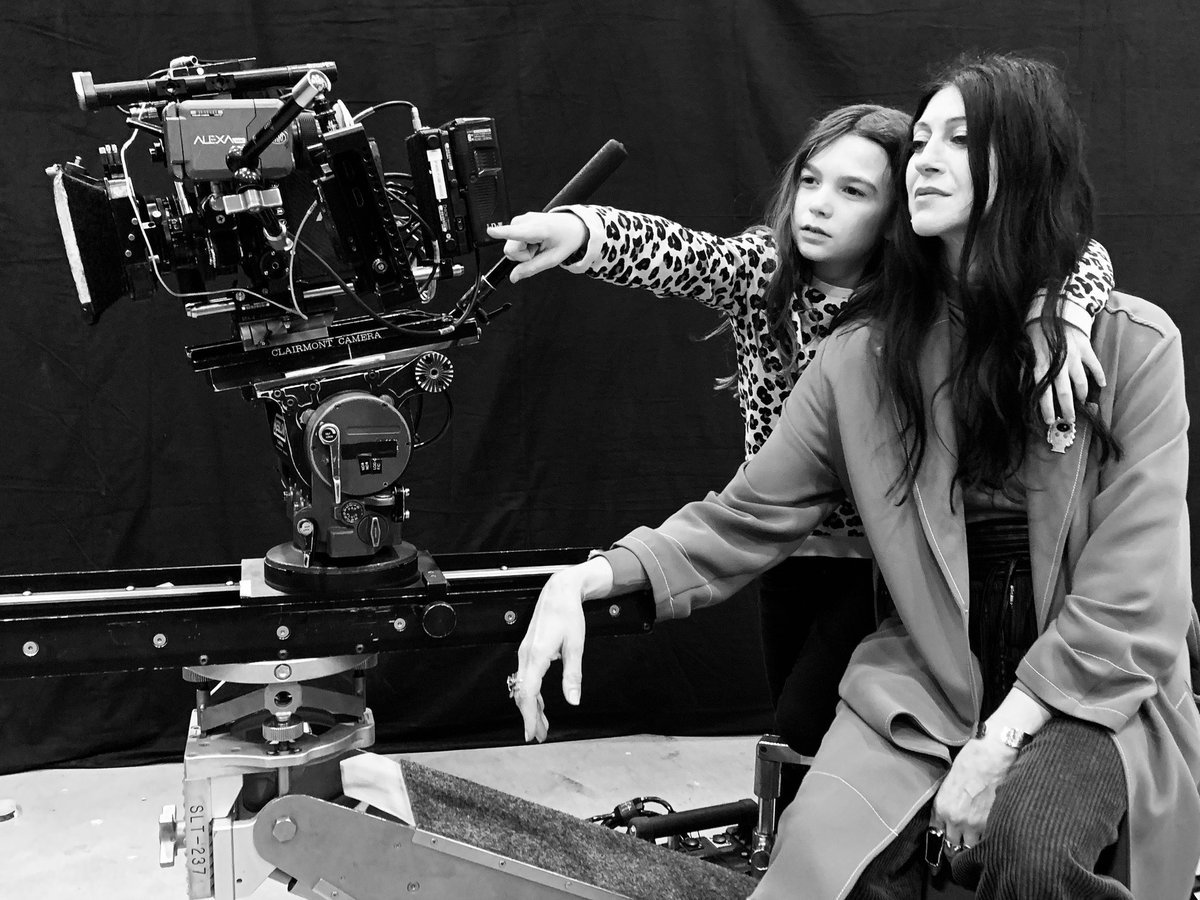
Actress Brooklynn Prince and director Floria Sigismondi on the set of The Turning, 2018. (Photo: Twitter)
Here are eighteen new movies due to be released in theaters or via other viewing platforms this January, all of which have been directed and/or photographed by women. These titles are sure to intrigue cinephiles and also provoke meaningful discussions on the film world, as well as the world in general.
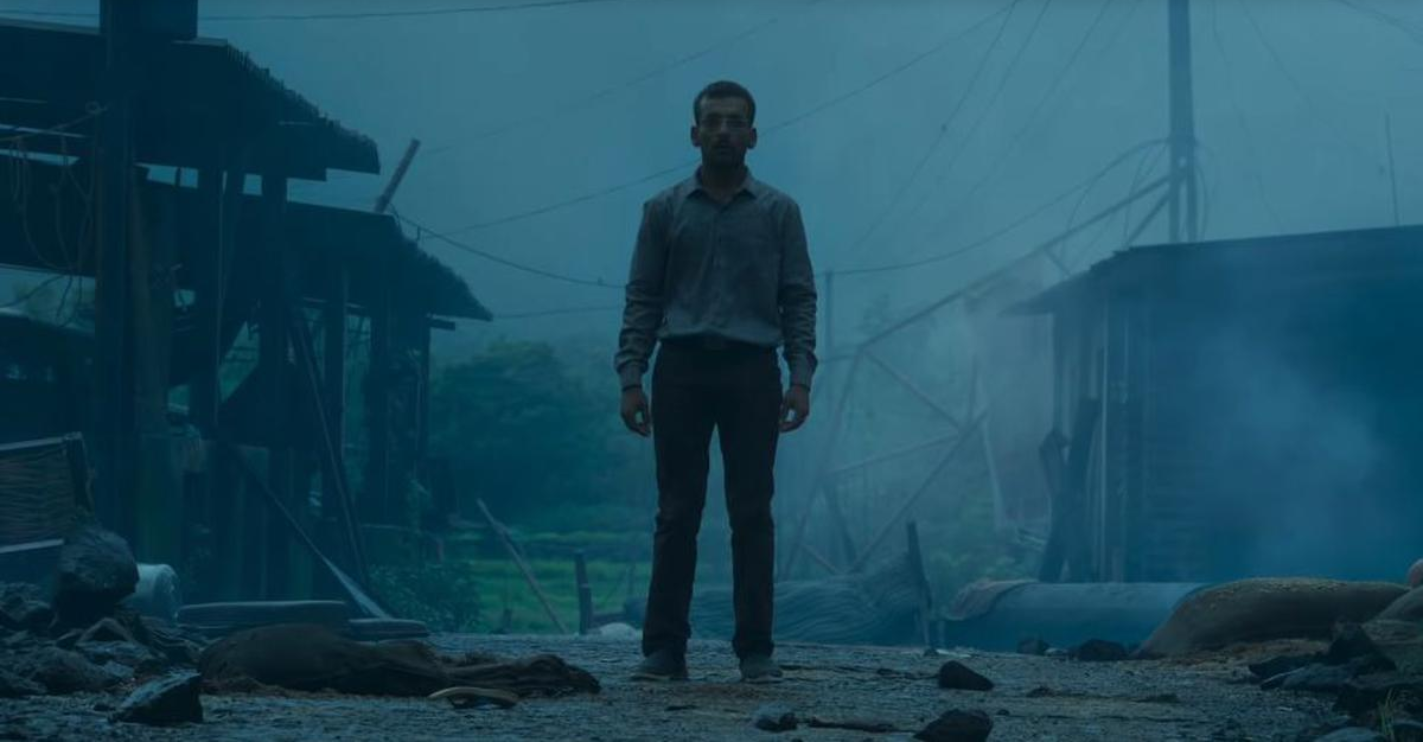
JANUARY 1 (streaming on Netflix): Ghost Stories (dirs. Zoya Akhtar, Dibakar Banerjee, Karan Johar and Anurag Kashyap) – Netflix synopsis: “The directors of Emmy-nominated Lust Stories (Zoya Akhtar, Anurag Kashyap, Dibakar Banerjee and Karan Johar) reunite for this quartet of thrillers.”
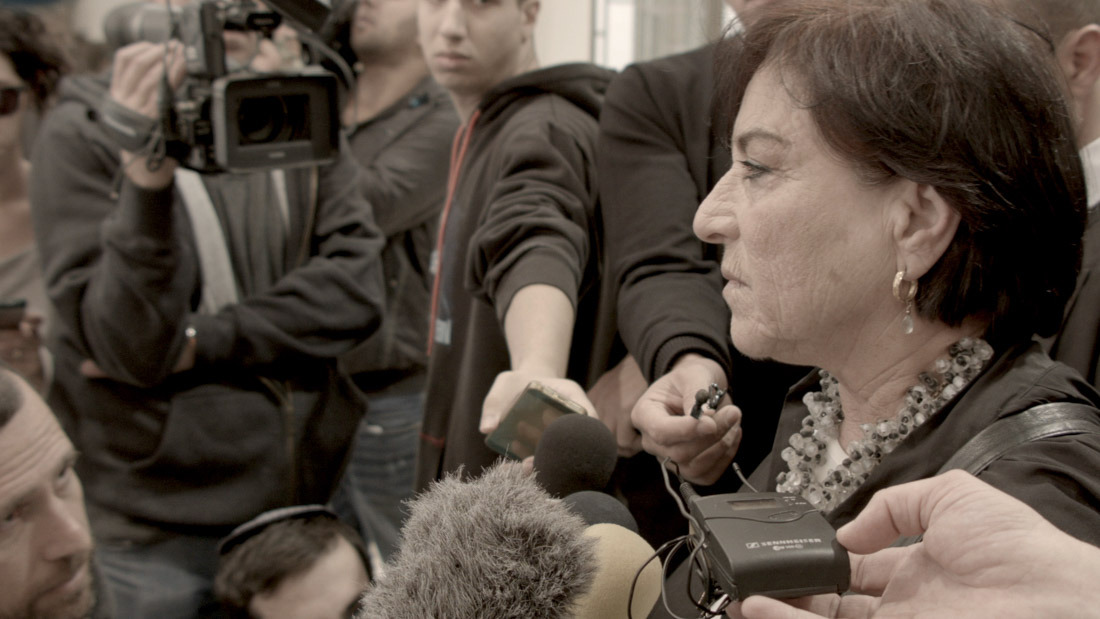
JANUARY 3: Advocate (dirs. Philippe Bellaiche and Rachel Leah Jones) – Quad Cinema synopsis: “Lea Tsemel defends Palestinians: from feminists to fundamentalists, from non-violent demonstrators to armed militants. As a Jewish-Israeli lawyer who has represented political prisoners for five decades, Tsemel, in her tireless quest for justice, pushes the praxis of a human rights defender to its limits. Advocate follows Tsemel’s caseload in real-time, including the high-profile trial of a 13-year-old boy—her youngest client to date—while also revisiting her landmark cases and reflecting on the political significance of her work and the personal price one pays for assuming the role of “devil’s advocate.” Tsemel spoke truth to power before the term became trendy and she’ll continue to do so after fear makes it unfashionable.”

JANUARY 3 (re-release): One Child Nation (dirs. Nanfu Wang and Jialing Zhang) (DPs: Yuanchen Liu and Nanfu Wang) – Cinema Village synopsis: “After becoming a mother, a filmmaker uncovers the untold history of China’s one-child policy and the generations of parents and children forever shaped by this social experiment.”

JANUARY 7 (streaming on Netflix): Live Twice, Love Once (aka Vivir Dos Veces) (dir. Maria Ripoll) (DP: Núria Roldos) – Netflix synopsis: “When Emilio (Oscar Martínez) is diagnosed with Alzheimer’s disease, he and his family embark on a quest to reunite him with his childhood crush.”

JANUARY 10 (in theaters), JANUARY 28 (on VOD): Afterward (dir. Ofra Bloch) – City Cinemas Village East Cinema synopsis: “Jerusalem-born trauma expert Ofra Bloch forces herself to confront her personal demons in a journey that takes her to Germany, Israel and Palestine. Set against the current wave of fascism and anti-Semitism sweeping the globe, Afterward delves into the secret wounds carried by victims as well as victimizers, through testimonies ranging from the horrifying to the hopeful. Seen as a victim in Germany and a perpetrator in Palestine, Bloch faces those she was raised to hate as she searches to understand the narratives of the Holocaust and the Nakba, violent and non-violent resistance, and the possibility of reconciliation.”
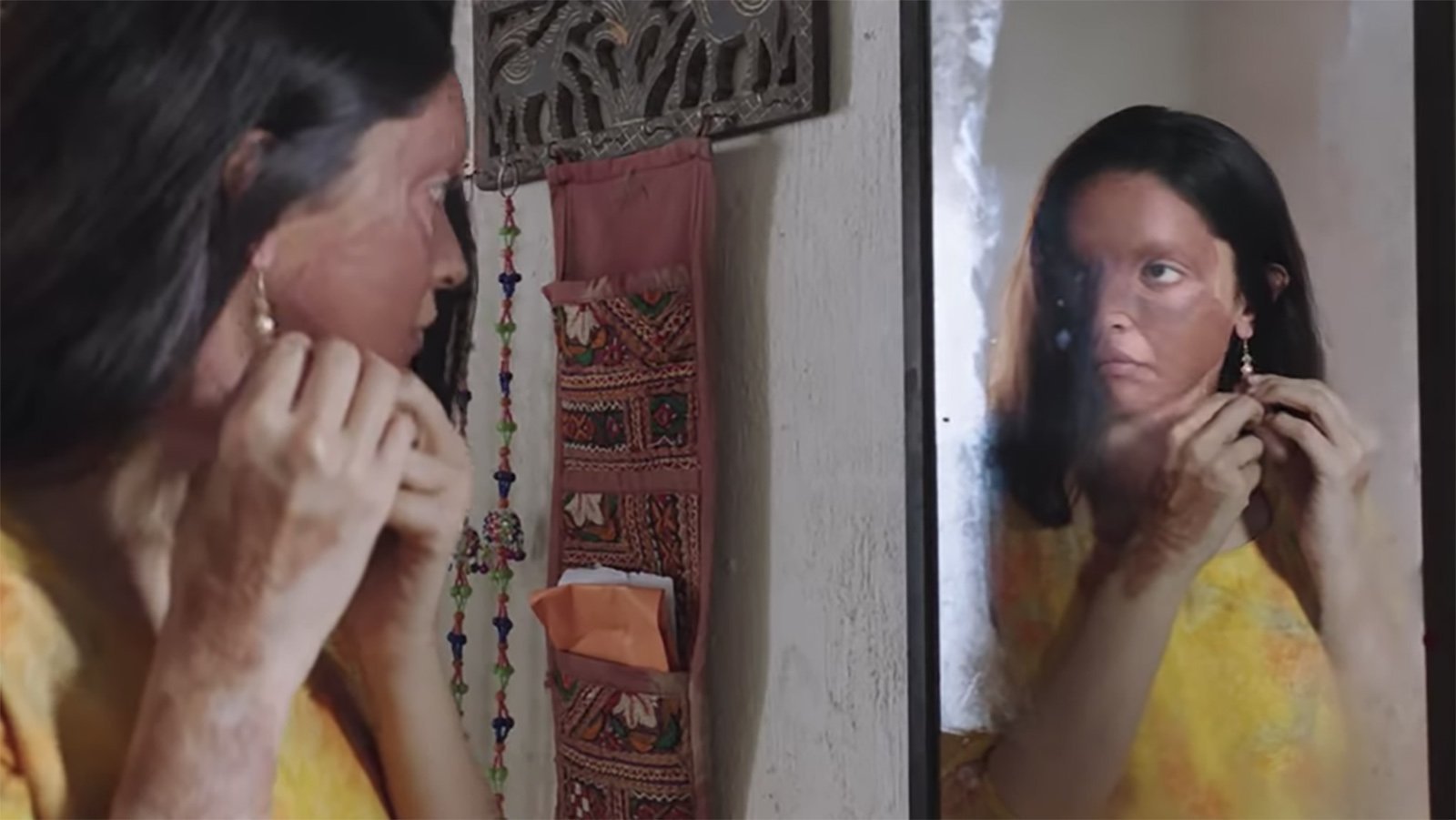
JANUARY 10: Chhapaak (dir. Meghna Gulzar) – AMC Theatres synopsis: “Malti (Deepika Padukone) was attacked with acid on a street in New Delhi, in 2005. Through her story, the film makes an attempt to understand the on-ground consequences of surviving an acid attack in India, the medico-legal-social state of affairs that transpires after the acid has been hurled and the face is irreparably burnt.”
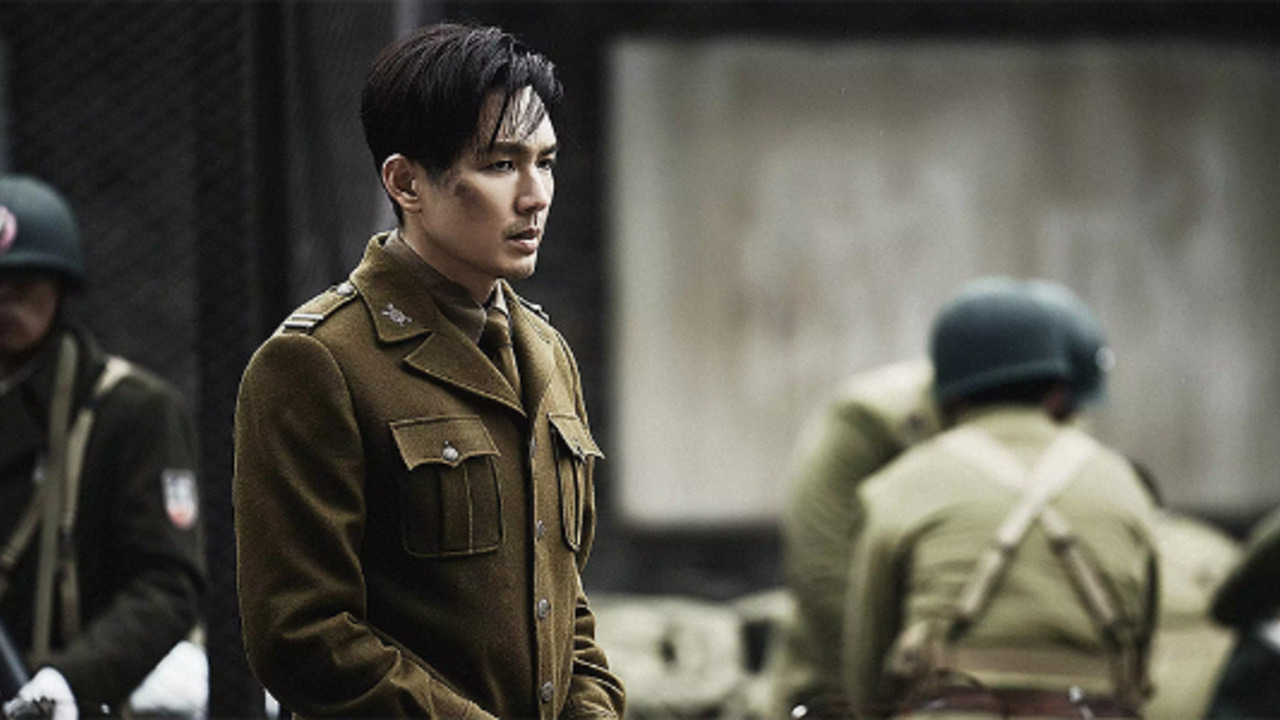
JANUARY 10: Liberation (dirs. Xiaoyang Chang and Shaohong Li) – Far East Films synopsis: “Based on real life events, the film is set in January 1949 and follows a group of soldiers involved in the final stages of the Battle of Pingjin. The cast includes Wallace Chung, Elane Zhong, Zhou Yiwei, Philip Keung, and Yang Mi.”

JANUARY 10: Tanhaji: The Unsung Warrior (dir. Om Raut) (DP: Keiko Nakahara) – AMC Theatres synopsis: “Tanhaji Malusare was an unsung Maratha warrior during the 17th century Maratha Empire, whose acts of valor and bravery continued to inspire soldiers long after his death in battle. He was endowed with a body of steel, courage of a lion with an agile mind and Chhatrapati Shivaji’s closest aide and trusted lieutenant. Ready to lay down his life for his King and country, this brave heart went to war, armed with a few Maratha soldiers to get back the Kondana Fort against the Mughal army headed by Udaybhan. Mughal’s had muscle power, but Tanhaji had sharp acumen. Unfortunately, Marathas won Kondhana Fort, but lost their Lion. Tanhaji left behind a void that none in history could ever fill. Tanhaji: The Unsung Warrior is a visual extravaganza that depicts the life and times of this unsung warrior, whose valor still makes the Nation proud.”

JANUARY 10: The Woman Who Loves Giraffes (dir. Alison Reid) (DPs: Dale Hildebrand, Lainie Knox and Iris Ng) – Quad Cinema synopsis: “In 1956, four years before Jane Goodall immersed herself in the world of chimpanzees, 23-year-old biologist Anne Innis Dagg made an unprecedented solo journey to South Africa to study giraffes in the wild. In this enlightening and inspiring documentary, the now-86-year-old retraces her groundbreaking steps with the help of old letters and stunning, original 16mm film footage. The intimate window into Dagg’s life as a young woman—and the world’s first ‘giraffologist’ whose research findings formed the foundation for many modern scientists —is juxtaposed with a first-hand look at the devastating reality that giraffes are facing today to create a bracing impact.”

JANUARY 16 (streaming on Netflix): Jezebel (dir. Numa Perrier) – Eye for Film’s SXSW review by Jennie Kermode: “Sex cam work is often portrayed as shameful, something only desperate women do and something that is bound to lead to unhappiness, yet – at least prior to the passing of the SESTA/FOSTA Act in the US – it revolutionised sex work, making it much safer by enabling people who had been out on the streets to earn a living from a virtual space. Numa Perrier’s beautifully observed drama Jezebel tells the story of one young woman whose life is transformed by it in a positive way.
“Perrier plays Sabrina, a phone sex worker with a young daughter, deadbeat boyfriend and home full of hangers-on to support. She has also made space for her younger sister Tiffany (Tiffany Tenille), whose life as a full time carer abruptly changes when their ailing mother is hospitalised. At the same time as dealing with the complicated emotions this brings, Tiffany needs to find a new way to make a living, so Sabrina persuades her to pursue an opportunity in sex camming, for which purpose the younger woman reinvents herself as Jezebel.
“The taboo of taking one’s clothes off in a forbidden space is always scariest the first time. Jezebel hesitates when doing it in front of the boss, but only briefly. Starting the same day means there’s no time for worry to build up, and the boss’ sister, who also performs there, takes her through the basics in a friendly and supportive way. To be clear, there’s no actual sex involved in this, though certain acts are simulated – with much laughter when the clients aren’t there – in order to increase earnings. As Jezebel comes to understand how much of it is about trickery and play, she loses her fear – but it’s as she starts to take control of her own sexuality that she really finds her strength, both at work and elsewhere in life.
“This is a film that never takes the easy route of eroticising its subject for the audience. Yes, it includes upper body nudity and we see the women at the cam business posing for clients, but their activity is very much presented as work, with a lot of humour at the expense of clients who take it seriously. Nevertheless, Jezebel gets to know some of her clients and forms a particular bond with a foot fetishist called Bobby (voiced by Brett Gelman), who changes the way she thinks about herself.
“It’s not all fun. A scene in which Jezebel is confronted with racism and has to try and explain to her white colleagues why a particular slur is not equivalent to the misogynistic insults they take in their stride is tough to watch, and has implications right across the service sector. There’s an acknowledgement of the nastier side of the internet and the way that the economic interests of the people least likely to face serious abuse there – also the people who have the most money and social status to begin with – act to resist attempts to fix it. We also see the strife that develops as the relationship between Jezebel and Sabrina changes, and the sniping the former has to put up with from the men in the household.
“Despite all this, this is a warm-hearted and positive story about a young woman taking control of her life, and it’s refreshing to see such stories being told about working class women in stigmatised professions. Shot close-up to emphasise the cramped spaces in which its heroine lives and works, it invites the viewer to share her delight as the world opens up to her.”
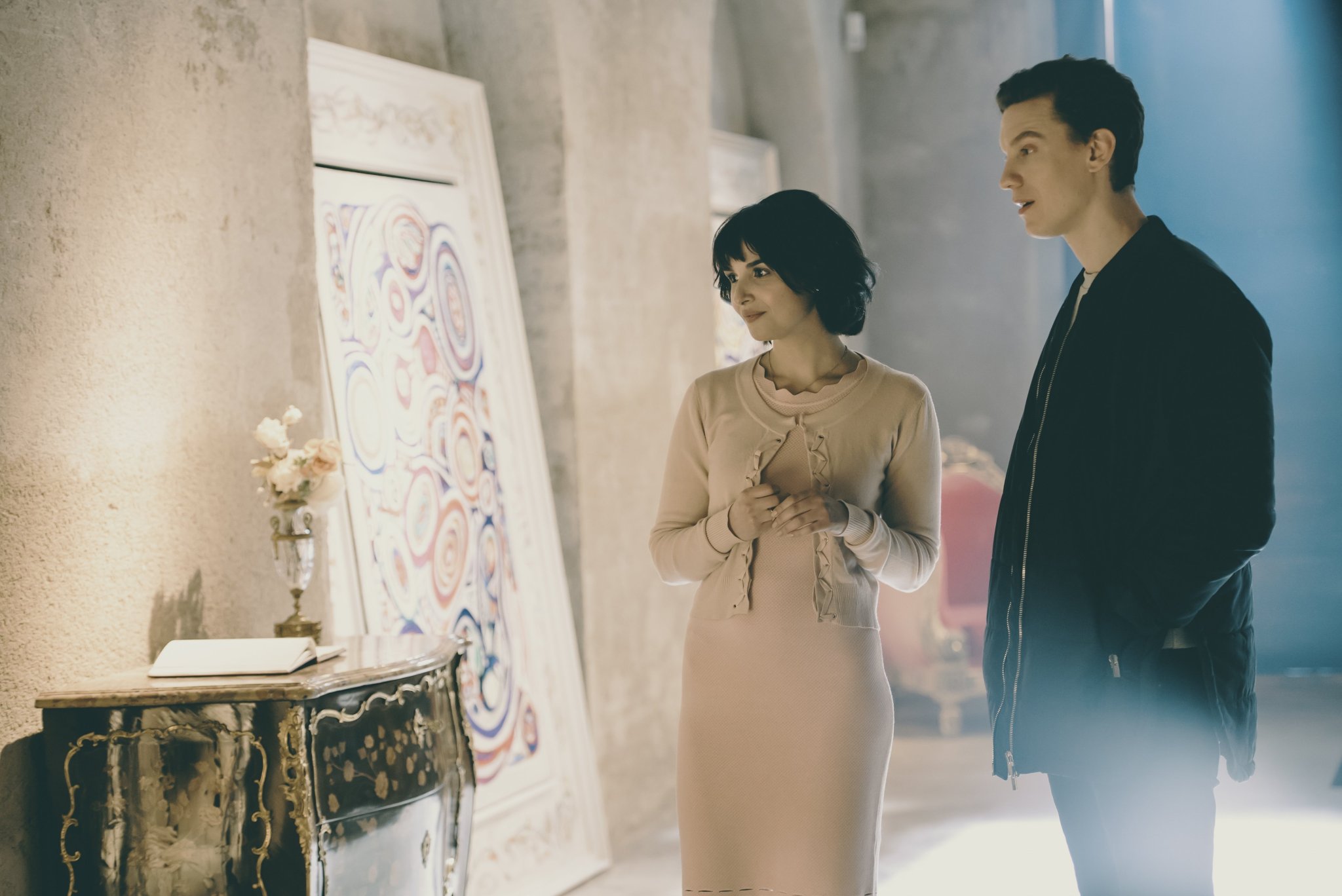
JANUARY 17 (in theaters & on VOD): The Host (dir. Andy Newbery) (DP: Oona Menges) – From a First Showing article by Alex Billington: “A disturbing tale of a London banker and an unassuming Dutch femme fatale, The Host follows Robert Atkinson (Mike Beckingham) and Vera Tribbe (Maryam Hassouni), two strangers with dark and disturbing secrets. When Robert flees London with a briefcase of stolen money, he seeks refuge in Amsterdam at Vera’s home. As they try to suppress their inner demons, a course of destruction emanates from their hidden secrets that can never be escaped.”
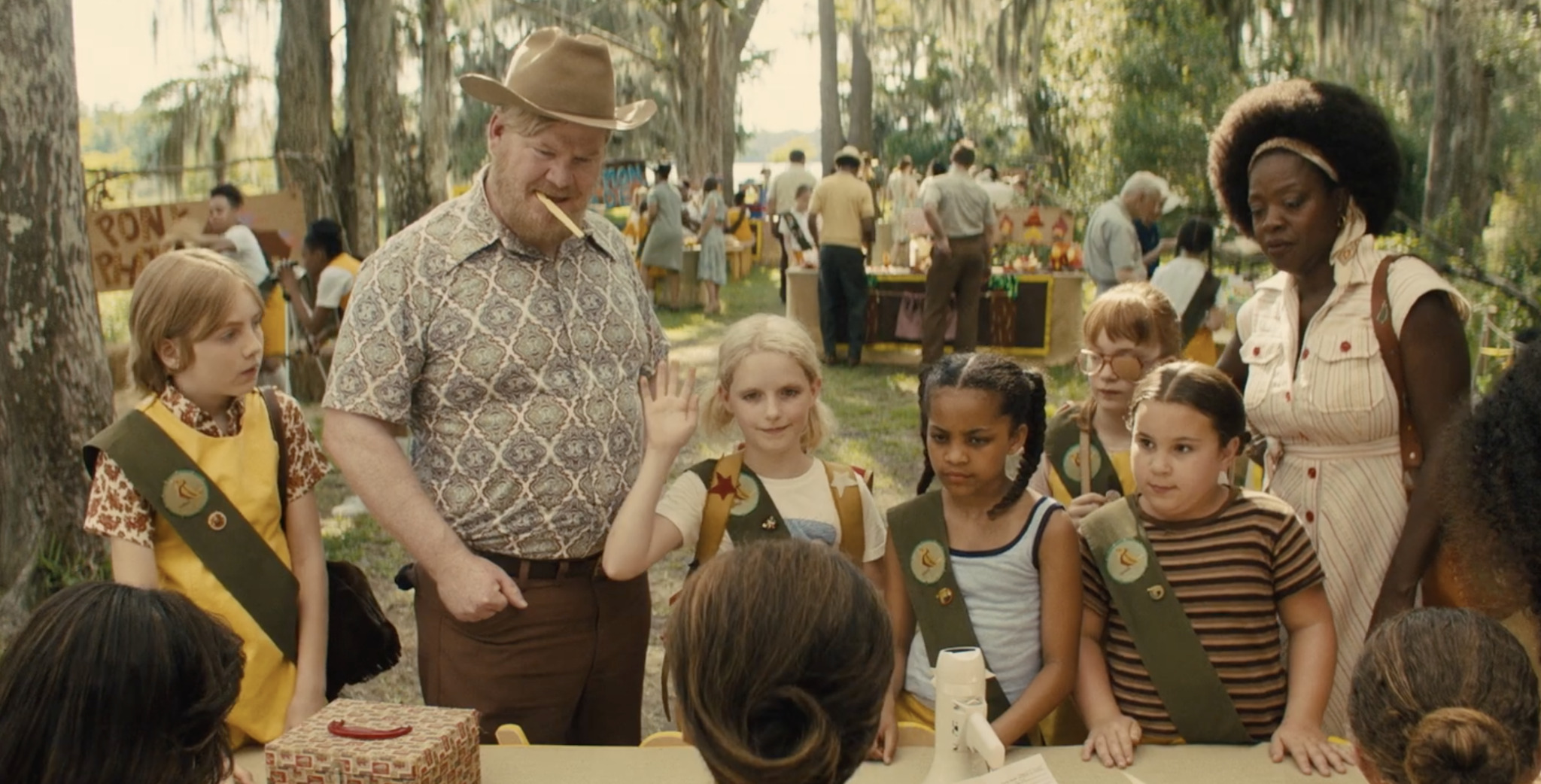
JANUARY 17 (streaming on Amazon Prime Video): Troop Zero (dirs. Bert & Bertie) – Seattle International Film Festival synopsis: “In 1977, the Voyager spacecraft was launched into the cosmos with a gold-plated record, conveying a playlist that best represented humanity and the Earth, a message to anyone who might be out among the stars. And, in Troop Zero, quirky nine-year-old Christmas Flint, played by the charismatic McKenna Grace (Gifted; I, Tonya), is set on getting her voice on that recording. Her way in: the 1977 Birdie Scout Jamboree, where a select troop’s vocalizing will be featured on the recording. But when rural Georgia’s demure Troop 5, led by the judgmental Miss Massey (Allison Janney), won’t have her, Christmas must start her own troop—with a down-to-earth Viola Davis by her side—and assemble an unorthodox team, despite Miss Massey’s best attempts to disqualify the underdogs. Cue shenanigans and a lively David Bowie-infused soundtrack. Add comedian Jim Gaffigan to the mix as Christmas’s hapless attorney father, and Troop Zero promises to be a sweet, silly, family-friendly comedy-drama with a warmhearted message of acceptance and the power of friendship. In their sophomore feature, premiering on the closing night of [last] year’s Sundance Film Festival, female co-directing duo Bert & Bertie bring us an irresistibly fun and touching celebration of unconventionality.”
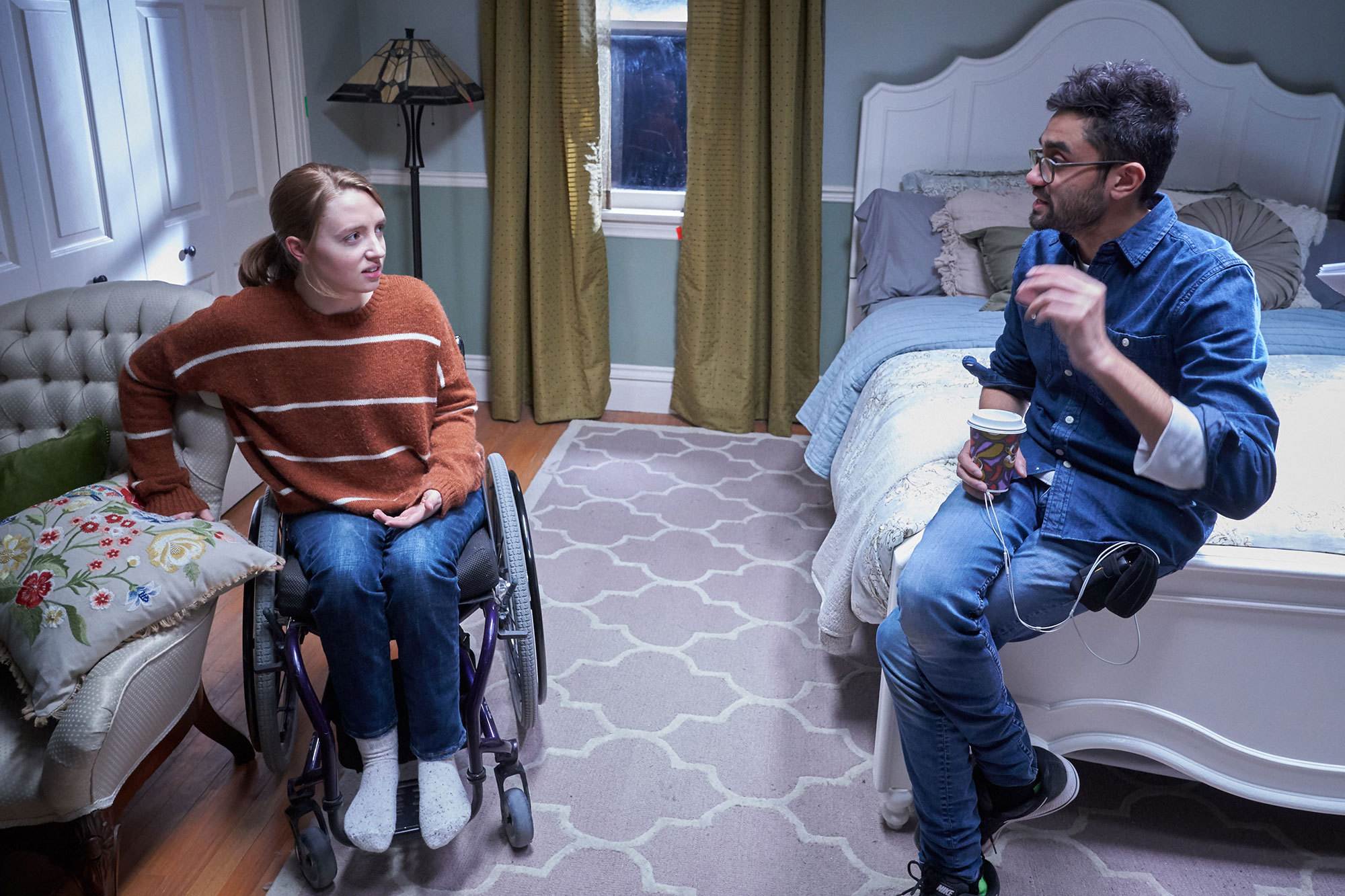
(set photo; no production stills have been released yet, as far as I can tell)
JANUARY 24: Run (dir. Aneesh Chaganty) (DP: Hillary Spera) – From a Slash Film article by Ben Pearson: “Aneesh Chaganty, the co-writer/director of last year’s computer screen mystery Searching, is following up that movie with a more traditionally-filmed thriller called Run. Sarah Paulson (Glass, ‘American Horror Story’) stars opposite newcomer Kiera Allen.
“…Run follows a smart, cool teenager known as ‘Daughter’ (Allen) who uses a wheelchair and is raised in complete isolation by ‘Mother’ (Paulson), and the girl slowly learns that her mother is keeping a sinister secret.”
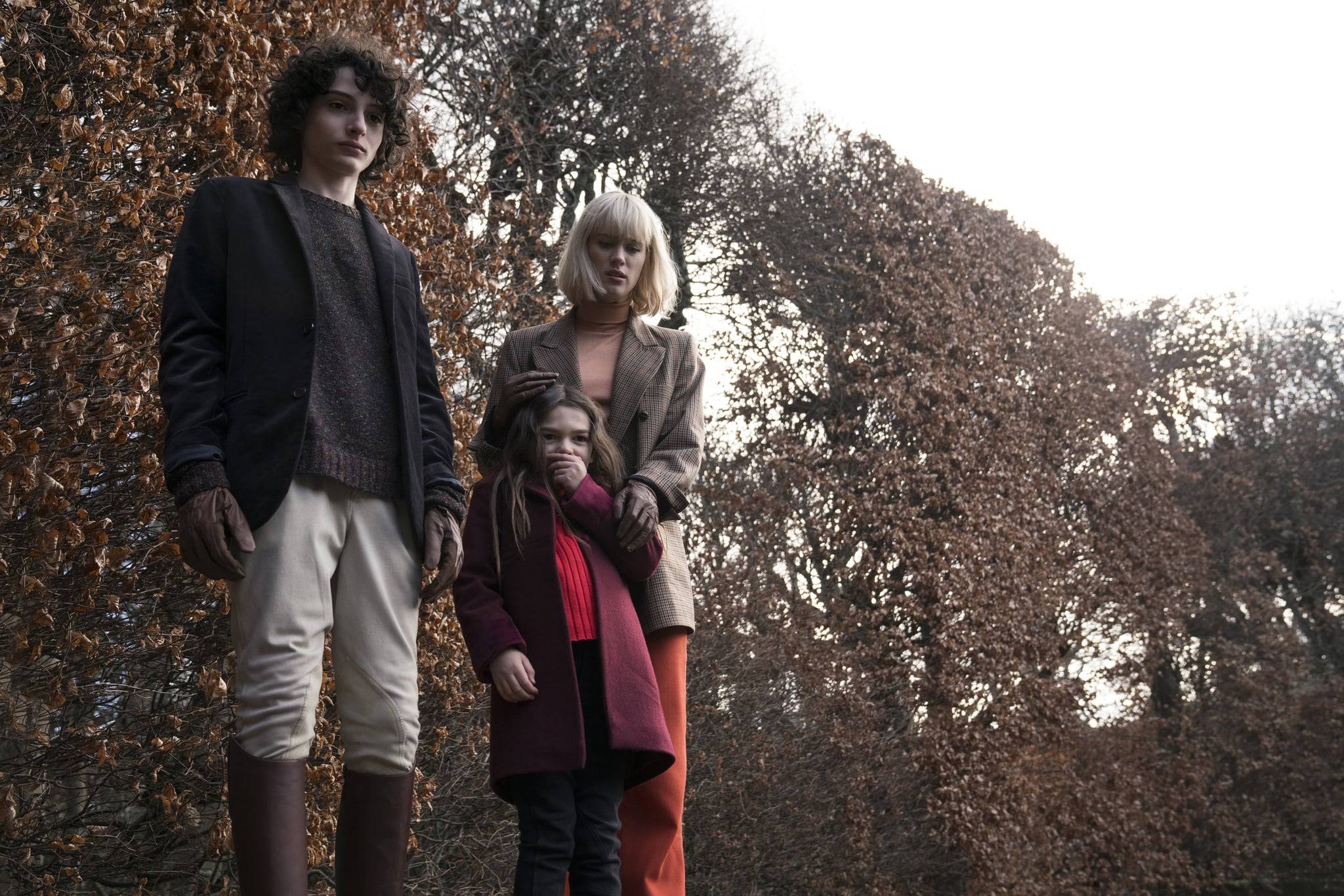
JANUARY 24: The Turning (dir. Floria Sigismondi) – Synopsis from the film’s official website: “For more than 100 years, a deeply haunting tale has been passed down to terrify audiences. DreamWorks Pictures’ The Turning takes us to a mysterious estate in the Maine countryside, where newly appointed nanny Kate is charged with the care of two disturbed orphans, Flora and Miles. Quickly though, she discovers that both the children and the house are harboring dark secrets and things may not be as they appear.
“Inspired by Henry James’ landmark novel, the haunted-house thriller is directed by spellbinding visualist Floria Sigismondi (The Runaways, Hulu’s ‘The Handmaid’s Tale’) and stars Mackenzie Davis (Terminator: Dark Fate, The Martian), Finn Wolfhard (It, Netflix’s ‘Stranger Things’), newcomer Brooklynn Prince (The Florida Project) and Joely Richardson (Red Sparrow, The Girl with the Dragon Tattoo).”
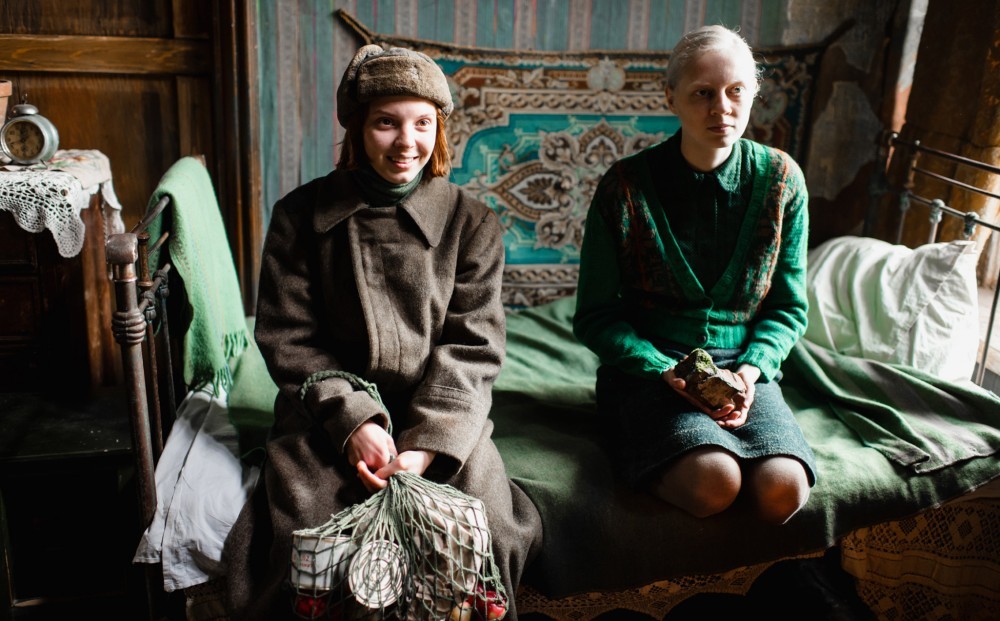
JANUARY 29: Beanpole (dir. Kantemir Balagov) (DP: Kseniya Sereda) – IONCINEMA’s Cannes Film Festival review by Nicholas Bell: “In the words of Plato, “Only the dead have seen the end of war.” Such seems the case for the survivors left to pick-up the pieces in 1945 Leningrad during the first autumn after the end of WWII in Kantemir Balagov’s strikingly astute sophomore feature, Beanpole. Following two years on the heels of an equally impressive debut, 2017’s Closeness (which detailed a heinous kidnapping in late 90’s Nalchik, from whence he is from), Balagov goes further into the past to examine the lives and friendship of two Russian women struggling to move forward during the construction of Leningrad, which suffered one of worst sieges in history. Based loosely on Nobel Laureate Svetlana Alexievich’s book The Unwomanly Faces of War, Balagov co-wrote with scribe Aleksandr Terekhov (of Aleksey Uchitel’s 2017 Mathilde) a formidable psychological portrait of two women matched by the aching ferocity of two superb cinematic debuts from leads Viktoria Miroshnichenko and Vasilisa Perelygina.
“Many of the more popular international cinema dealing with the reconstruction period of post-WWII tends to center on the rise of survivors (usually male protagonists) through the rubble of Germany—but two unforgettable Nina Hoss performances come to mind dealing specifically with this time and location in 2008’s Anonyma and 2014’s Phoenix.
“Balagov grasps the mantle of his Russian predecessors with Beanpole, a haunting, visually striking depiction of women’s roles during reconstruction. Miroshnichenko is galvanizing as Iya, her nickname the titular period slang to describe her gangly frame (which is treated to a much more graceful comparison in the French subtitle translation as La Girafe). Suffering from debilitating spasms diagnosed as ‘post-concussion syndrome,’ which would later come to be recognized as PTSD, Iya is a broken soul working as a nurse in a Leningrad hospital.
“Having developed a warm relationship with her superior, Iya is designated as a literal Angel of Death, secretly assisting in euthanizing patients who will not recover from their wartime wounds, desiring to die. Likewise, the first act’s supreme tragedy involves the accidental death of the child, Pashka (Timofey Glazkov), who we initially assume belongs to Iya. Suddenly, Masha (Perelygina) arrives, the mother of the child who entrusted her son to her best friend so she could stay behind on the front lines and avenge the death of the child’s father. Upon learning of Pashka’s death, her reaction is to go out dancing, the rationale being she needs to work on having another baby. In Masha’s mind, a child will allow her to heal from the trauma inflicted by the war. However, it seems Masha’s internal scars have left her sterile—and so Iya is tasked with producing the salve which will assuage their passage to a brighter future.
“Both Iya and Masha are color coded as red and green (colors representing rebirth and wounds/war), designs which complement one another, begin to infiltrate, and eventually shift between the women as their vulnerabilities and resiliencies fluctuates. As the title indicates, Iya’s height (note, her name means violet in Greek, a color which requires two primaries to mix together) hints at Balagov’s subtexts regarding reconstruction, specifically women’s bodies and how they are allowed to move about in space or claim agency. Iya’s ungainliness paints her as the beautiful swan who was never able to realize she was no longer an ugly duckling.
“Beautifully textured cinematography from Kseniya Sereda captures a tremendously vibrant color palette of these period interiors, flanked by the less colorful but grainy exteriors of a bedraggled but bustling Leningrad (where a near-Anna Karenina moment occurs). Balagov concocts a third tremendous debut from Ksenia Kutepova, a remnant of a downgraded oligarchy whose son desires to marry Masha—Kutepova walks away with one of the film’s best moments as she highlights the underbelly of the façade afforded privileged woman (also of note, Olga Dragunova of Closeness appears in a minor role as a surly seamstress).
“Balagov pointedly avoids any direct mention of Stalin or Lenin, whose visual representations are also absent from Beanpole. However, his film channels the energies of some of Russia’s greatest filmmakers, with a mise en scene recalling Aleksey German’s classic My Friend, Ivan Lapshin (1985), which depicts the effects of Stalin’s 1930s purge on a small town in Russia. However, Beanpole plays like a sister film to Larisa Shepitko’s underrated and unforgettable 1966 film Wings, wherein a female ex-fighter pilot cum school teacher cannot find meaning in her life during peace time. Tragic, hopeful and subversive (the film paints a complex portrait of friendship and sexuality which would have been impossible to make in Russia), Beanpole confirms Balagov’s stature as a major contemporary filmmaker.”
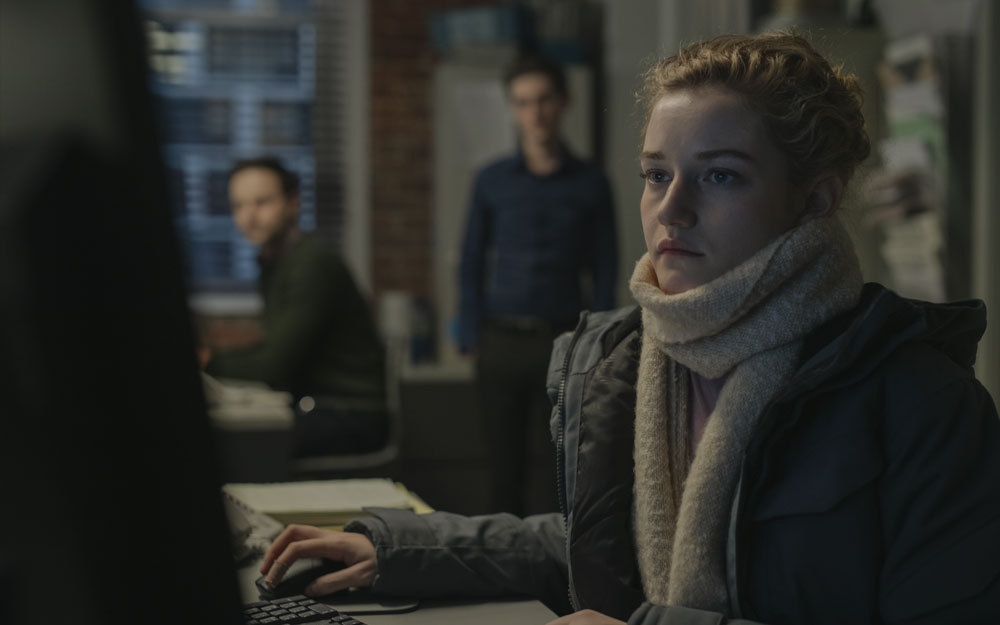
JANUARY 31: The Assistant (dir. Kitty Green) – IndieWire’s Telluride Film Festival review by Eric Kohn: “Harvey Weinstein doesn’t appear in The Assistant, and nobody mentions him by name, but make no mistake: Director Kitty Green’s urgent real-time thriller marks the first narrative depiction of life under his menacing grip. ‘Ozark’ breakout Julia Garner is a revelation as the fragile young woman tasked with juggling the minutiae of the executive’s life, arranging a never-ending stream of airplane trips, staving off angry callers, and picking up the trash left in his wake.
“Beyond a few unfocused glimpses of a hulking figure roaming his office in the background, the Weinstein of The Assistant is a phantom menace who barrels down on the young woman’s life, but this fascinating psychological investigation doesn’t allow him to hijack a story that belongs to her. The Assistant doesn’t document the specifics of Weinstein’s abuses recounted by so many over the past two years; instead, it explores the harassment and control that kept his unwitting enablers under his grip.
“Green’s first fiction feature following the innovative true-crime documentary Casting JonBenét feels like a natural extension of her earlier work. Built out of immaculate research into the working conditions under Weinstein and how they affected many of the young women on its payroll, the movie unfolds as a gradual accumulation of intricate details, mapping out the character’s exhausting routine until it becomes her own private Twilight Zone. The Assistant adopts such a gradual pace that it sometimes works against the stunning performance at its center, but there’s no doubting the hypnotic power of a movie that digs inside Weinstein’s harrowing reign and observes the mechanics that allowed it to last so long. A quiet work with major ambitions, The Assistant is a significant cultural statement in cinematic form.
“As Jane, Garner delivers a masterclass of small, uncertain gestures. A Northwestern grad who harbors dreams of producing movies, she’s already enmeshed in an endless work cycle as the movie begins: Hopping out of her Astoria home before the sun rises, polishing up the vacant office, speeding through emails, printing out price sheets, and so on; the rest of the company slowly comes to life around her. Green constructs the atmosphere with a masterful focus on fragments of business talk, the clacking of keyboards, and ringing phones that draw out the drab nature of Jane’s work: She’s at once at the center of the action and entirely removed from it.
“And that includes the activities of her invisible boss, who only seems to notice her when she screws up. It doesn’t take long: After angering some moody client, Jane gets a call from her unseen overlord as fragments of his bitter tirade (‘They told me you were smart’) are barely audible. The specifics matter less than the way the abuse plays out on Garner’s face as she sinks into her hands, and the formal procedure that follows is just a few steps shy of a dark joke: The pair of unnamed male assistants (Noah Robbins and Jon Orsini) who sit across from Jane and judge her every move assemble behind her to dictate an apology email, and Jane does as she’s told. As much as The Assistant involves the process through which one man exerts control over a woman trapped by his direction, it also shows how the toxic workplace infects others in its grasp.
“As the physical toil of Jane’s work piles up — cleaning dishes, taking out the garbage, dealing with paper cuts — she begins to notice the evidence of Weinstein’s worst crimes. The offhand discovery of an earring piques Jane’s interest, as does a passing comment from one of the men at the company that nobody should ever sit on the office couch. Green makes the brilliant gamble of letting audiences pick up the pieces. With time, it becomes clear that Jane sees no recourse but to contend with circumstances that have since become a matter of grotesque public record.
“For a while, The Assistant seems as though it could simply hover in Jane’s world for hours, as if presenting the #MeToo equivalent of Chantal Akerman’s Jeanne Dielman. But then the movie injects a subtle plot twist, as Jane’s suddenly tasked with taking a young new assistant (Kristine Froseth) to her own hotel room. The wide-eyed Ohio transplant’s sudden A-list treatment confounds Jane, who seems as if she’s in denial about her boss’ real agenda with the young woman, and instigates a visit to the company HR office that pitches the movie into a whole new level of discomfort. Played by ‘Succession’ star Matthew Macfadyen, the executive tasked with belittling Jane for her complaint magnifies the way the company exerted control over their liabilities and how they got away with it. The backlash Jane experiences from her small attempt to take charge is devastating, and it ends with a sudden email from her boss that gives her just enough encouragement to keep her in line.
“The Assistant pads out so much of its 85-minute runtime with eerie textures that it tends to linger on the same note of despair, and it struggles to move the story into a new place by its closing act. The tension dissipates as The Assistant drifts toward its finale, and there’s a lingering sense that it underserves Jane’s story by basking so much of the company’s happenings in total mystery. It’s hard not to imagine what Green, whose previous work has used reenactments and voiceover to immerse viewers in real events, might have accomplished if she’d paired these scenes with real accounts from Weinstein’s victims.
“On the other hand, The Assistant doesn’t need to overstate the nature of Jane’s conundrum. Best appreciated as an experimental narrative about workplace oppression, it’s a fascinating illustration of how the worst abuses can remain hidden even from those closest to the lion’s den. Green has not set out to make the definitive retelling of the Weinstein scandal, the reporting on his years of sexual abuse and coverups, or the fallout that destroyed his company. (Brad Pitt’s Plan B already has that project in development.) Instead, the movie hovers in silent moments when taking action simply doesn’t seem feasible. The absence of payoff only adds to the haunting spell, and imbues the drama with purpose. Amid galvanizing stories about what it took to speak out, The Assistant is an essential reminder of why it took so long for the world to hear about it.”
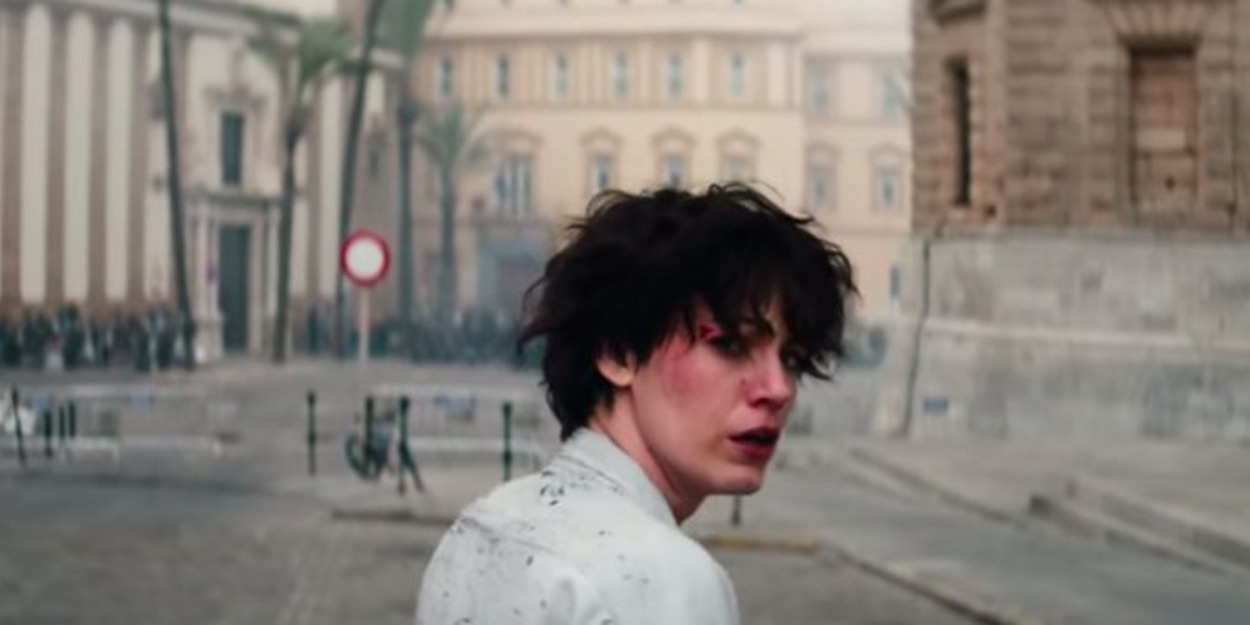
JANUARY 31: The Rhythm Section (dir. Reed Morano) – Paramount Pictures synopsis: “Blake Lively stars as Stephanie Patrick, an ordinary woman on a path of self-destruction after her family is tragically killed in a plane crash. When Stephanie discovers that the crash was not an accident, she enters a dark, complex world to seek revenge on those responsible and find her own redemption.”

JANUARY 31 (streaming on Netflix): 37 Seconds (dir. HIKARI) – Toronto International Film Festival synopsis by Giovanna Fulvi: “Thirty-seven seconds without breathing at the time of her birth was all it took for Yuma (Mei Kayama) to develop cerebral palsy. For the physically restricted 23-year-old, those brief moments have shaped the course of her life. They take on additional significance near the end of HIKARI’s original and accomplished debut feature, when another burning revelation carries the unsettling disclosure of a family secret.
“Imaginative and sincere, the film follows the joys and pains of Yuma’s slow process of empowerment. Surprising narrative turns chart her emancipation from the protection and exploitation she experiences at the hands of the most important people in her life, an overprotective mother (Misuzu Kanno) and Sayaka (Minori Hagiwara), a blogger and influencer who passes Yuma’s work off as her own. A brilliant mangaka, Yuma has a vivid visual imagination. Although she can’t walk, she can draw, creating amazing stories as the driving force behind Sayaka’s success — the social stigma around Yuma’s physical disability preventing the acknowledgment of her talent. When an unprejudiced publisher of manga porn asks her to gain some sexual experience in order to produce a more ‘realistic’ story, Yuma embarks on an unlikely journey within Tokyo’s underbelly, where she’ll find adventure, generosity, and humanity.
“In crafting this unique Bildungsroman, HIKARI finds a special style of filmmaking. Blending Japanese pop with humour and bold tenderness, she draws an honest portrayal of disability, brilliantly brought to life by the amazing performance of first-time actress Mei Kayama.”
Here we are on December 31, so it’s time to go over my list of the films I watched in 2019. I didn’t watch as much as I hoped – the total count is 263 titles – but I tried my best to expand my cinematic knowledge as best as I could. In addition, I’ve added the list of films I’ve seen this year that were directed by women, as well as the results of another fun thing I did called the Watch Four Films Challenge. Enjoy!
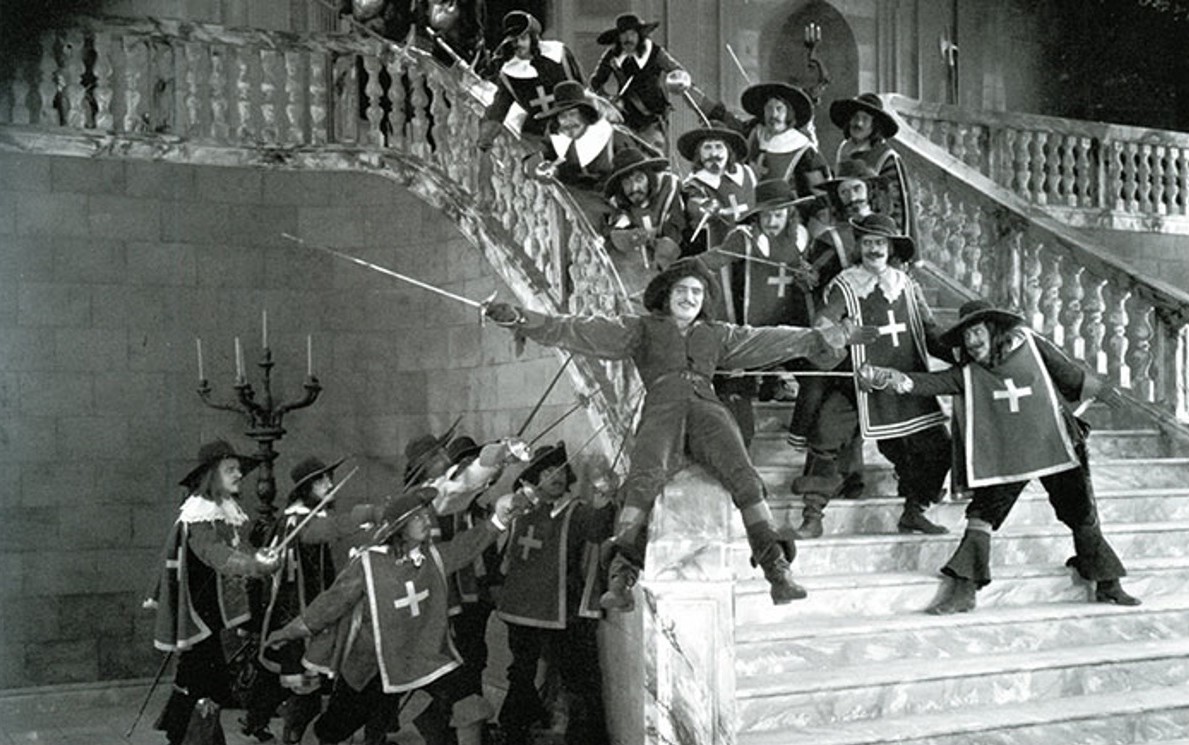
1920-1924: The Three Musketeers

1930-1934: An American Tragedy; Blondie Johnson; Blood Money; The Cabin in the Cotton; Cavalcade; From Headquarters; Honor Among Lovers; If I Were Free; Jewel Robbery; The Kennel Murder Case; Le Million; The Song of Songs; They Call It Sin; The Thin Man; This Man Is Mine; Transgression
1935-1939: Confessions of a Nazi Spy; Craig’s Wife; The Ex-Mrs. Bradford; Fast and Furious; Fast and Loose; Fast Company; Front Page Woman; The Hunchback of Notre Dame; In Name Only; The Irish in Us; Marked Woman; Merrily We Live; Sabotage; The Walking Dead; The Women; You Can’t Have Everything
1940-1944: A Girl, a Guy, and a Gob; The Amazing Mrs. Holliday; It Happened at the Inn; Johnny Eager; Night Train to Munich; Our Town; Our Wife; Panama Hattie; Parachute Battalion; Reap the Wild Wind; They Met in the Dark; Turnabout
1945-1949: Bedlam; The Boy with Green Hair; Dead Reckoning; Force of Evil; The Ghost and Mrs. Muir; House of Strangers; Isle of the Dead; The Loves of Carmen; Nobody Lives Forever; La Otra (aka The Other One); Railroaded!; The Velvet Touch; White Heat
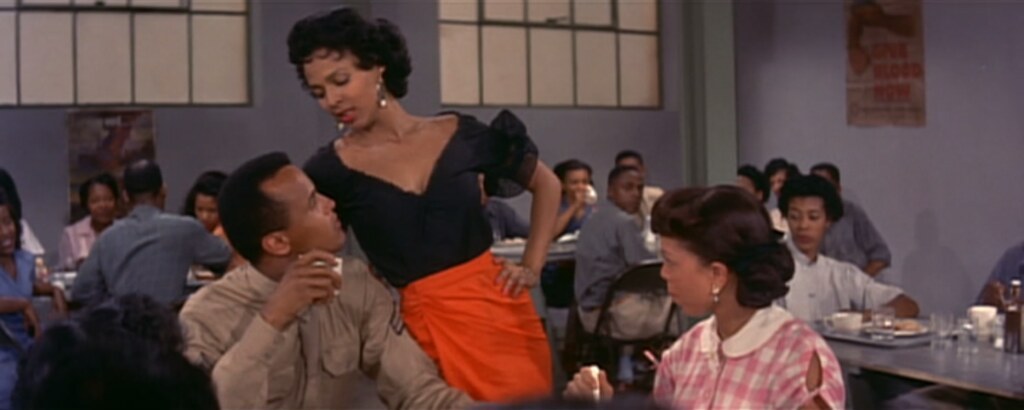
1950-1954: All About Eve; The Asphalt Jungle; The Belle of New York; Bright Road; Carmen Jones; Crime Wave; His Kind of Woman; Hollywood Story; I Love Melvin; The Jackie Robinson Story; Julius Caesar; The Killer That Stalked New York; M; Pagan Love Song; Rancho Notorious; 711 Ocean Drive; Show Boat; The Tattooed Stranger; Texas Carnival; The Turning Point; Two of a Kind; Untouched
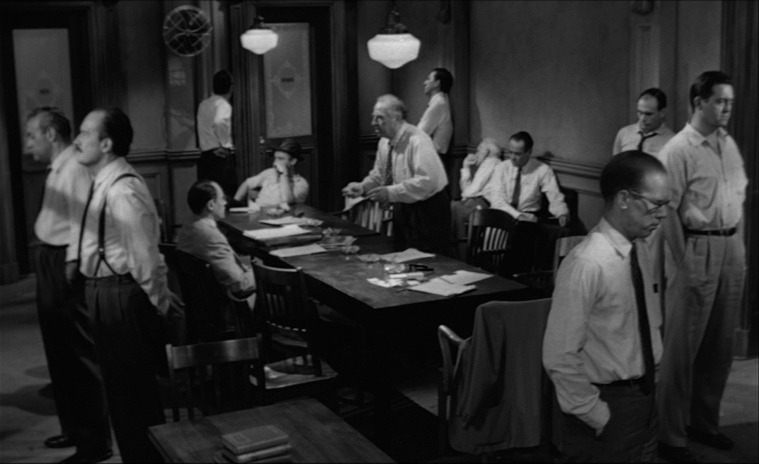
1955-1959: The Black Scorpion; Macabre; The Opposite Sex; Over-Exposed; Pillow Talk; A Summer Place; 12 Angry Men; Up Periscope; Women’s Prison
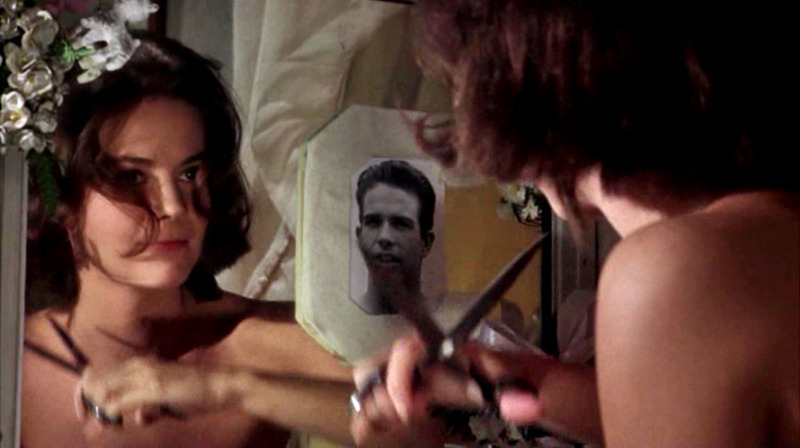
1960-1964: Carnival of Souls; Gypsy; The Honeymoon Machine; Love with the Proper Stranger; Midnight Lace; The Pink Panther; Seven Days in May; Something Wild; Splendor in the Grass; Where the Boys Are

1965-1969: Ebirah, Horror of the Deep (aka Godzilla vs. the Sea Monster); Funeral Parade of Roses; The Gay Deceivers; The Glass Bottom Boat
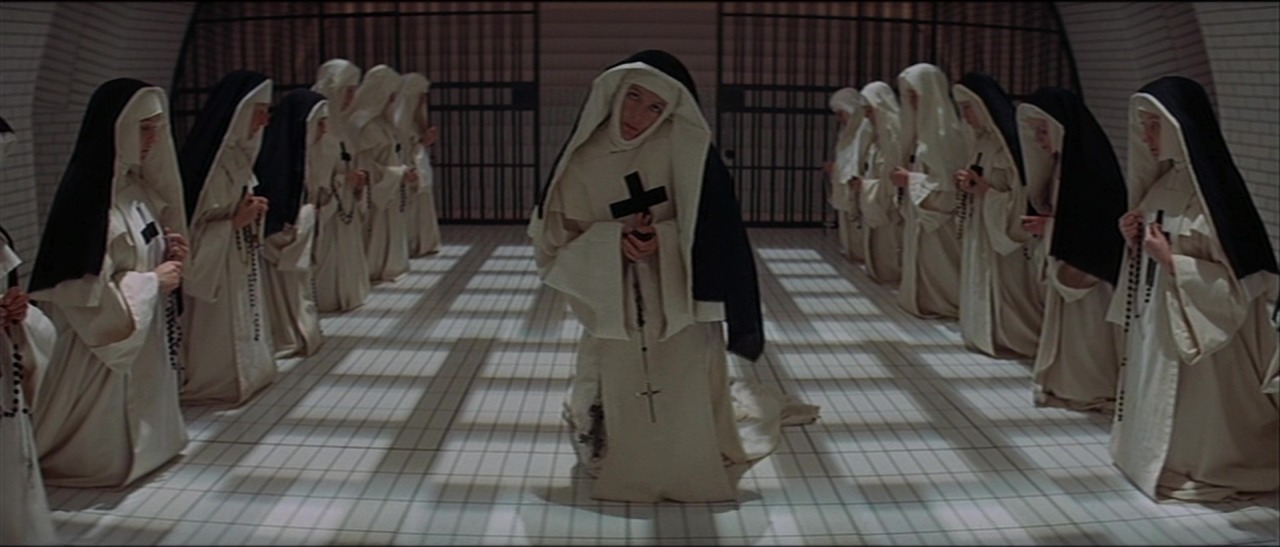
1970-1974: The Devils; Dracula A.D. 1972; Klute
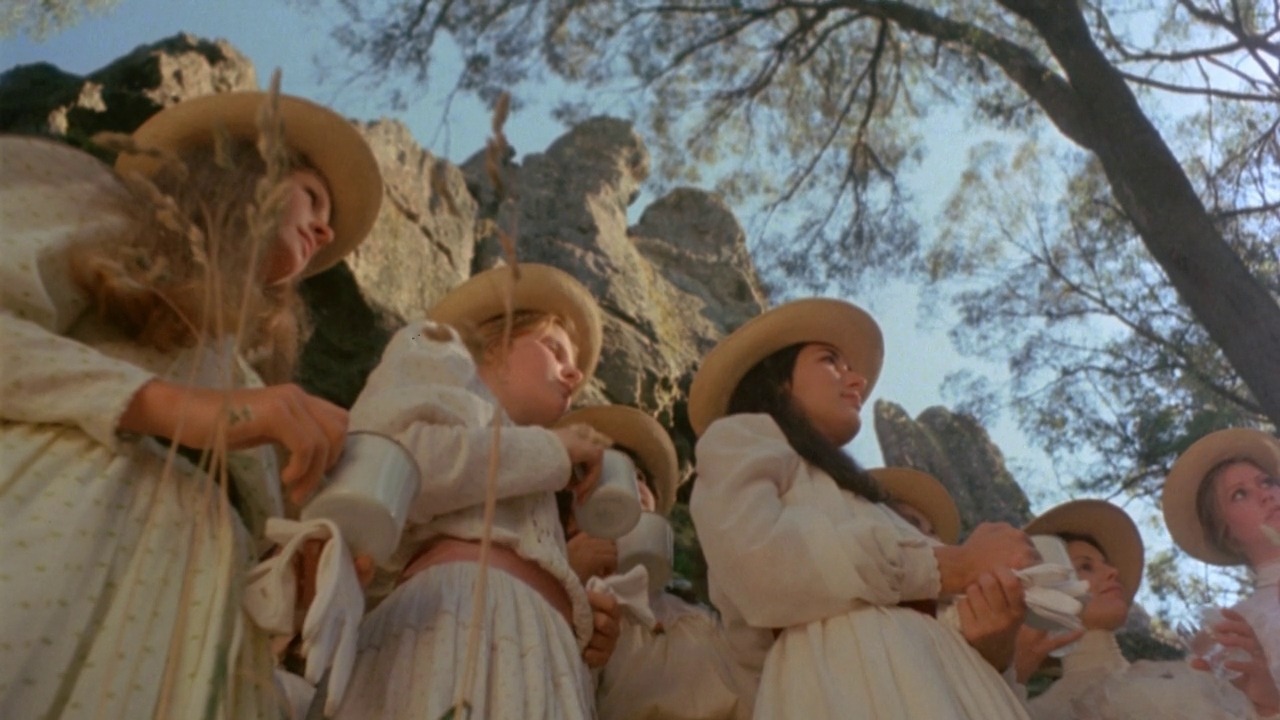
1975-1979: The American Friend; Between the Lines; The Brood; Escape from Alcatraz; The Late Show; Marathon Man; Picnic at Hanging Rock; Shivers
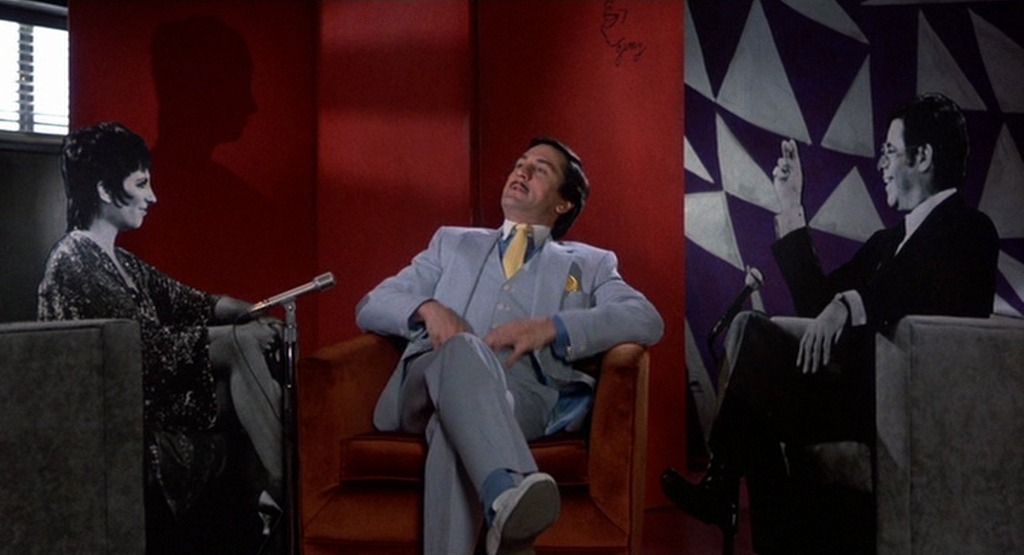
1980-1984: Black Candles; Bloody Birthday; Dark Habits; The Dead Zone; Fear City; Flashdance; Inferno; The King of Comedy; Labyrinth of Passion; Pepi, Luci, Bom; What Have I Done to Deserve This?
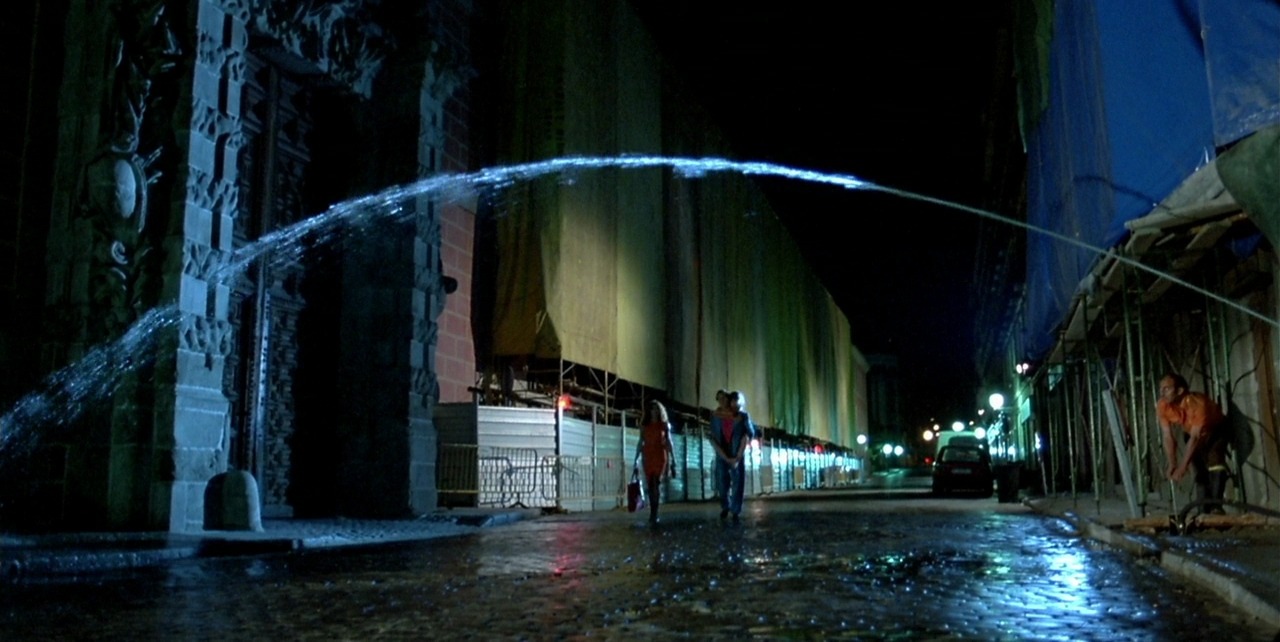
1985-1989: Child’s Play; Cocktail; Hairspray; Law of Desire; Matador; Pumpkinhead; The Running Man; Sorority House Massacre; Steel Magnolias; Witness; Women on the Verge of a Nervous Breakdown
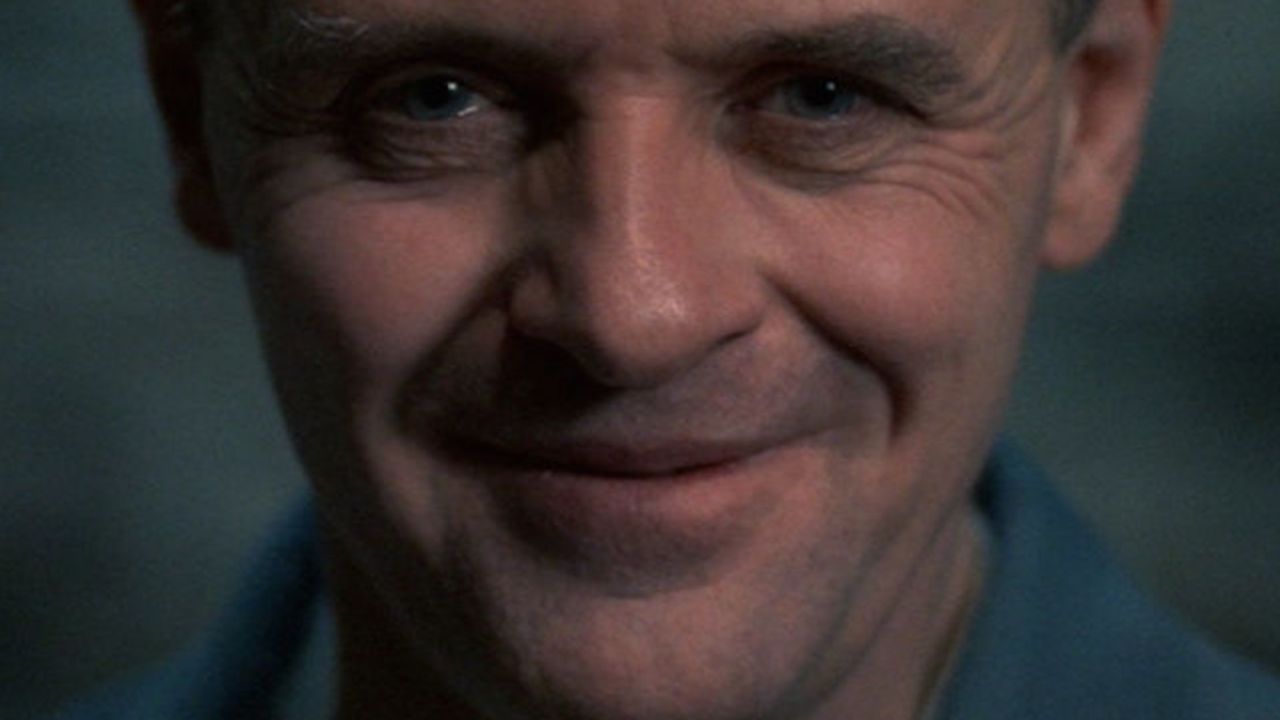
1990-1994: Candyman; The Crow; Days of Thunder; High Heels; Home Alone; In the Line of Fire; Kika; Misery; No Fear, No Die; Philadelphia; The Silence of the Lambs; Tie Me Up! Tie Me Down!
1995-1999: Absolute Power; All About My Mother; Blue in the Face; Boogie Nights; Breakdown; But I’m a Cheerleader; Daylight; Deep Blue Sea; Desperado; The End of the Affair; Fathers’ Day; The Flower of My Secret; Foxfire; Happiness; Live Flesh; The Mask of Zorro; Maximum Risk; Miami Rhapsody; Never Talk to Strangers; Outbreak; Se7en; Smoke; Snake Eyes; The Truth About Cats & Dogs; Welcome to the Dollhouse
2000-2004: About a Boy; Bad Education; Confessions of a Dangerous Mind; The Devil’s Backbone; Mean Girls; Spy Kids; Spy Kids 2: Island of Lost Dreams; Spy Kids 3: Game Over; Talk to Her; The Wedding Planner

2005-2009: The Brave One; Broken Embraces; Doubt; Eastern Promises; Everybody’s Fine; Moon; Music and Lyrics; The Notorious Bettie Page; Poseidon; 35 Shots of Rum; Twilight; Vacancy; Volver
2010-2014: Bachelorette; The Back-up Plan; Better Living Through Chemistry; Gone; Harry Dean Stanton: Partly Fiction; I’m So Excited!; Laggies; Olympus Has Fallen; The Skin I Live In; 2 Days in New York; Water for Elephants
2015-2019: Ad Astra; After; All Is Well; Always Be My Maybe; Ant-Man and the Wasp; Aquaman; Ask Dr. Ruth; Avengers: Endgame; Bombshell; Booksmart; Boy Erased; Breaking In; Can You Ever Forgive Me?; Can You Keep a Secret?; Captain Marvel; Damsel; The Dead Don’t Die; Despite Everything; Disobedience; Eighth Grade; The Farewell; God’s Own Country; The Good Liar; Greta; High Life; Hustlers; I Feel Pretty; Isn’t It Romantic; Joker; Julieta; The King; Knives Out; Let the Sunshine In; Life of the Party; The Lighthouse; The Lost City of Z; Ma; Marriage Story; The Meg; Moonlight; Mr. Right; Murder Mystery; Once Upon a Time… in Hollywood; Pain and Glory; Poms; Richard Jewell; Security; Set It Up; A Simple Favor; Spider-Man: Far from Home; Spider-Man: Into the Spider-Verse; Support the Girls; Transit; Uncut Gems; Untouchable; Us
Films by Women 2019
Watch Four Films Challenge 2019 (I made a challenge for myself to see how many directors I could watch at least four films by this year, anything either never seen before or work I haven’t seen in so long that it feels like the first time)
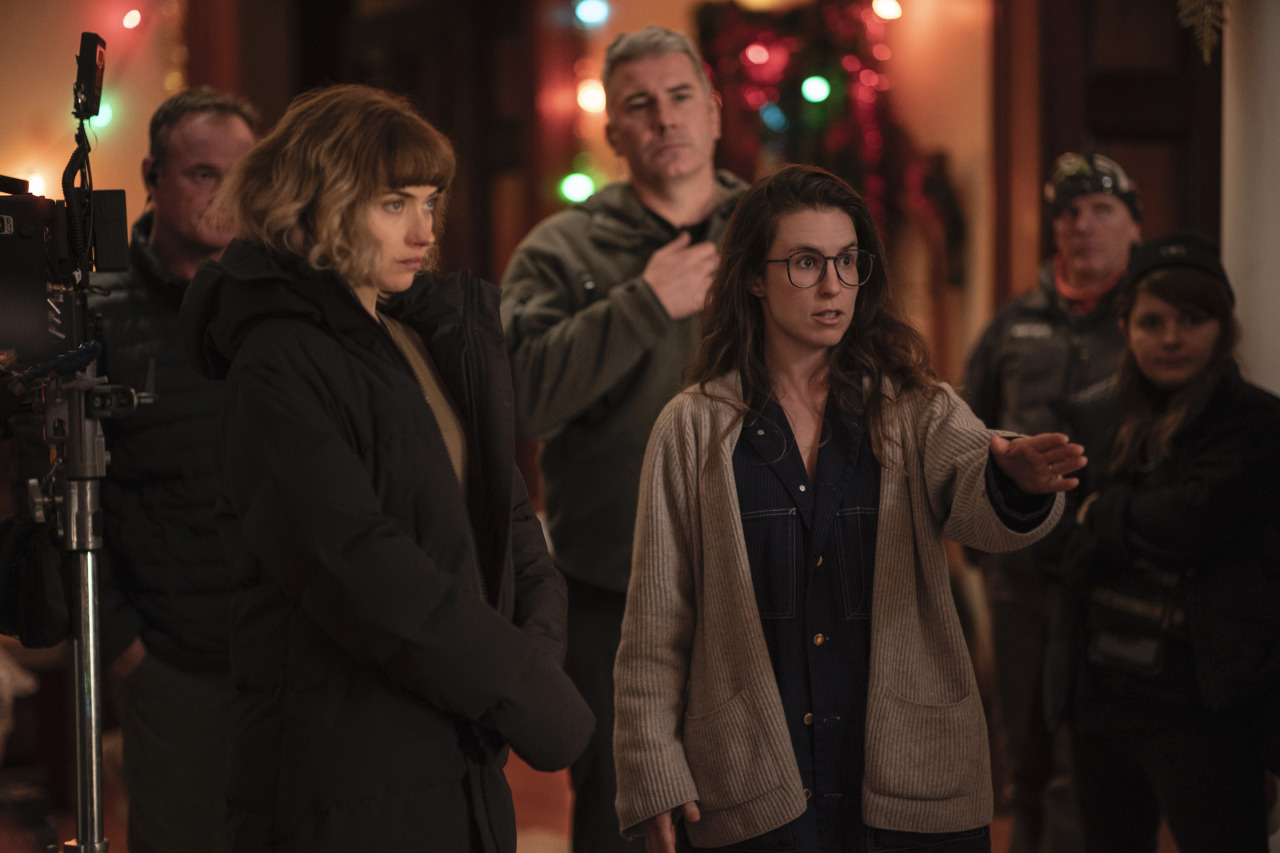
Actress Imogen Poots (l.) and director/screenwriter Sophia Takal (r.) on the set of Black Christmas, 2019. (Photo: Fortune Magazine via Kirsty Griffin/Universal Pictures)
Better late than never! Just as 2019 comes to a close: here are fourteen new movies due to be released in theaters or via other viewing platforms this December, all of which have been directed and/or photographed by women. These titles are sure to intrigue cinephiles and also provoke meaningful discussions on the film world, as well as the world in general.
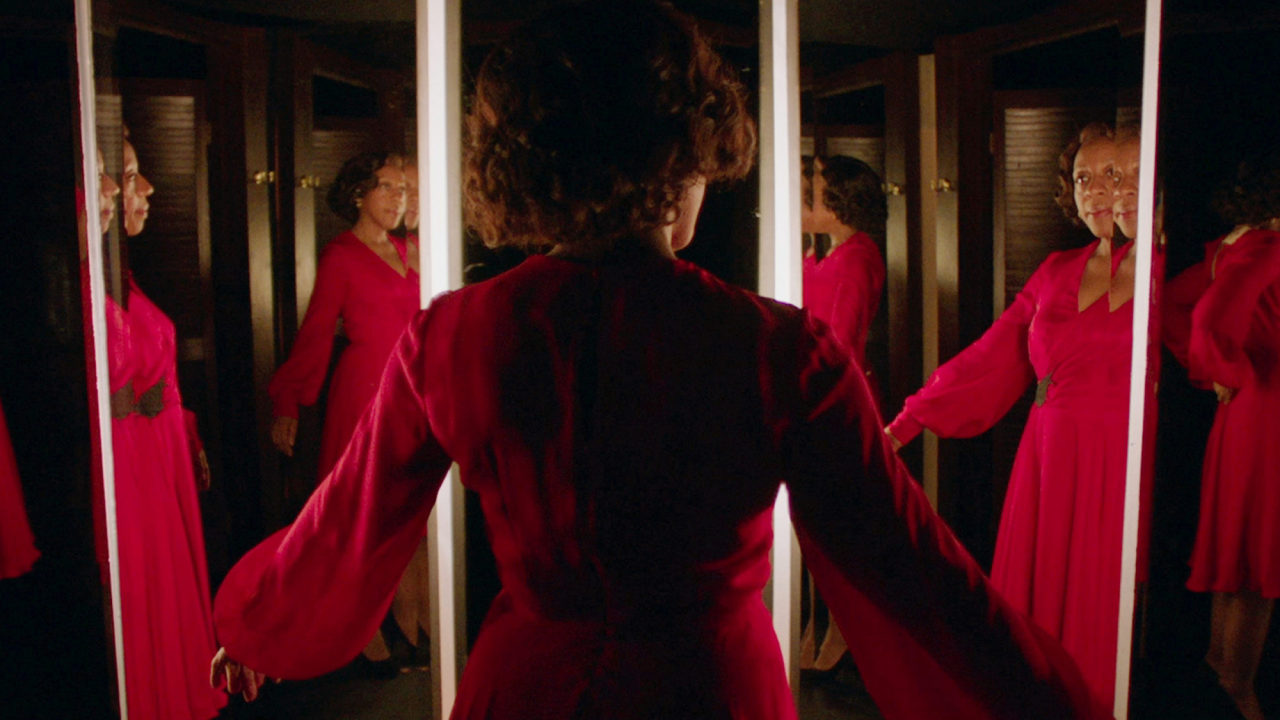
DECEMBER 6 (in theaters), DECEMBER 10 (VOD): In Fabric (dir. Peter Strickland) (DP: Ari Wegner) – Metrograph synopsis: “A lonely woman (Marianne Jean-Baptiste), recently separated from her husband, visits a bewitching London department store in search of a dress that will transform her life. She’s fitted with a perfectly flattering, artery-red gown—which, in time, will come to unleash a malevolent curse and unstoppable evil, threatening everyone who comes into its path. From acclaimed horror director Peter Strickland, the singular auteur behind the sumptuous sadomasochistic romance The Duke of Burgundy and auditory giallo-homage Berberian Sound Studio, comes a truly nightmarish film, at turns frightening, seductive, and darkly humorous. Channeling voyeuristic fantasies of high fashion and bloodshed, In Fabric is Strickland’s most twisted and brilliantly original vision yet.”
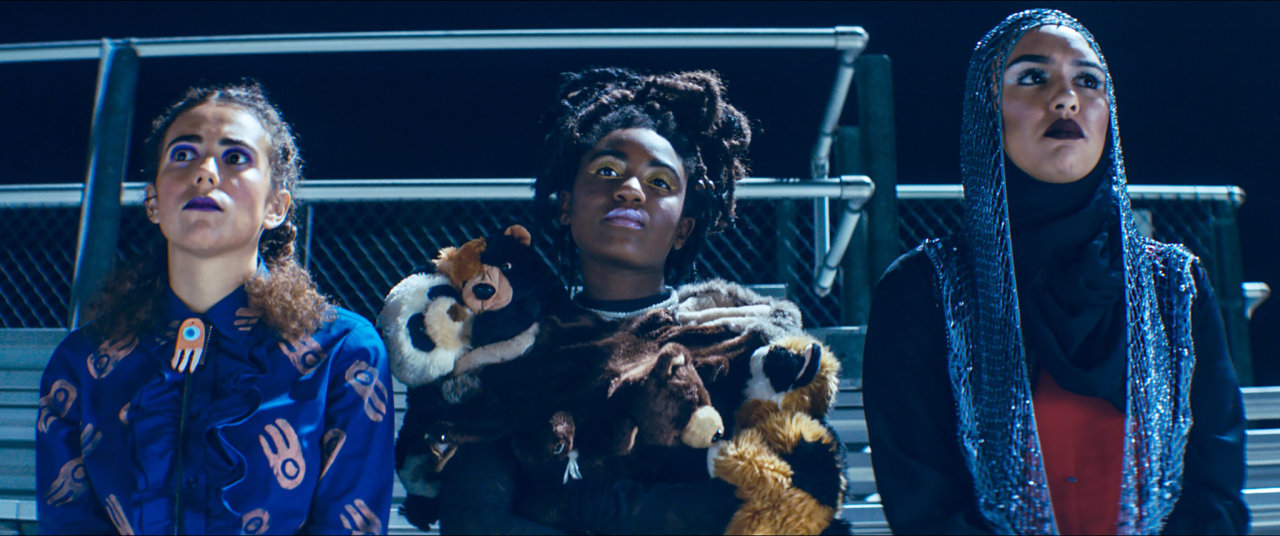
DECEMBER 6 (in theaters & on VOD): Knives and Skin (dir. Jennifer Reeder) – IFC Films synopsis: “Knives and Skin follows the investigation of a young girl’s disappearance in a stylized version of a rural Midwest town that hovers just above reality, led by an inexperienced local sheriff. Unusual coping techniques develop among the traumatized small-town residents with each new secret revealed. The ripple of fear and suspicion destroys some relationships and strengthens others. The backdrop of trauma colors quintessential rituals—classrooms, dances, courtship, football games—in which the teenagers experience an accelerated loss of innocence while their parents are forced to confront adulthood failures. This mystical teen noir presents coming of age as a lifelong process and examines the profound impact of grief.”

DECEMBER 6 (in theaters & on VOD/digital): Little Joe (dir. Jessica Hausner) – Variety’s Cannes Film Festival review by Owen Gleiberman: “Just about every horror movie has an opening stretch — it could be 20 minutes, or even the first 45 — that inches along in a creep-out mode of anticipatory anxiety, building to the moment when the demon, the slasher, the monster, the source of the fear factor is revealed. These days, the film will then usually turn into a ride. But even if it doesn’t, the source of the horror always becomes tangible, visible, alive. It takes audacity, and a special skill, to sustain that early mood of premonitory dread over an entire film. And that’s what happens in Little Joe, an artfully unnerving, austerely hypnotic horror movie about a very sinister plant.
“Behind the opening credits, the camera hovers, at a skewed high angle, over rows and rows of flower seedlings — hundreds of them — arranged with antiseptic precision in some sort of glassed-in white-on-white tech bunker of a laboratory. It’s hard not to notice that the flowers look a bit phallic, and when viewed in closeup, the bulbs, with a bit of red poking out at the top, suggest Venus flytraps just after they’ve had a munch. Years of horror thrillers have geared us to survey a scene like this one and expect, down the road, the eruption of something ghastly: an alien, perhaps, or monster seed pods like the ones in Invasion of the Body Snatchers. Little Joe wants us to be quietly unsettled by those plants. We look at them and wonder: Is this a nursery from hell?
“The answer is yes, sort of. Little Joe, it turns out, is a variation on Invasion of the Body Snatchers. But it’s not the umpteenth remake; we hardly need another one of those. Instead, the Austrian filmmaker Jessica Hausner, directing her first English-language feature (and her fourth film to be shown at Cannes), picks up on the proverbial “Body Snatchers” theme — people turned into sinister conformist replicants of themselves — and updates it to our era in a singular and disturbing way.
“In Little Joe, Hausner works in a shivery and deliberate modernist spook-show style, one that calls up echoes of early David Cronenberg and the Stanley Kubrick of The Shining. She holds us in a refined trance, tantalized with fascination at what’s waiting around the corner. Keeping her camera moving with slow-glide voyeurism, she turns those plants into disquieting creatures even when they’re just sitting there being their innocent selves.
“The high-tech hothouse nursery where much the film is set is part of Planthouse Biotechnologies, a corporate plant-breeding laboratory in England that uses genetic engineering to create profitable new breeds. The seedlings glimpsed in the opening scene are the creation of Alice Woodard (Emily Beecham), a senior plant breeder with the company who has come up with the idea of a flower that gives off a scent so ambrosial it makes people euphoric just to sniff it. The flower she’s invented is pretty, but in a deceptively unspectacular way. It has a brown stem with a slight curve in it that looks like the sort of ‘designer’ lamp you can buy at Target, and the bud opens into a snowball of red tendrils that makes the flower resemble an exotic chrysanthemum. Alice takes one of the plants home, where she lives as a single mom with her son, Joe (Kit Connor), who looks to be about 12. Setting the plant on a table with a light over it, she even names it: She calls the flower — and the entire breed — Little Joe.
“The flower’s scent is indeed divine. People take in one smoky burst of that pollen (it happens when the plant spreads its tendrils), and it transforms their mood. They feel happy. But they also feel different. They no longer feel completely like themselves. They look and sound the same, but on some barely perceptible level they don’t act in quite the same way. They’re a bit placid, a bit neutral, a bit in their own zone. They’re no longer engaged — not really — with the outside world. But it doesn’t matter (at least, to them), because the new way they feel is just as good; in fact, it feels better. They want to keep feeling that way. And thanks to the effect of Little Joe, they do.
“If this all sounds vaguely familiar, that’s because Hausner, working from a script she co-wrote with Géraldine Bajard, has built Little Joe around a daring metaphor. The original Invasion of the Body Snatchers, made in 1956, with ordinary buttoned-down citizens being turned into emotionless ‘pod people,’ has sometimes been interpreted as a comment on the McCarthy era, but it was really a sci-fi allegory of the creeping social conformity of the 1950s. The 1978 version updated that same drone-of-conformity idea to the flaked-out weirdness of the post-counterculture ’70s.
“Little Joe spins it into a startling satirical view of the age of psychopharmacological drugs. The plants in Little Joe are nothing more, or less, than a horror-movie version of antidepressants. And in terms of the film’s drama, what’s sinister isn’t just the change in behavior we note in various characters: first Joe, a sweet kid who turns quietly indifferent to his mother, then Chris (Ben Whishaw), Alice’s devoted assistant on the plant project, who’s got a crush on her but then seems to morph into an office drone.
“No, the really creepy thing is the loyalty they develop to the plant that’s transformed them. Once they’ve been converted to their new state of weirdly numb contentment, they become fiercely protective of their new way of being; no one is allowed to question it. And that’s the scathing allegorical thrust of Little Joe. It presents a landscape of medicated zombies who join in a cult of their own well-being, and who regard their new state as an ideology — not just a way to be but the way to be. Symbolically speaking, they’re addicts who don’t know it, hooked on the sinister interior aroma of mood-modification drugs.
“Hausner gets pinpoint performances out of her actors, and she needs to, since so much of Little Joe pivots around the subtlest of personality shadings. Emily Beecham, who’s like a more vivacious Claire Foy, plays Alice as beaming but increasingly troubled, a scientist who didn’t know she created a monster, and is now desperate to put that genie back in the bottle. Ben Whishaw is super-sly as the benign colleague who becomes a weasel without quite shedding his devotion to Alice. He’s not against her; he just wants her to join. David Wilmot is an arresting chameleon — now raging, now snake-oil smooth — as Alice’s office mate Karl, and Kerry Fox is superb as Bella, the mentally fragile Planthouse veteran who’s the first one to detect a shift in personality (in her dog). As for the film’s musical score, by Teiji Ito and Markus Binder, it’s practically another character: an Asian-flavored cacophony of drip drums, flute quavers, and shrieking tech that goes to work on your system.
“How you react to Little Joe may well hinge on your own beliefs about antidepressants — whether you think they’re an unalloyed force of good, a profit-driven conspiracy by Big Pharma (with the psychiatric establishment as their marketer/enablers), or something in between. But given how little direct criticism of our psychotropic-drug culture you can actually encounter in the media, it may be that a horror movie — albeit a shiveringly delicate and understated art-house one — is the ideal way to present the argument that we’re becoming a society of people too artificially addicted to well-being, regardless of the cost, to see anything outside it.”
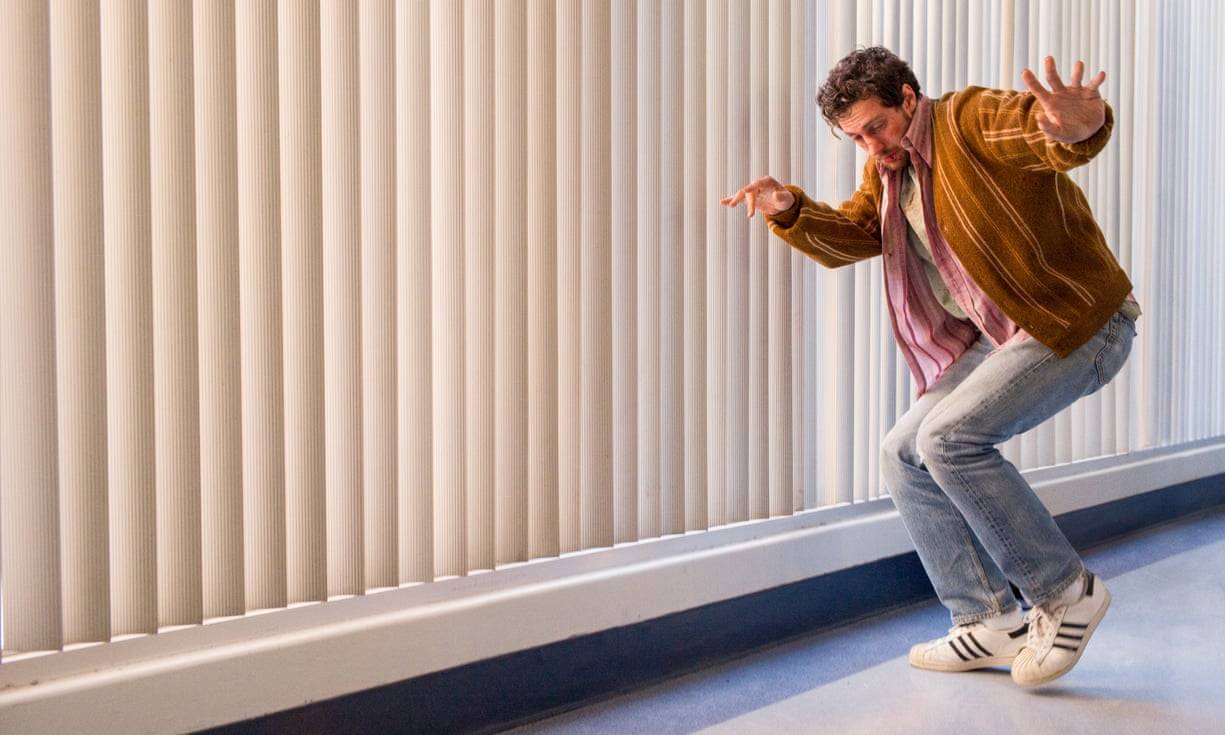
DECEMBER 6: A Million Little Pieces (dir. Sam Taylor-Johnson) – Chicago Sun-Times review by Richard Roeper: “You had to feel for James Frey. In January 2006, the School of the Art Institute grad turned best-selling author took arguably the most brutal verbal beatdown in the history of ‘The Oprah Winfrey Show.’ Granted, Frey brought it upon himself, when it was revealed his mega-successful addiction memoir A Million Little Pieces contained major exaggerations and fabrications. Oprah, who initially had championed the book, was not amused. She called Frey on the carpet in front of a studio audience and millions of viewers. It seemed excessive. It was painful to watch.
“A few years later, Oprah said she owed Frey an apology. By then, Frey had bounced back in a big way, with a seven-figure deal to write novels for Harper Collins. Since then, his career has continued to thrive, most recently with a ‘Story By’ credit for the acclaimed theatrical release Queen & Slim. Now, some 16 years after the publication of A Million Little Pieces, a film adaptation from director/co-writer Sam Taylor-Johnson (Fifty Shades of Grey, no relation) is getting an understated release, and it’s reasonable to assume a good percentage of viewers will have little or no knowledge of the controversial story behind the source material. Not that it should matter. As a stand-alone work of cinema fiction, A Million Little Pieces is an effective blunt instrument of a film — a rough-edged, unvarnished, painfully accurate portrayal of addiction and rehabilitation.
“Aaron Taylor-Johnson (husband of the director) delivers a stunning performance as the self-destructive, hardcore addict James. There’s nothing Hollywood or glamorous about this work; Taylor-Johnson looks like a walking ghost as James wakes up on a plane bound for Minneapolis (he doesn’t even know how he got there), where he is met by his brother Bob (Charlie Hunnam), who takes James straight to a rehab facility. Hunnam delivers steady, powerful work in a small but pivotal role. We all know someone like Bob (perhaps we’re someone like Bob), who is worn out by James’ behavior but refuses to give up on him, because he’s family.
“James is hardly all-in with a 12-step recovery plan; like many an addict, he thinks he’s smarter than everyone else in the room and he’ll figure out his own path to recovery. While in rehab, he meets archetypes such as a stern but caring supervisor (Dash Mihok, best known as Bunchy on ‘Ray Donovan’), a possible love interest in the badly broken Lilly (Odessa Young) and a father figure in a man named Leonard (Billy Bob Thornton). The fine supporting cast, most notably Thornton, rescue these roles from overly cliched status.
“Sam Taylor-Johnson infuses A Million Little Pieces with a frenetic, jarring style capturing the fragmented, jagged, blurred-realities world of the addict, and Aaron Taylor-Johnson delivers a raw, bruising, commanding performance as a man who is either going to find a measure of peace in the day-to-day world of recovery or is going to wind up dead. There’s no third option. But as James Frey has demonstrated, there IS such a thing as a second act in an American life.”
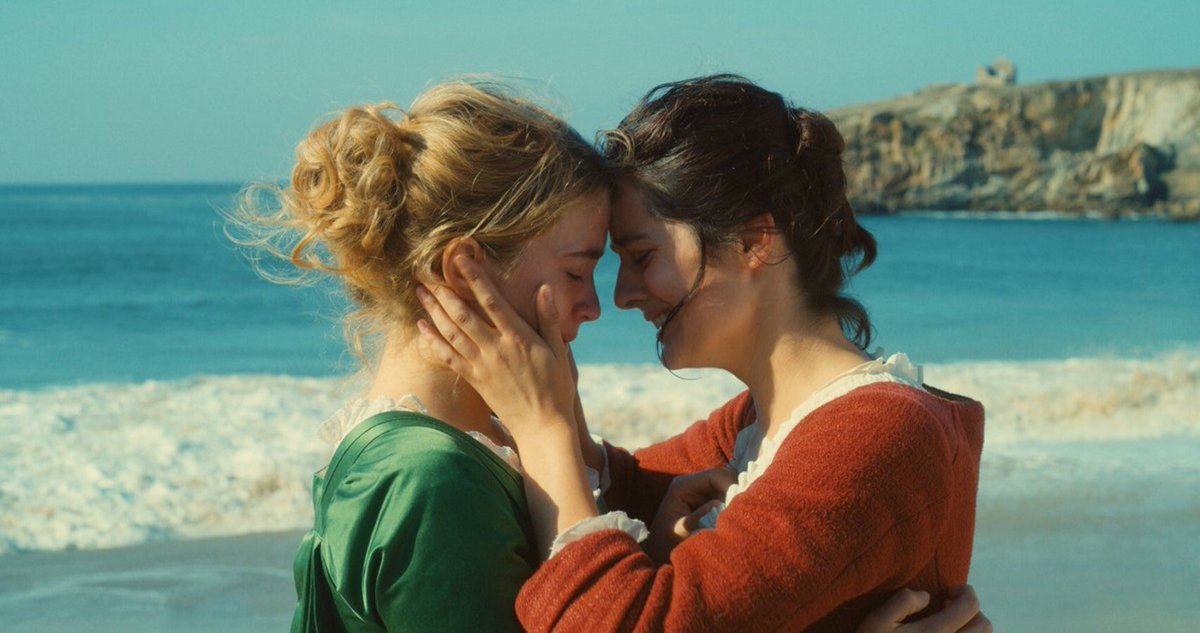
DECEMBER 6 (in select cities); FEBRUARY 14, 2020 (wide release): Portrait of a Lady on Fire (dir. Céline Sciamma) (DP: Claire Mathon) – Slate review by Dana Stevens: “Why, Héloïse wants to know, does the portrait look so little like its subject? ‘There are rules. Conventions. Ideas,’ explains Marianne, unconvincingly. The face in the painting, Marianne’s first attempt at a portrait of Héloïse, is placid, rosy, and conventionally feminine in its inoffensive prettiness; the real Héloïse (Adèle Haenel), though even more beautiful, has an intimidatingly direct gaze and a serious, even somber demeanor. But given the purpose of the portrait—Heloïse’s mother plans to present it as a gift to the Italian nobleman whom Héloïse is to marry, sight unseen—it’s understandable why Marianne (Noémie Merlant) would soften Héloïse’s features and blunt the severity of her expression. In Céline Sciamma’s austere yet sensuous fourth feature Portrait of a Lady on Fire (which opens Friday in New York and Los Angeles before a wide release in February), this frequently altered painting becomes an index of the changing relationship between the two young women: At first distant, proper and ladylike, it slowly turns into something passionate, truthful, and almost unbearably intimate.
“Of course, another reason the portrait might not resemble Héloïse at first is because she never posed for it. Furious at her powerlessness to escape the arranged marriage, she walked out midsitting on the last artist who tried to paint her, leading him to destroy his work. Now her mother (Valeria Golino) tells Héloïse that Marianne has been brought in to be her companion on her daily cliffside walks; Marianne must soak in as much about Héloïse as she can on those walks, squirrel away sketches, and work on the portrait in private. There’s more backstory, but the information needed for the film’s stark setup is simple to grasp: two women, a canvas on an easel, a secret, the sea.
“The year, according to the production notes, is 1770, but no on-screen legend or other temporal marker clues us in to that date other than the women’s corseted floor-length dresses. The location is equally indeterminate: an isolated house on a high cliff by the ocean. (The film was shot on location on the coast of Brittany.) In the early scenes especially, the story seems to take place in a timeless, almost abstract space, like the films Ingmar Bergman shot with only a handful of actors on the Swedish island of Fårö. Though men appear, namelessly and briefly, at the beginning and end, Portrait of a Lady on Fire takes place almost completely in a world made up of women: the two leads, Heloïse’s mother, the young house servant Sophie (Luàna Bajrami), and in one scene a group of village women who sing a haunting a cappella song around a bonfire. But it’s the off-screen men who call all the shots in these women’s lives; those rules, conventions, and ideas that govern Marianne’s painting of an upper-class bride-to-be are the same ones responsible for Héloïse’s desperate sense of entrapment.
“To give away any more than the fact that the two women fall madly in love would be to deprive the viewer of Portrait of a Lady on Fire’s greatest pleasures: the stolen glances on cliffside walks, the conversations that end just as the truth is about to be spoken, the quiet contests of will over the content and meaning of that ever-changing canvas. Again and again Sciamma finds ways to deliver meaning cinematically rather than in words, whether through the placement of faces in the frame or a detail revealed obliquely in a mirror. In addition to being a swoon-worthy romance—a bodice-ripper in which corsets are not torn but slowly, lovingly unlaced—this is a meditation on feminism, art, and feminist art, as embodied by the portrait of the title but also by the embroidery being stitched by Sophie the housemaid—and, late in the film, by an extraordinary artistic collaboration the three young women undertake together. Without ever needing to spell it out, Sciamma makes clear that the weight of patriarchy means that this idyll by the sea may be these young women’s one chance to experience anything like real passion or freedom. That knowledge, on both the audience’s part and the lovers’, lends every moment of their time together—a fragment of music Marianne plays for Héloïse on the harpsichord, a shared reading of Ovid’s Metamorphoses—a kind of desperate poignancy.
“Adèle Haenel, the fierce-eyed, dark-browed beauty who plays Héloïse, may be familiar to audiences from her roles as an uncompromising AIDS activist in the 2017 French drama BPM or a young Belgian doctor in the Dardenne brothers’ The Unknown Girl. She’s also Sciamma’s romantic partner in real life and has already played the object of desire in the director’s debut film, Water Lilies. That real-life connection, whether you go in knowing about it or not, adds another layer to what’s on screen: the story of one woman attempting to render her love for another, not only with a paintbrush but with a camera. As Marianne, Noémie Merlant is also extraordinary: As she stands at the easel her huge dark eyes take in every detail of her beloved’s face, and though she didn’t do the painting herself (the portraits in the film are by the artist Hélène Delmaire), you completely believe she could have.
“Portrait of a Lady on Fire is that rare movie in which every choice feels thought through, meaningful, and right, from the costumes by Dorothée Guiraud to the cinematography by Claire Mathon. (When it comes to collaborating on feminist art, Sciamma walks the walk.) When the musical passage Marianne plays for Héloïse early in the film—the ‘Summer’ section of Vivaldi’s Four Seasons—returns at the end in its full orchestral glory, there’s a sense of inevitable, if tragic, completeness. Just like the short time the lovers have together, Portrait of a Lady on Fire is minimal but perfect, without an image, a glance, or a brushstroke to spare.”
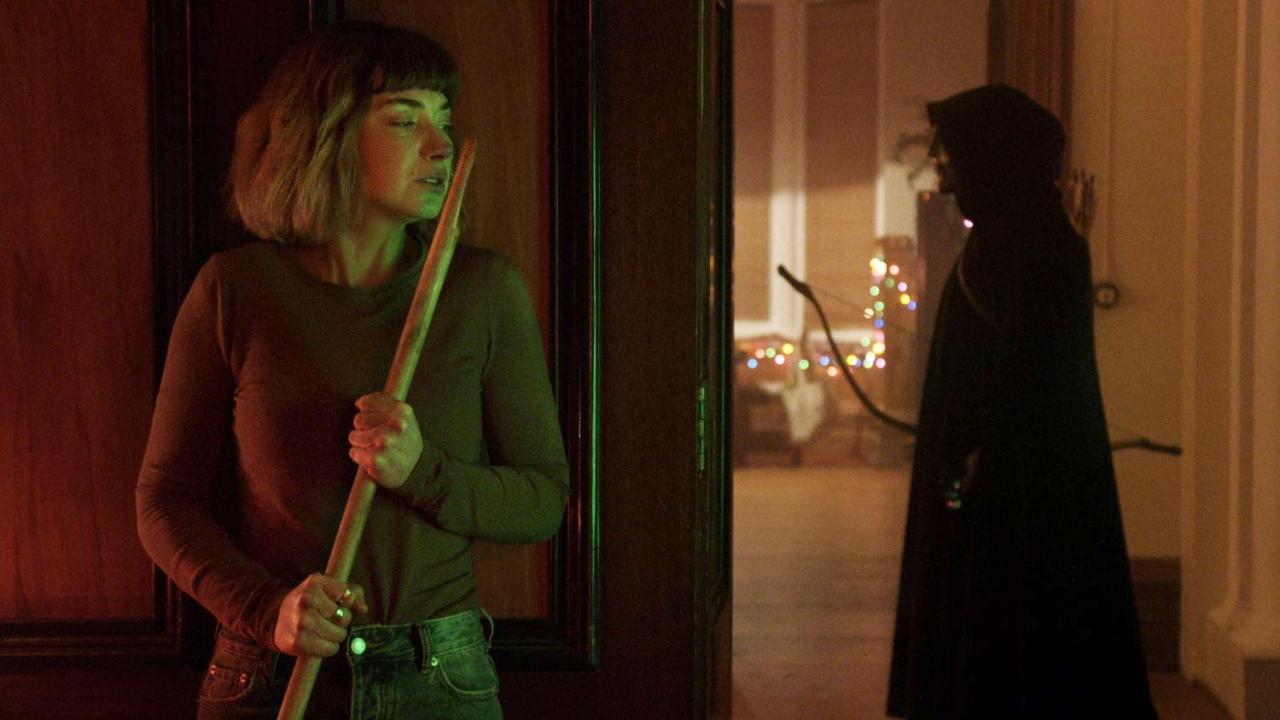
DECEMBER 13: Black Christmas (dir. Sophia Takal) – Los Angeles Times review by Kimber Myers: “The biggest gross-out moment in Black Christmas isn’t the gory death of a sorority girl at the gloved hands of a masked killer. Instead, it’s the scene where a cop globs mayonnaise onto white bread. This PG-13 remake of Bob Clark’s 1974 slasher classic follows in the feminist footsteps of its predecessor, while still subverting audience expectations at each opportunity. Fans of the original — and those who like their horror movies deadly serious and brimming with blood — might not love writer-director Sophia Takal’s take, but Black Christmas is a fun film that gets its kicks out of literally smashing the patriarchy.
“Structural misogyny is alive and well on the Hawthorne College campus, whether in the form of white-male-author-loving professor Gelson (Cary Elwes) or the fraternities like Delta Kappa Omega where sexual assault is brushed under the beer-stained rugs. But Riley (Imogen Poots) and her sorority sisters at Mu Kappa Epsilon are fighting back, and their efforts have made them targets of a killer who is stalking the quad as campus quiets for the holidays. Sorority girls — ahem, women — begin disappearing, while Riley is getting creepy DMs from someone claiming to be Hawthorne’s long-dead founder who seems to have chosen her as his next victim.
“While Takal’s previous work — her stunning debut Always Shine and the solid ‘New Year, New You’ episode of Hulu’s ‘Into the Dark’ — focused on the pain women inflict on one another as a result of society’s pressures, Black Christmas is more concerned with men as its villains. Clark’s film wore its second-wave feminism on its ’70s-era blouse sleeves, so it shouldn’t be surprising that Takal’s Black Christmas is a women’s horror film for a new generation, full of cheeky pro-female T-shirts and casual talk about menstrual cups.
“But this version doesn’t just update the disturbing phone calls of the original for menacing DMs; it gives the sorority sisters the agency to fight back in ways Clark’s movie didn’t. The script from Takal and April Wolfe isn’t subtle in its message about the dangers of toxic masculinity and rape culture versus the power of female solidarity, but it also has fun with its feminist themes in ways that will have like-minded viewers cheering and the less-enlightened shaking their fists. While the commentary is pointed, their screenplay is often blunt, hammering home the film’s larger ideas. Beyond Riley, the sorority sisters feel largely interchangeable, and more characterization could have helped invest the audience more deeply in their safety and survival.
“The PG-13 rating for Black Christmas might seem like a ploy for a larger, younger audience, but the lack of explicit violence feels more like a deliberate choice for Takal. The genre often glories in the gory deaths of women, but Black Christmas cuts away from the kill shot.
“This doesn’t always work — sacrificing visual coherence and sometimes leaving the audience wondering exactly what just happened — but it subverts the usual visual pleasures and terrors of horror films in a manner aligned with its larger themes. This remains a horror film, but it’s a sometimes enjoyably goofy one that prefers to make its audience laugh than to make them scream.”
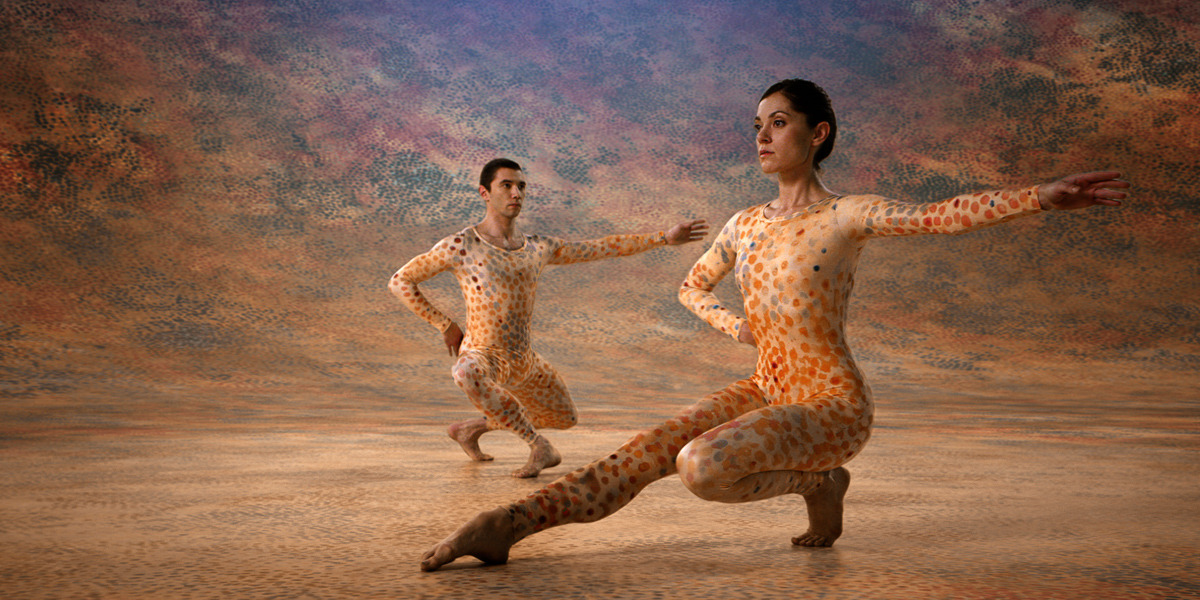
DECEMBER 13: Cunningham (dir. Alla Kovgan) – Film at Lincoln Center synopsis: “One of the most visionary choreographers of the 20th century, Merce Cunningham could also be counted among its great modern artists, part of a coterie of important experimenters across media that included Robert Rauschenberg, Brian Eno, Jasper Johns, and his long-term romantic partner John Cage. This painstakingly constructed new documentary both charts his artistic evolution over the course of three decades and immerses the viewer in the precise rhythms and dynamic movements of his choreography through a 3D process that allows us to step inside the dance. Director Alla Kovgan has created a visceral experience that both reimagines and pays tribute to Cunningham’s groundbreaking technique.”
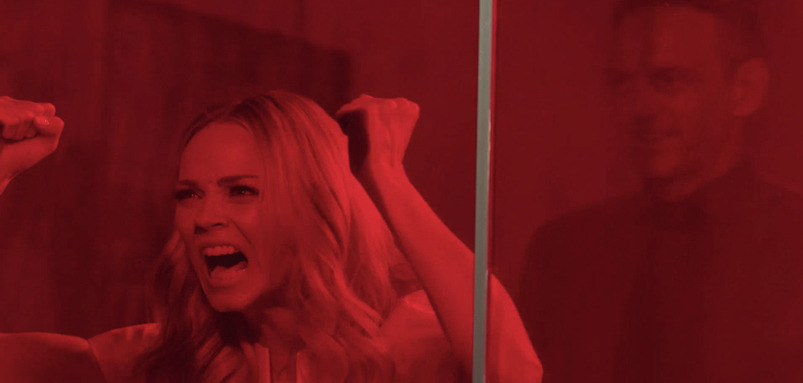
DECEMBER 13 (in theaters & on digital/VOD): Rabid (dirs. Jen Soska and Sylvia Soska) (DP: Kim Derko) – Eye for Film’s FrightFest review by Jennie Kermode: “Remaking an iconic film is always a difficult proposition. Whatever you do, someone’s going to be unhappy, and even if it’s widely agreed that you’ve done a good job, you’ll only get limited credit for your work. For this reason, some filmmakers refuse to have anything to do with it – but where there is a fresh artistic angle to explore, the stakes change. The Soska sisters’ Rabid is less a remake and more of a reconstruction of the story in David Cronenberg’s original Rabid, approaching it with different priorities.
“Groundbreaking as it was, Cronenberg’s film had a plot that mirrored this, the traffic accident that precipitates the action (and foreshadows one of the director’s own experiments with somebody else’s material, Crash) coming out of nowhere. Here, we get the sense that Rose has been crashing all her life. Played this time around by Laura Vandervoort, she’s no longer a model but a fashion designer, an early hint that she will have more agency – but just as the Soska sisters acknowledge the advances that women have made, they introduce us to her as a bruised and uncertain young woman in a mercenary industry where ego is essential to survival. Because we get to know her before the crash, we understand it as something with more than superficial consequences. Rose’s facial disfigurement doesn’t just rob her of her beauty, it fractures her sense of identity.
“The solution to this is a trip to a private clinic working with experimental skin grafts. Rose isn’t rich – that myth about the fashion industry is knocked firmly on the head – but she is assured that, because she is such a perfect subject, all the costs will be met for in return for her ongoing availability for follow-up study. When after the procedure, her doctor takes her aside for a word about side effects, some viewers will experience flashbacks to Meryl Streep in Death Becomes Her: “Now a warning?!” But this film is nothing if not self-aware. It’s peppered with references to Cronenberg’s own work and much more besides. Indeed, it opens with a conversation about the dubious value of originality in art. Self-consciousness is an important aspect of the subject under dissection. Like Gene Tierney’s Laura or Clint Eastwood’s Man With No Name, Rose has the qualities of an archetypal, folkloric figure, enduring the same events over and over again in different places, in different forms.
“Whilst there is nothing here that awes quite like Cronenberg’s metro panic scene, with what we see of events playing out on a smaller scale to suit a still-tight budget and tighter on-set health and safety regulations, the new Rabid still delivers its share of shocks, this time in an atmosphere charged by reflections on the #MeToo movement and the way that violence functions as an everyday factor in many women’s lives. It’s lit in a style that plays with the clichés of fashion studio shoots, the huge empty apartment in which Rose stays with her foster sister Chelsea (Hanneke Talbot) taking on the qualities of a stage. Like the slick medical packaging around the ‘protein blend’ that our heroine is given to quench strange appetites, it has a distancing effect. In fashion, says Rose, you can be anything you want to be, but in accepting a new version of her old face she puts herself in a position where other identities are grafted onto her. Making one small concession after another, she gradually cedes her humanity, the physical changes that follow coming to seem entirely logical.
“Lingering on the sidelines, Chelsea is a witness unable to change events, with all the emotional baggage that brings. Moving closer as the narrative evolves is fashion photographer Brad (Benjamin Hollingsworth), whose persistent interest in Rose disquiets her despite her initial attraction to him, as if concession to that would inevitably entail a loss of power. Meanwhile, the shapes and coded guises of the fashion world move in and out of focus, abstraction passing comment on itself. Though some viewers seems to have missed it entirely, there’s a lot of humour here. It’s necessary for the film to retain its balance and remain engaging.
“It’s existential horror that really makes Rabid work and if this version has one major flaw it’s that it focuses too much on the physical towards the end, with aspects of the final sequence resembling certain video games and consequently losing their impact. For the most part, however, this is an impressive film, building on the original but speaking for itself. At a time when social norms are undergoing rapid shifts, it nevertheless succeeds in establishing a sense of otherness, in finding the edge.”

DECEMBER 13: Seberg (dir. Benedict Andrews) (DP: Rachel Morrison) – Time Magazine’s Venice Film Festival review by Stephanie Zacharek: “Once you’ve seen Jean Seberg’s face, a marvel of secrecy and revelation akin to the shifting tones of leaves in afternoon light, you never forget it. Seberg is probably best known as the co-star of Jean-Luc Godard’s 1960 Breathless, a film that helped introduce the then-newborn French New Wave to the world. She plays the femme fatale Patricia Franchini, an American in Paris aspiring to be a journalist. Her handsome petty-criminal boyfriend, played by Jean-Paul Belmondo, murders a policeman and retreats to Patricia’s apartment to hide, but in the end, rather than protecting him, she brings about his downfall. As Patricia, Seberg’s face is a charming but not fully readable mask of youthful self-assurance and ambition, half sweet, half cool, and framed by a sunray-colored pixie cut. She’s a gamine with a scheme, loyal to herself above all others.
“Kristen Stewart, her features so unmistakable and definitive, is all wrong to play Seberg—but only until you’ve watched her for, say, 10 minutes, or maybe 15, after which she and the mysterious, beguiling, ill-fated actress appear to meld into one bold, shimmering presence. This Stewart-Seberg human hologram is the center of British stage director Benedict Andrews’ Seberg, playing here in Venice out of competition. Seberg isn’t strictly a biopic; it’s a blunt portrait of a woman, a political activist as well as a movie star, whose life was kicked into a downward spiral by a devious government organization. The picture is potent and engaging; even its fictionalized elements ring with the spirit of truth. And Stewart is off the charts, though that’s hardly a surprise. She’s among the greatest actresses of our day, though to call her ‘great’ does a disservice to her subtlety—maybe it’s better to call her the master of the small gesture. The flicker of her eyelids is a dialect unto itself.
“Seberg focuses on one period in the actress’ life, the late 1960s and early 1970s, during which she was the subject—and the victim—of an investigation launched by the FBI’s COINTELPRO program under the guidance of J. Edgar Hoover. Seberg, who was born in Iowa but made her name chiefly in European films, was by all accounts a thoughtful actor and human being, but her life wasn’t a happy one, and Andrews’ film offers some highly believable explanations for that. She attracted the FBI’s attention because she’d given money to several Civil Rights groups in the 1960s, as well as to the Black Panther Party. She was also involved in a brief extramarital affair with activist Hakim Abdullah Jamal (played here, with perfectly modulated expressiveness, by Anthony Mackie).
“Beginning in the late 1960s, after Seberg had come to Hollywood to make a film (the 1969 musical Paint Your Wagon), the FBI harassed, intimidated and spied on her, prying into her personal life and spreading damaging rumors. In Seberg, the two FBI agents assigned to the case are played by Vince Vaughn and Jack O’Connell: It’s O’Connell’s character, Jack Solomon, who comes to feel sympathy for the duo’s target, seeing that she’s being needlessly crushed in the gears of Hoover’s plan to eradicate black activist groups. O’Connell brings some deeply human shading to his characterization of this by-the-book government guy. In one of the movie’s finest scenes—presumably a fantasy, a small, glittering thread of wishful thinking—Solomon approaches Seberg in a Parisian bar, circa the early 1970s, presenting her with her FBI file. She looks at it with anger, with curiosity—and then she passes it back to him. This is the movie’s way of granting Seberg some of the dignity she was denied in real life. In the movie, if not in life, she knows the extent of what was done to her; she couldn’t have known the scope of it as she was living through it, and suffering.
“In 1970, when the bureau learned that Seberg was four months pregnant, they spread rumors that a leader of the Black Panther party had fathered the child. (In the film, Jamal is cited as the alleged father.) The rumors damaged not only Seberg’s professional reputation, but her personal life. She attempted suicide several times, and in 1979 was found dead in her car, not far from her Paris apartment. Her death was ruled a probable suicide. Her ex-husband, the writer Romain Gary, blamed the FBI for her death, claiming that the agency’s investigations caused permanent and escalating emotional damage.
“Seberg doesn’t depict that end—the circumstances of the actress’ death are noted on a title card at the film’s close. That’s important, because Stewart plays Seberg as a woman full of life—she’s keeping Jean alive for us for the moments we’re able to watch her on-screen, and that time is precious. Stewart isn’t an impersonator or a mimic, which is why, in the early moments of Seberg, I found her a little wrong. Even with her perfectly bleached hair, and even though she’d perfected that elusive Sebergian half-pout, I looked at her and could see only Stewart, bold and brave in her stammering way. A little later, I saw how wrong I was. As an actor, Stewart is a vessel, not the driver of a vehicle. She didn’t ‘learn’ Seberg; she opened herself up to this sad, lost woman, allowing her to rush in, to fill every channel and vein. Stewart hears the language of ghosts, and she translates it for us. The words are all there, finding their way out through the light in her eyes.”
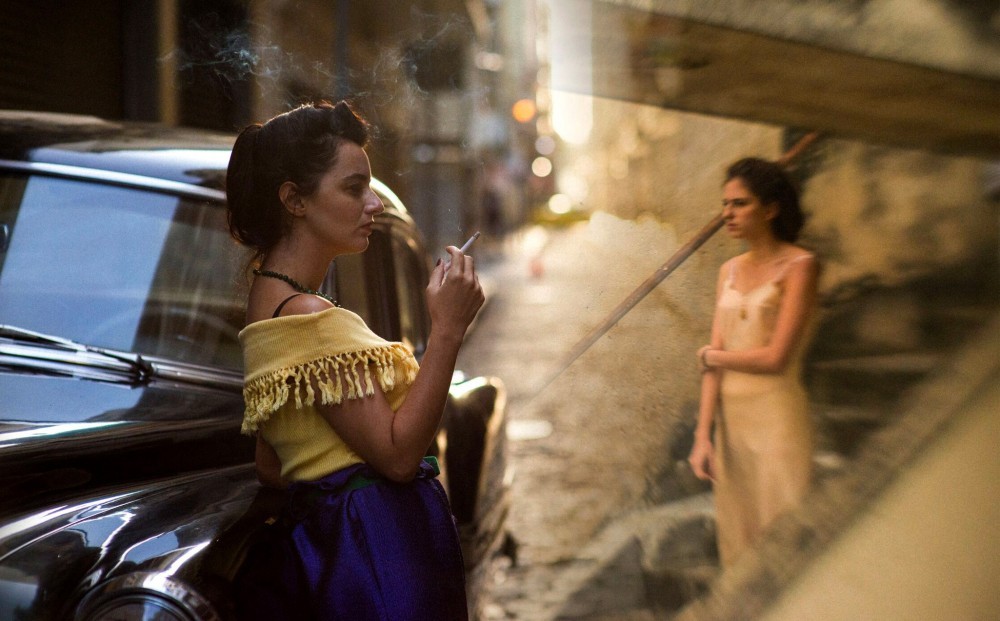
DECEMBER 20: Invisible Life (dir. Karim Aïnouz) (DP: Hélène Louvart) – Film Forum synopsis: “Acclaimed Brazilian filmmaker Karim Aïnouz brilliantly recreates 1950s Rio de Janeiro in this tropical melodrama of two inseparable sisters: Eurídice (Carol Duarte), 18, and Guida (Julia Stockler), 20. They live restricted lives with their conservative parents. However, each nourishes a passionate dream: Eurídice of becoming a renowned pianist; Guida of finding true love. In a shocking turn of events, they are separated and forced to live apart. Karim Aïnouz’s first film, Madame Satã, a Jean Genet-inspired story of 1930’s Rio’s drag demi-monde, premiered at Film Forum in 2003. Invisible Life shares with it this director’s commitment to immersing himself in the emotional lives of his characters, visualized through rich, inventive, and lush imagery. Based on Martha Batalha’s popular novel The Invisible Life of Eurídice Gusmão, the film is Brazil’s official submission to the 2020 Academy Awards® for Best International Film.”
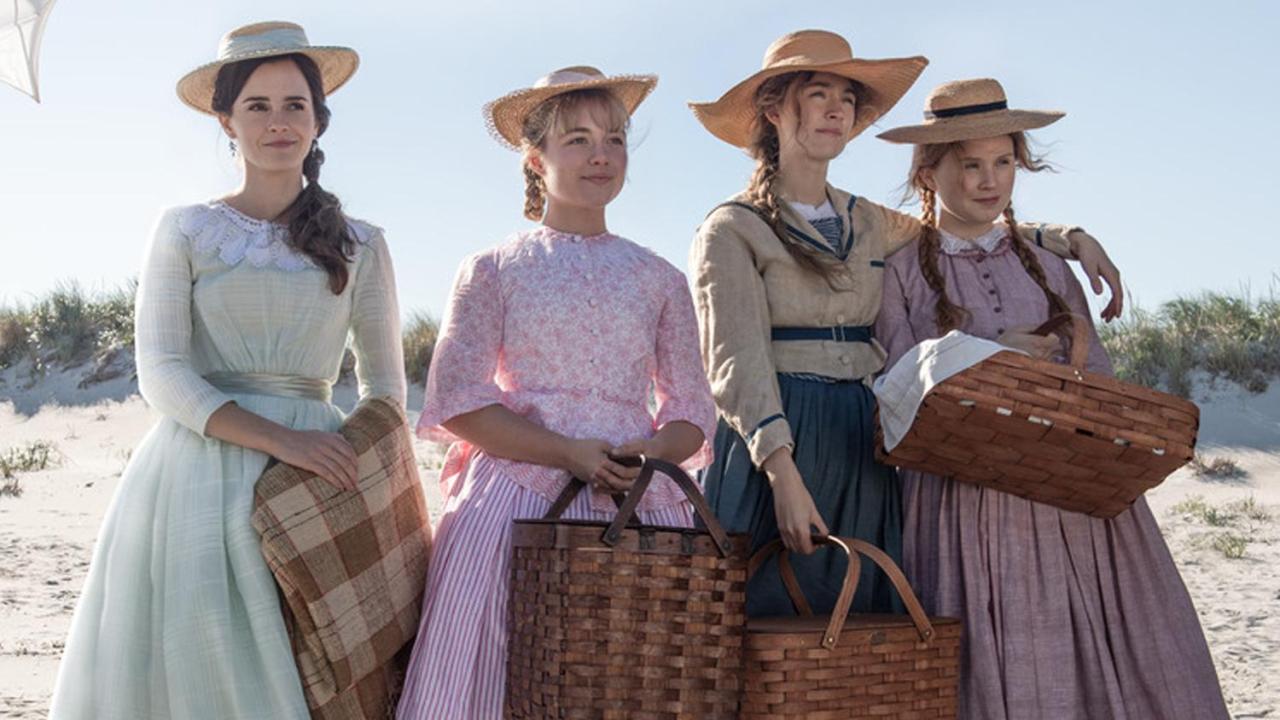
DECEMBER 25: Little Women (dir. Greta Gerwig) – Polygon review by Karen Han: “In Greta Gerwig’s new film adaptation of Little Women, as the strong-willed Jo March (Saoirse Ronan) embarks on her writing career, her publisher (Tracy Letts) gives her some advice. If her main character is a woman, the story should end with her married or dead. The character must fall into a specific definition of womanhood, made more palatable for public consumption. Though Jo is living in the 1860s, similar rules still exist for female characters in popular culture today — hence the paper-thin female-led reboots of originally male-led movies, and facile ideas of what makes a female character strong. What makes Little Women particularly refreshing is that Gerwig treats the four March sisters as equals, rather than as right or wrong for wanting different things.
“Eldest sibling Meg (Emma Watson) is the domestic; among her sisters, she’s the best at taking care of the household. Unlike Jo, she wants to get married and have a family of her own. Jo is the most free-spirited sister, tomboyish and determined to have as much agency over her life as any man would have over his. Beth (Eliza Scanlen) is the shy one whose passion lies in music, rather than in an attempt to fly the coop like her sisters. Youngest sister Amy (Florence Pugh) is arguably Jo’s opposite, embracing stereotypically feminine ideas of beauty and propriety. She’s haughty where Jo is hot-tempered.
“The film, based on Louisa May Alcott’s 1868 novel, skips back and forth through time rather than unfolding chronologically. The sisters’ adolescence and young adulthood are shown in parallel, with Gerwig and editor Nick Houy making the transition between the two easily distinguishable by subtle shifts in color palette (the past generally uses warmer colors) as well as through characters’ hairstyles. As children, they’re bonded partially by necessity. They’re helping their mother (Laura Dern) make ends meet as their father (Bob Odenkirk) serves as a pastor in the Civil War. As young women, they’ve scattered, and they’re reckoning with where their desires in life have brought them, and with the expectations placed on women at the time.
“Gerwig gives each sister her fair shake. As the siblings grow into and through their teenage years, their disparate personalities and desires bring them into conflict, but Gerwig never allows any one March sister to come across as a villain. Their relationships with each other (and their lives in general) aren’t so black and white, and none of them are treated as foolish or lesser for what they want, even though they all want very different things. Even heartthrob Laurie (Timothée Chalamet), a force of chaos who captures both Jo’s and Amy’s attention, can’t tip the scales too far.
“That nuance is clearest in the dynamic between Jo and Amy, who lash out at each other, accusing each other of wrong or shallow choices. But Gerwig casts no such judgment on either of them. They’re both making the best of the patriarchal society they live in, with Amy understanding that she’ll marry for financial stability rather than love, and that her talent for art isn’t enough to grant her independence as a woman. And Jo submits to her publisher’s revisions to her short stories and novels because she knows there’s no other way they will get published, and earning money to help support her family is more important than her artistic integrity.
“Though most of Gerwig’s attention is on Jo, the evenhandedness with which she treats the whole family makes Little Women less a story about pursuing your dreams at any cost, and more about the value of kindness. One of the most affecting parts of the film is the burgeoning friendship between Beth and Mr. Laurence (Chris Cooper), an older gentleman who lives nearby. There’s little dialogue between them — they communicate largely through gestures. Beth is grateful for being able to come play the piano in his home, while he appreciates the simple comfort of her music. At the beginning of the film, it’s assumed that he’s a grouch and a recluse, but Beth’s kindness toward him reveals kindness in return.
“That may seem like a saccharine message, but Gerwig keeps the story in motion to the point where it’s difficult not to simply be swept up. The camera moves along with Jo as she rushes from one thought to the next, not only conveying a sense of her character, but a feeling of movement, growth, and freedom. The rush of youthful energy makes the film all the more affecting when it slows down, painting a comprehensive picture of the ups and downs of life rather than settling for something rose-colored.
“All their lives have meaning and importance, even if conventional pop culture wisdom or society might say otherwise. Meg isn’t lesser for wanting to get married, nor is Amy for being more stereotypically feminine, nor is Jo for being more stereotypically masculine in dress and behavior. As in Lady Bird, Gerwig allows her characters to be unconventional and selfish — that is, everything the stereotypical heroine isn’t supposed to be. It feels empowering to see four distinct women who all fall into different molds being treated respectfully, as though their decisions and personalities are all valid.
“Apart from one scene that feels like a belated, unnecessary recognition of the lack of racial diversity in the cast, the film doesn’t strike a single false note. It carries viewers through the lives of four very different women without picking any one to be the ‘right’ way of doing things. The cast is uniformly wonderful as well, with Pugh in particular perfectly embodying the way fits of youthful pique can get the better of us when we are denied the things we want. That degree of earnestness — and love for both the joyful and bittersweet parts of life — makes Little Women a pure joy.”
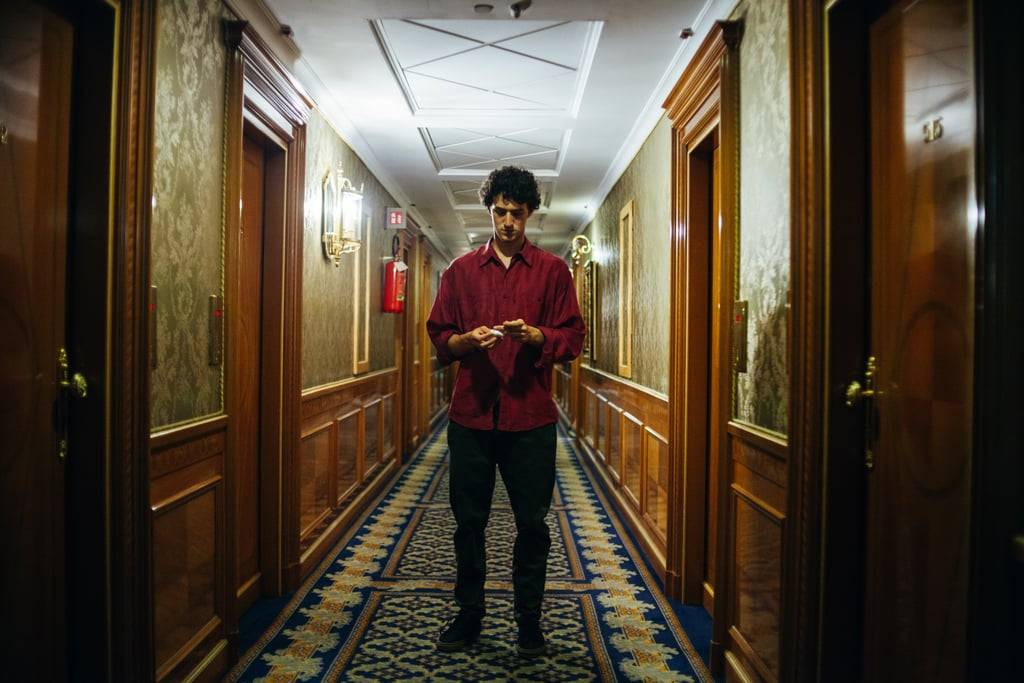
DECEMBER 26 (streaming on Netflix): The App (dir. Elisa Fuksas) – PopSugar synopsis: “In this ‘Black Mirror’-esque thriller, an actor and industrial heir heads to Rome to shoot his very first movie, but while he’s there, he starts using a dating app, and that habit gradually develops into a self-destructive obsession.”
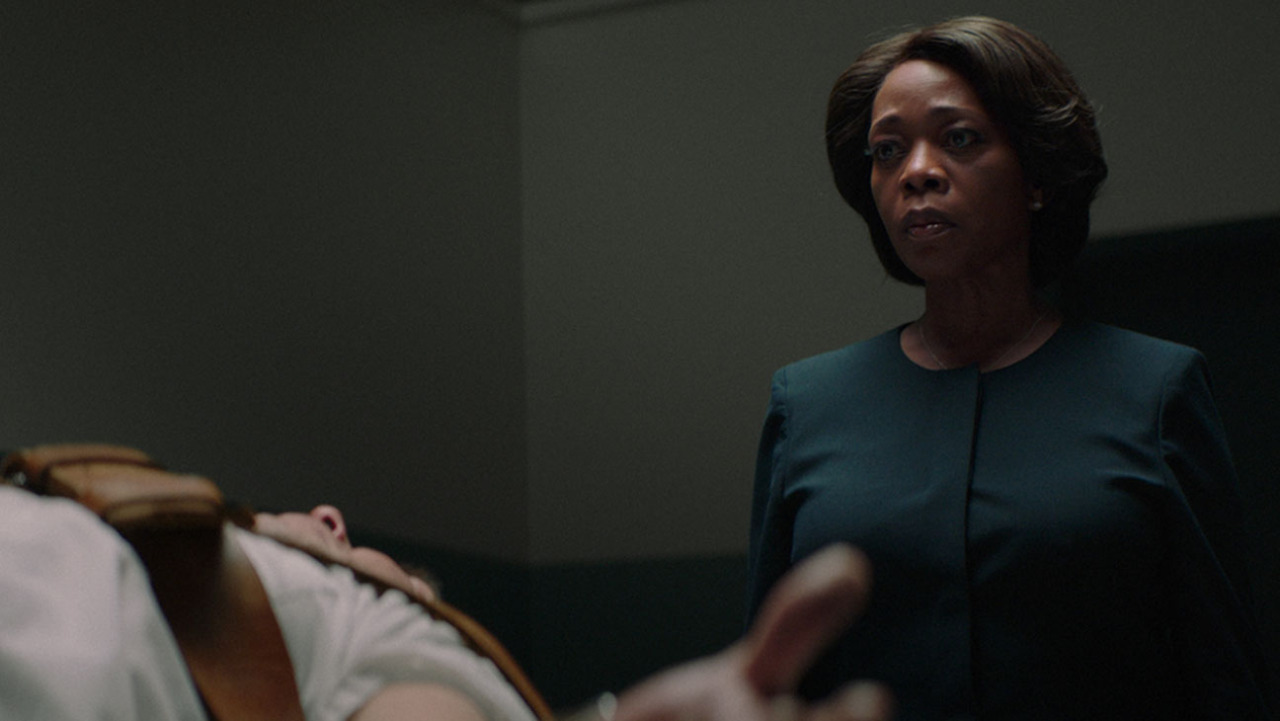
DECEMBER 27: Clemency (dir. Chinonye Chukwu) – IndieWire’s Sundance Film Festival review by Eric Kohn: “At a time when movies can be reverse engineered to generate awards season buzz, Clemency provides a welcome alternative: a mature star-driven vehicle elevated by a brilliant performance that deserves all the awards it can get. As icy prison warden Bernadine Williams, Alfre Woodard embodies the extraordinary challenges of a woman tasked with sending men to their death, while bottling up her emotions so tight she looks as if she might blow. Writer-director Chinonye Chukwu’s second feature maintains the quiet, steady rhythms of a woman so consumed by her routine that by the end of the opening credits, it appears to have consumed her humanity as well. But over the course of the devastating process of preparing for another execution, Woodard injects the drama with the tantalizing possibility that humanity might creep back in.
“No matter the strength that Woodard brings to her role, Clemency is a tough sell from its harrowing opening minutes, in which Bernadine oversees the twelfth execution of her long tenure and witnesses it go horribly awry in front of a petrified crowd: Blood spurts, the body contorts, and Bernadine’s staff is traumatized. Chukwu captures the setup for this shocking accident in disturbing clinical terms, establishing a mood of the haunting psychological portrait to come.
“Bernadine was already a cold, humorless overlord, but the backlash to the execution only makes matters worse for the next victim in line. Anthony Woods (a restrained Aldis Hodge) retains his innocence for a homicide charge from years ago, and as the deadline for his execution looms, his frumpy, aging lawyer Marty (Richard Schiff, purposeful and wise) has started to lose his sense of commitment. In a series of tense exchanges with Bernadine, he rails against her lack of empathy for the prisoners even as he acknowledges the lost cause at hand. ‘You can’t save the world,’ she sighs. ‘That’s the problem,’ he replies.
“In Bernadine’s view, she has a responsibility to treat the death sentence in professional terms, but that philosophy is at odds with the job at hand. In a pivotal scene, she describes the mechanical details of Anthony’s planned execution while he cries in silence, and the disconnect establishes the extent to which Bernadine has learned to obscure her sympathies to a near-psychotic degree.
“All of which means she’s not exactly well suited to be a supporting wife to her frustrated husband (Wendell Pierce, in a calm, measured turn). Clemency stumbles into more conventional melodramatic plotting as it chronicles Bernadine’s troubled marriage, but the actors never overplay their arguments, and their troubles certainly make sense in the context of Bernadine’s mounting pressures at work. As media attention grows and protestors gather outside the prison, it’s inevitable that she’ll reach some kind of breaking point — but even she lacks the power to save Anthony from the likelihood that he’ll die soon enough.
“It can be a suffocating experience to sit with such downbeat circumstances for nearly two hours, and Clemency does push the limit. Even Chukwu’s insightful screenplay can’t justify a tangential conversation between Bernadine and the aging chaplain (Michael O’Neill), or the handful of redundant conversations as the movie creeps toward its final act. But that bumpy middle section gives way to the mortifying suspense of the climactic moments, as the clock ticks down to Anthony’s execution and the likelihood of a magical reprieve continues to fade.
“Meanwhile, the movie leaves room to explore Anthony’s own struggles, as he veers from utter despair to tentative optimism and back again. In a fleeting scene as Anthony’s estranged partner, Danielle Brooks delivers a devastating monologue that puts Anthony’s past in context, as well as the movie’s themes. While Clemency doesn’t overstate the role of race in its scenario, it inevitably becomes a subtle thematic foundation as Bernadine contemplates her role in Anthony’s imminent death. As with Ava DuVernay’s Middle of Nowhere, Chukwu’s movie bemoans the endless of cycle of broken families caused by a system that puts black men behind bars on autopilot.
“Beyond that, Clemency illustrates how systematic execution can destroy both ends of the equation. Woodard portrays Bernadine as a shell of a woman a few shades shy of robot. Going out for drinks with one of her peers, he says, ‘You suck at conversation!’ Throughout Clemency, it’s clear that Bernadine has lost touch with the essence of human connection because her job so often requires her to end it.
“Chukwu maintains an impressive command over her material, but Woodard herself becomes the movie’s central storyteller. The final shot is a galvanizing snapshot of her internal battle, and possibility that it might finally make its way to the surface. While the title of Clemency may refer to the literal prospects of escaping death row, it’s equally invested in a personal quest for the exoneration of the soul.”
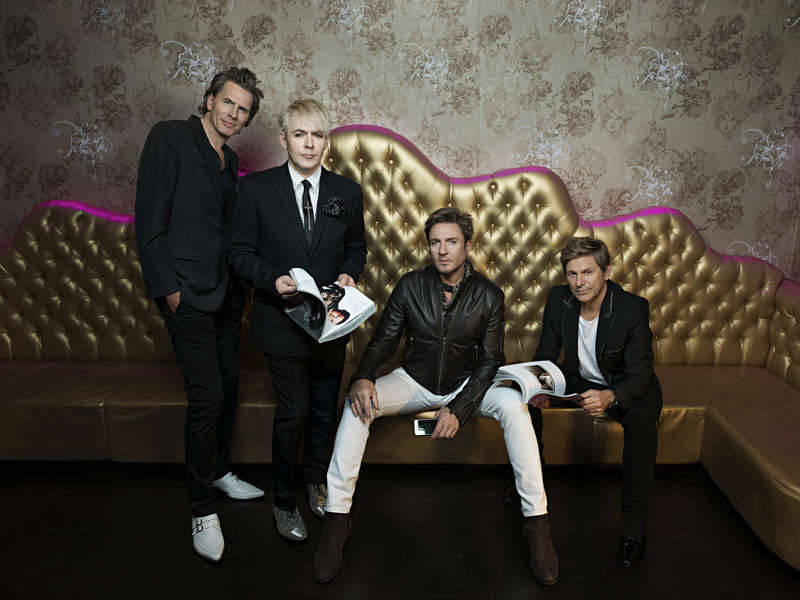
DECEMBER 27 (airing on Showtime at 9:00 PM EST): Duran Duran: There’s Something You Should Know (dir. Zoë Dobson) – Showtime synopsis: “With exclusive access, the band opens up about their extraordinary career and talks candidly about the highs and lows they have endured together over four long decades. This is the band at their most relaxed, intimate and honest. We spend time with John at his LA home; Simon pays a visit to his former choirmaster; Roger goes back to where it all started in Birmingham and Nick dusts off some of the 10,000 fashion items that the band have meticulously cataloged and collected over the course of their career.”
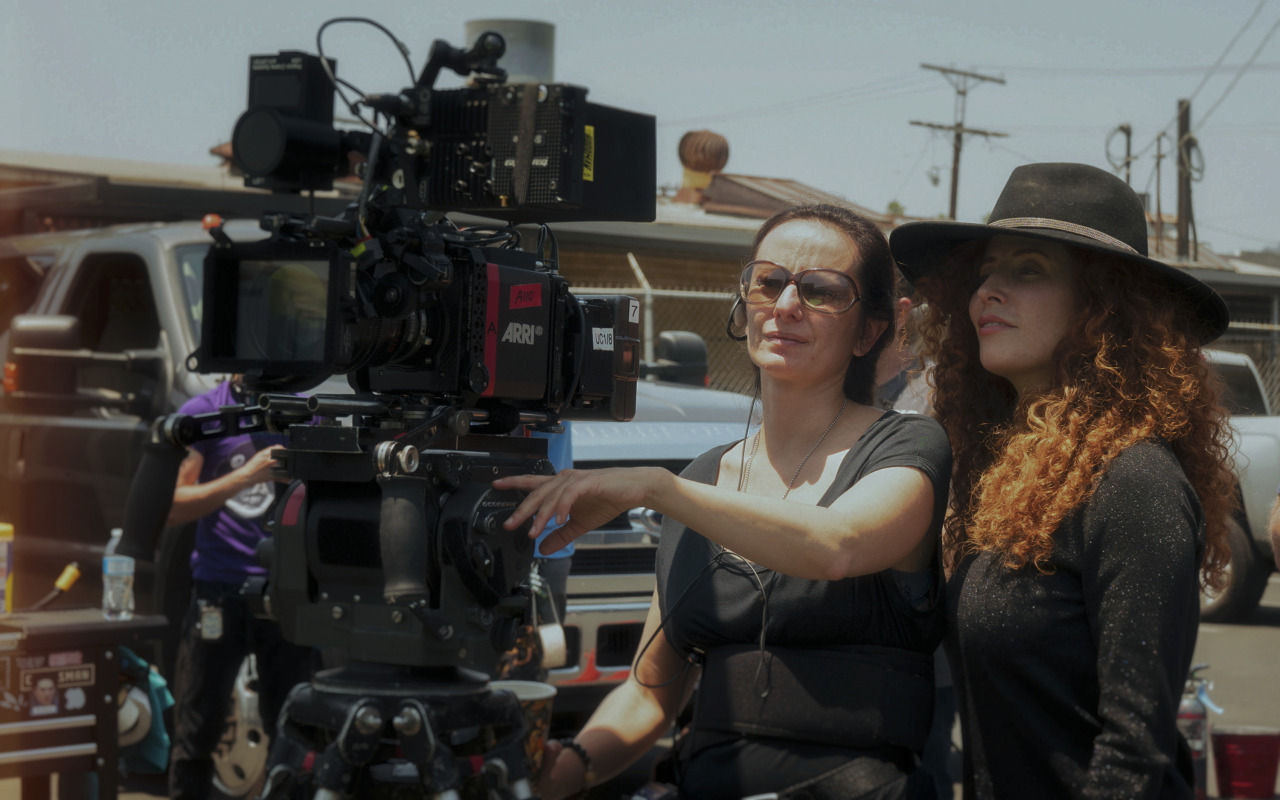
Cinematographer Natasha Braier and producer/director Alma Har’el on the set of Honey Boy, 2018. (Photo: IndieWire via Amazon Studios)
Here are thirty-six new movies due to be released in theaters or via other viewing platforms this November, all of which have been directed and/or photographed by women. These titles are sure to intrigue cinephiles and also provoke meaningful discussions on the film world, as well as the world in general.
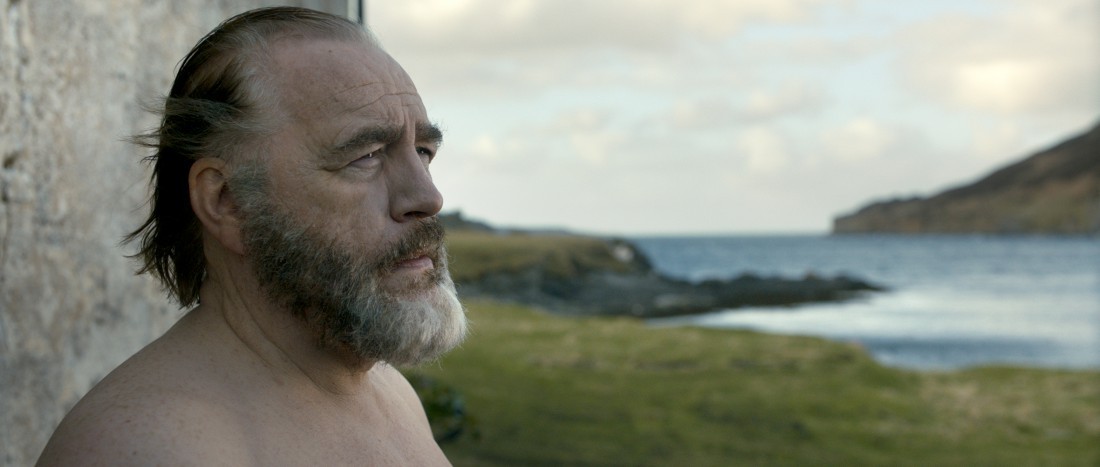
NOVEMBER 1: The Etruscan Smile (dirs. Oded Binnun and Mihal Brezis) – San Joaquin International Film Festival synopsis: “Rory MacNeil, a rugged old Scotsman, reluctantly leaves his beloved isolated Hebridean island and travels to San Francisco to seek medical treatment. Moving in with his estranged son, Rory’s life will be transformed, just when he expects it least, through a newly found love for his baby grandson. The Etruscan Smile – the feature debut of Israeli filmmakers Oded Binnun and Mihal Brezis – is based on the bestselling book La sonrisa etrusca by Spanish author Jose Louis Sampedro, with the story being transposed to Scotland and the United States. The heart of the film is another unforgettable role by actor Brian Cox.”
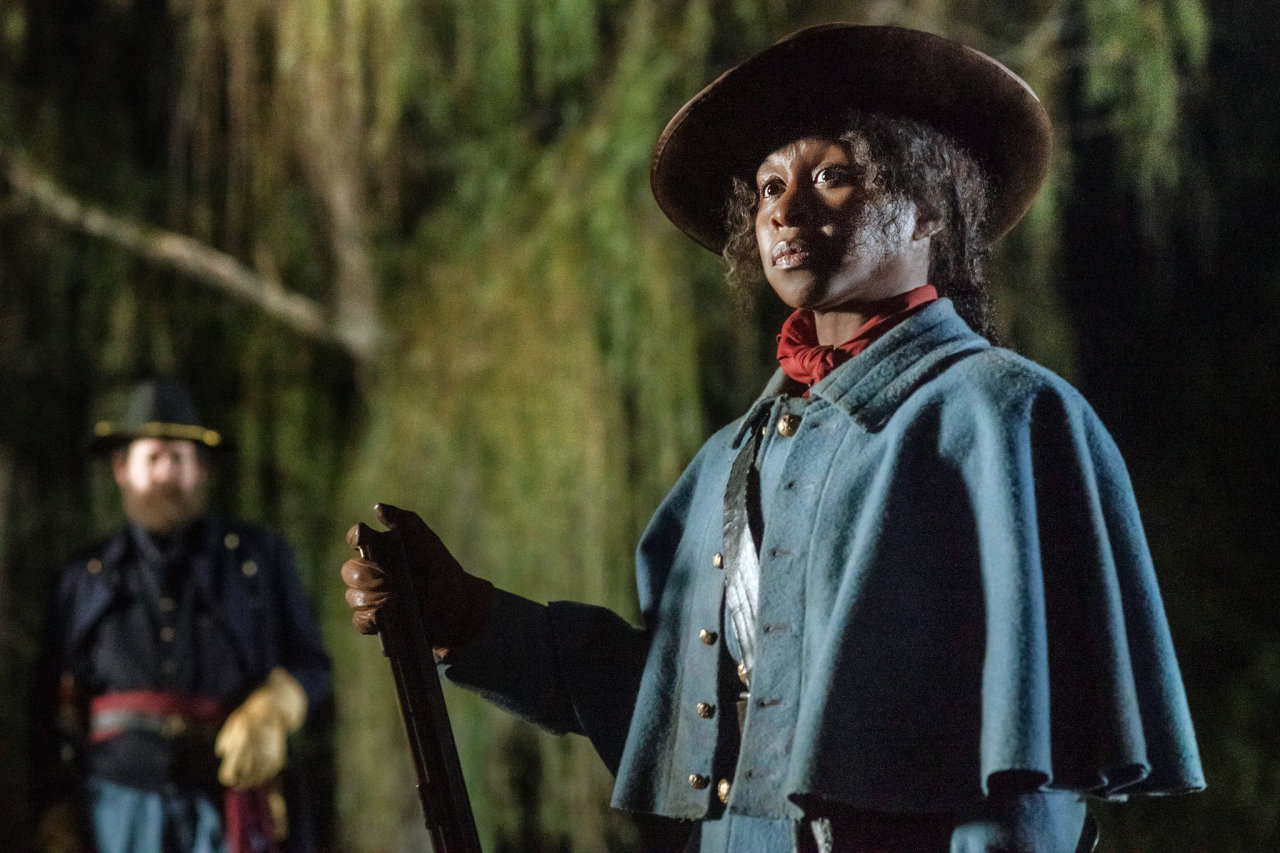
NOVEMBER 1: Harriet (dir. Kasi Lemmons) – Time review by Stephanie Zacharek: “Sometimes it’s hard to conceive of awe-inspiring historical figures like abolitionist hero Harriet Tubman as living, breathing people. But a single visual cue can make a difference: a recently discovered photograph shows a younger Tubman, a contemplative, vibrant-looking woman in a stylish dress. That’s the Tubman director Kasi Lemmons brings to life in her carefully observed biographical film Harriet: it’s as if Tubman walks among us, melting away the years between her life and ours.
“Cynthia Erivo plays Tubman, whom we first meet as a slave–her birth name is Araminta Ross–on a farm in Bucktown, Md., circa 1849. She’s married to a free black man and yearns for freedom herself, at least partly to escape the sinister advances of her master’s son (an oily Joe Alwyn). Araminta pulls off a daring escape, even leaping from a bridge when she finds herself cornered by the dogs and men on horseback who are quite literally hunting her. She makes her way, at great risk, to Philadelphia, building a new life for herself with the help of a sophisticated businesswoman and adviser (played, with glittering vitality, by Janelle Monáe). But the woman who now calls herself Harriet Tubman can’t forget those she left behind. She returns again and again to Maryland’s Eastern Shore, often in disguise, to guide other slaves to freedom. The dangers increase with each trip.
“Lemmons–who has directed some splendid pictures over the years, among them Eve’s Bayou and The Caveman’s Valentine–is fully alive to both the danger and beauty of the landscape of the American South–even the shape of a tree, craggy and twisted or lush with leaves, could be either a warning or a welcome. Erivo shines through it all, giving us a glimpse into the mind of a steadfast woman of purpose. Her Tubman is as bold and alive as the woman staring at us from that photograph. The directness of her gaze is the ultimate challenge.”
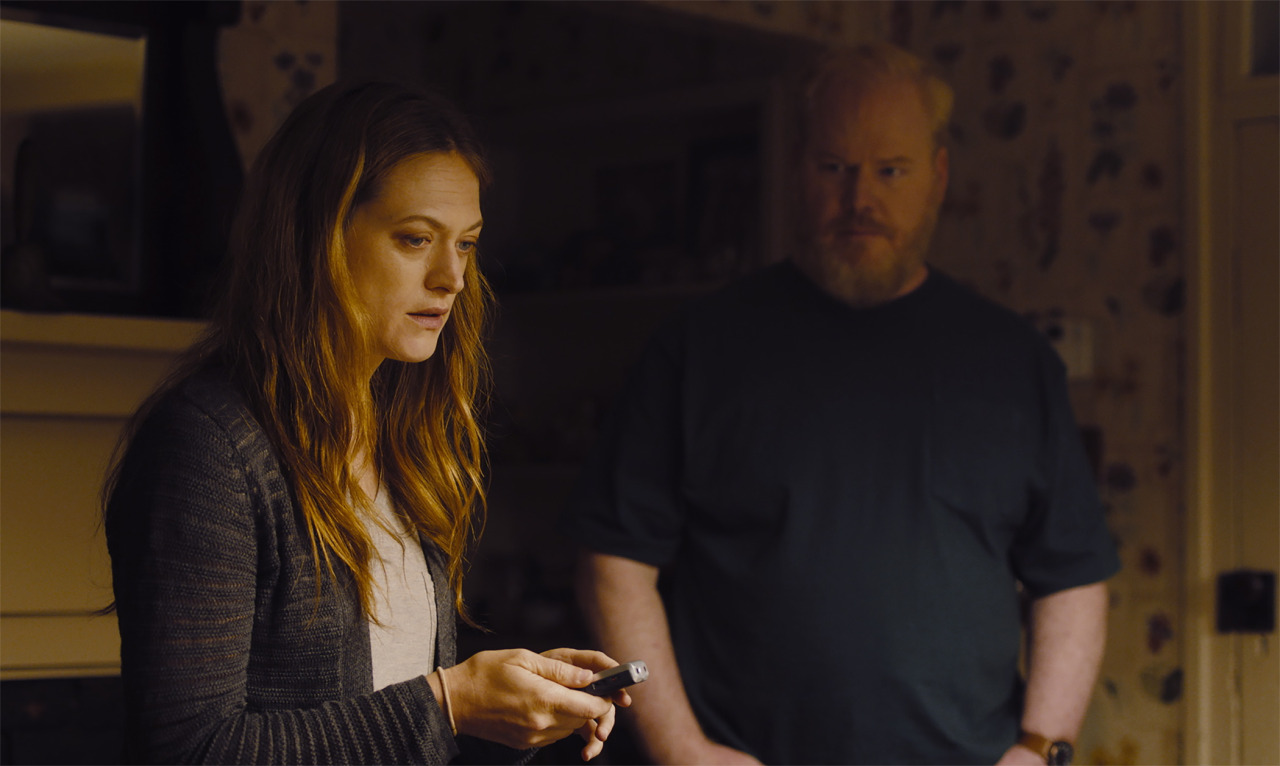
NOVEMBER 1 (NY), NOVEMBER 8 (LA): Light from Light (dir. Paul Harrill) (DP: Greta Zozula) – RogerEbert.com review by Monica Castillo: “There’s no right way to grieve the death of a loved one. Some of us chose to keep the sadness to ourselves, others talk through it or express it in creative ways. We move on, or we don’t. We take comfort in the small signs that they might somehow still be with us or we lay their memory to rest in the back of our minds.
“In Paul Harrill’s gentle drama Light from Light, a paranormal investigator and single mother named Sheila (Marin Ireland) is introduced to a widower, Richard (Jim Gaffigan), struggling with the recent death of his wife in a plane crash. He believes he can feel her presence but isn’t sure, and his questions have stumped his priest, Father Martin (David Cale), who in turn, invites Sheila to help. Together, they will try to find out if there is indeed a spirit in Richard’s home and hopefully, give him some sense of closure, whatever that may look like. Alongside the grown-ups’ heartaches are the troubles of young love between Sheila’s son Owen (Josh Wiggins) and his earnest girlfriend, Lucy (Atheena Frizzell).
“This young love acts as a kind of narrative counterweight to the heaviness of what the adults are grappling with – a love that was cut short by death yet lingers on. They are each learning their way into this new emotional space through Harrill’s quiet direction. In many scenes, emotions sit in silence, written on the faces of the actors but left unspoken, like when Sheila is unsure of what to say to the grieving widower who’s turned to her for answers or when her son challenges her parenting. Originally, Owen is the one afraid to get hurt if he falls for Lucy. Then as he lets his guard down, his mom tries to intervene in an attempt to save her son from whatever possible heartbreak awaits. But some feelings just need to be felt, be they good, bad or confusing.
“Harrill, who wrote and directed the film, isn’t as interested in the supernatural elements in the film as he is with the story’s few players. There’s a lot of room for emotions to breathe and wash over its characters, but never does it tip over into excess. It’s a muted portrait, quietly restrained in some ways that may feel restrictive but in others, remarkable in how far the actors can take these emotions without overacting. Ireland and Gaffigan give incredibly nuanced performances portraying characters who have more hurt behind their eyes than they let on. For Richard, it may be easy to see why he’s upset, but no amount of words could explain what he’s going through. In Sheila’s case, there are hints of a kind of an adrift, directionless frustration after the end of a relationship also meant she had to leave their shared paranormal group. In helping Richard find closure, Sheila might also close a chapter in her own life and move on.
“Light from Light sticks to a subdued aesthetic throughout the characters’ emotional journey. When Sheila and Richard trek up the Smokey Mountains to the crash site where his wife died, cinematographer Greta Zozula finds her darkest shades of grey and forest green, swallowing the characters in a somber state of sadness. Yet, in a sunny moment not long after, there’s a warm glow of hope and healing unmistakable on both the actors’ faces and the scene itself. The melodic acoustic score from Adam Granduciel and Jon Natchez complements the movie’s gentle approach to grief and love like a comfortable sweater on a rainy autumn day, striking the right chords at just the right times.
“Although it takes its time getting to where it’s going, Light from Light does eventually reach its destination. For a movie about grief, it’s surprisingly even-handed, not too melancholic, heavy or existential but mostly pensive. Those quiet scenes between actors allow the audience to fill in the unclaimed screentime with their own self-reflection. They’re also reminders of how unused we are to these silences and awkward it feels when we don’t have the right words to comfort someone. Then again, most of us never do enough listening to one another, awkward silences included, which makes Light from Light a tender lesson in listening to and observing one another.”

NOVEMBER 1 (LA), NOVEMBER 15 (NY): The Portal (dir. Jacqui Fifer) – City Cinemas Village East Cinema synopsis: “The Portal is an experiential documentary created as part of a bold, global vision to shift humanity out of a state of crisis. It brings to life the stories of six people who overcame adversity using stillness and mindfulness, inspiring the audience to follow in their footsteps and realize the unique potential that all humans have to change our world. With insights from three of the world’s foremost futurists–and a robot–the film unfolds into a beautiful, audiovisual spectacle that takes the viewer on their own mindfulness journey through the pain, joy and memory fragments of life.”

NOVEMBER 1: Queen of Hearts (dir. May el-Toukhy) – Variety’s Sundance Film Festival review by Guy Lodge: “‘Sometimes what happens and what must never happen are the same thing,’ says Anne, a successful lawyer given to flouting expected codes of conduct, midway through Queen of Hearts. As excuses for an offense go, it’s on the slender side — a slightly more formal version of ‘the heart wants what it wants’ — but Danish director May el-Toukhy’s sleek, engrossing melodrama isn’t liable to interrogate its characters. ‘What must never happen’ makes for a better story, after all, and her film leads its characters into that territory with a detachment as cool as its polished Scandi interiors. The heat comes from viewers’ own emotional response to its doozy of a central transgression, as middle-aged, comfortably married Anne (Trine Dyrholm) initiates a reckless sexual affair with her troubled teenage stepson Gustav (Gustav Lindh): The premise’s ‘what?!’ factor is so luridly high that the ‘why?!’ one gets pushed to the background.
“That this approach holds water for as long as it does comes largely down to the sharp, subtle gifts of Dyrholm, one of those actors who truly has to strain for a false note. Her finely shifting body language and simultaneously knowing, querying gaze go a long way toward making in-the-moment sense of an intelligent character’s most brazenly stupid decisions, even as we begin to suspect that the script, by el-Toukhy and Maren Louise Käehn, may be as bemused by her as we are.
“In a conversation piece pitched halfway between the delicate Sirkian tragedy and Adrian Lyne at his most sensational, it’s the overridingly controlled nature of proceedings — from performance to production design — that keeps Queen of Hearts from sliding into the hysterical silliness that its provocations invite. You can’t quite turn away from it even as you don’t quite believe it: That will carry el-Toukhy’s sophomore feature (formally, a sizable step up from her 2015 romantic comedy Long Story Short, also featuring Dyrholm) far on the international arthouse circuit, and ought to net the interest of international producers in the director’s next move. (Meanwhile, you can practically envisage a Robin Wright-starring U.S. remake of Queen of Hearts while watching it.)
“At a leisurely 127 minutes, the film takes time to build its crisis, while dropping hints from the off that something is rotten in, if not the state of Denmark, at least the state-of-the-art Danish home that Anne shares with her Swedish husband Peter (Magnus Krepper), an equally high-flying doctor, and their adorable twin girls. Though they’re an ostensibly enviable family, Peter confesses to wishing Anne were a little more submissive, while both partners are wedded to their jobs first and foremost. Their overall happiness seems brittle, cushioned by privilege but vulnerable to the slightest tremor: They get more than that when Gustav, Peter’s estranged son from his first marriage, moves in, having been expelled from both his school and his mother’s home in Sweden.
“With father-son relations all but frozen over, Anne at first quietly inserts herself into the void as Gustav’s ally, covering for his misdeeds and buying him a high-end laptop; as a lawyer who specializes in representing young victims of abuse, her overtures of generosity to the sullen, withdrawn boy at first seem an extension of her job. Yet that particular character detail only confuses the picture once her kindness crosses the line into intimacy, first via conversation, then a kiss, then a full-blown sex scene shot with a very Scandinavian fusion of explicit candor and white-linen restraint. As one who deals compassionately with trauma-afflicted children on a daily basis, does she not view herself as a perpetrator of sexual assault? Has she legally talked herself into a trickier view of the situation? Or is she not thinking at all — a woman of the law finally giving in to unfiltered urge?
“All these possibilities are kept afloat by Dyrholm’s fierce, fascinating performance — with an equally prickly, nuanced assist from Lindh, who can vulnerably switch gear in a single scene from precocious flirt to stunted brat. But if Queen of Hearts earns credit for casting no judgment on either character, its refusal to let us into anyone’s head begins to feel less like philosophical distance than a bit of a psychological dodge, particularly as the situation collapses into calamity, and Anne’s actions progress from heedlessly self-serving to clinically so. In one exchange between the lovers, el-Toukhy and Käehn tease the possibility that Anne may have a history of victimhood herself, before retreating into pointed ellipsis.
“There’s a lot to unpack there, but doing so might muddy up the film’s gorgeous, compelling ice-noir surface — so pristinely maintained by Jasper J. Spanning’s fluid, limpid camerawork and the tight string motifs of Jon Ekstrand’s anxious score. An uglier, more abrasive film could be made from this unpleasant story, though in the #MeToo era, the more elegant, aloofly accomplished one el-Toukhy has made should still prompt a flurry of debate over its portrait of a female predator. ‘You don’t understand how people work,’ says one exasperated character to another late in proceedings; if Queen of Hearts has a driving thesis beneath its glassy, alluring intrigue, it’s that no one really does.”
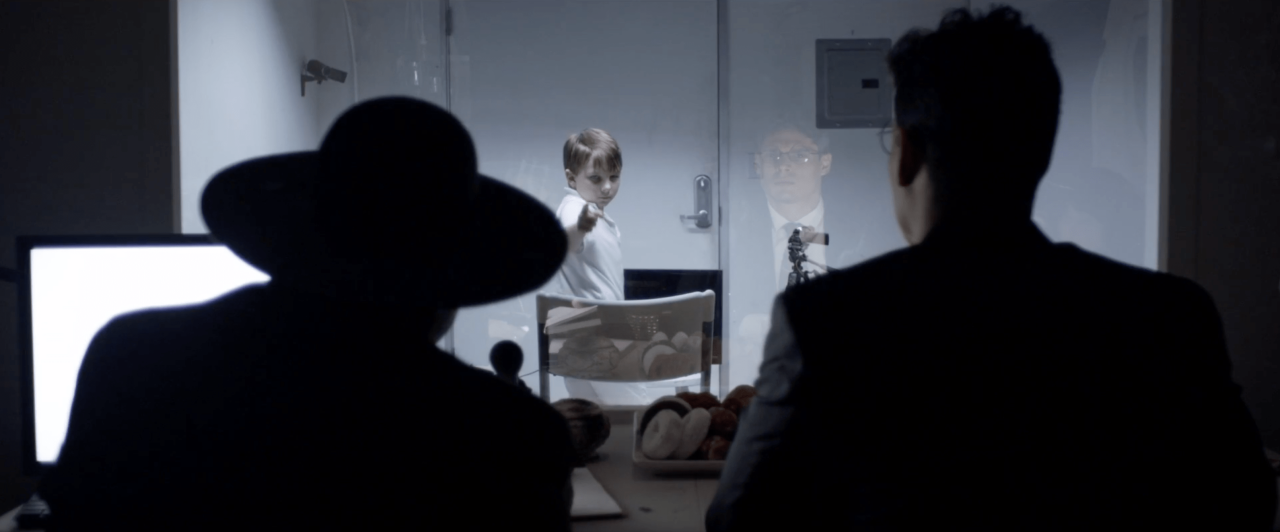
NOVEMBER 8: Ballet Blanc (dir. Anne-Sophie Dutoit) – Downtown Los Angeles Film Festival synopsis: “Set in a remote town in the Western U.S., a young boy who has a passion for ballet, appears out of nowhere. After being discovered in a church choir, he’s eventually adopted by a peculiar and frightening lonely local woman who has dark ambitions for him. She seems to be his master, but is she, really? The county eventually sends a social worker to investigate a particularly gruesome incident involving the boy. But this endearing youngster has a mind of his own, exerting his power and will over everyone. His frightening grand plan eventually comes into play, as he’s not who he appears to be, or is it our perception of him? Behind his innocent smile lies a gruesome secret that may change the world.”
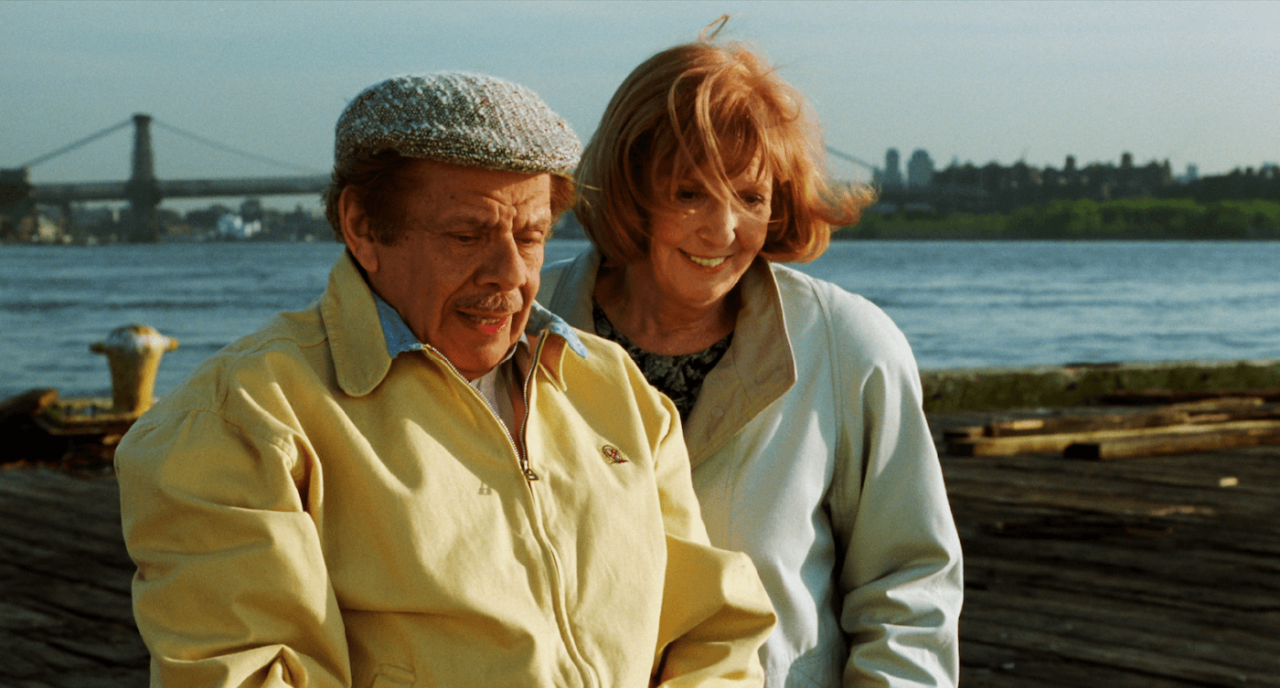
NOVEMBER 8 (NY): A Fish in the Bathtub (dir. Joan Micklin Silver) – Quad Cinema synopsis: “Legendary comedy duo (and real-life husband and wife) Jerry Stiller and Anne Meara star as the constantly bickering couple at the center of this sprightly comedy from writer-director Joan Micklin Silver (Hester Street, Crossing Delancey). When Sam (Stiller) stubbornly refuses to get rid of the new pet carp he’s unleashed in their bathtub, Molly (Meara) finally decides she’s had enough and moves in with their married son Joel (a young Mark Ruffalo). Desperate to get his mother out of his hair (and house), Joel enlists his boy-crazed travel agent sister (Jane Adams) to help repair their parent’s relationship—meanwhile he’s tempted toward infidelity by a flirtatious client (Missy Yager). Replete with Micklin Silver’s signature wit and loving lensing of New York’s city streets and suburbs, this little-seen gem is fun for the whole neurotic family.”
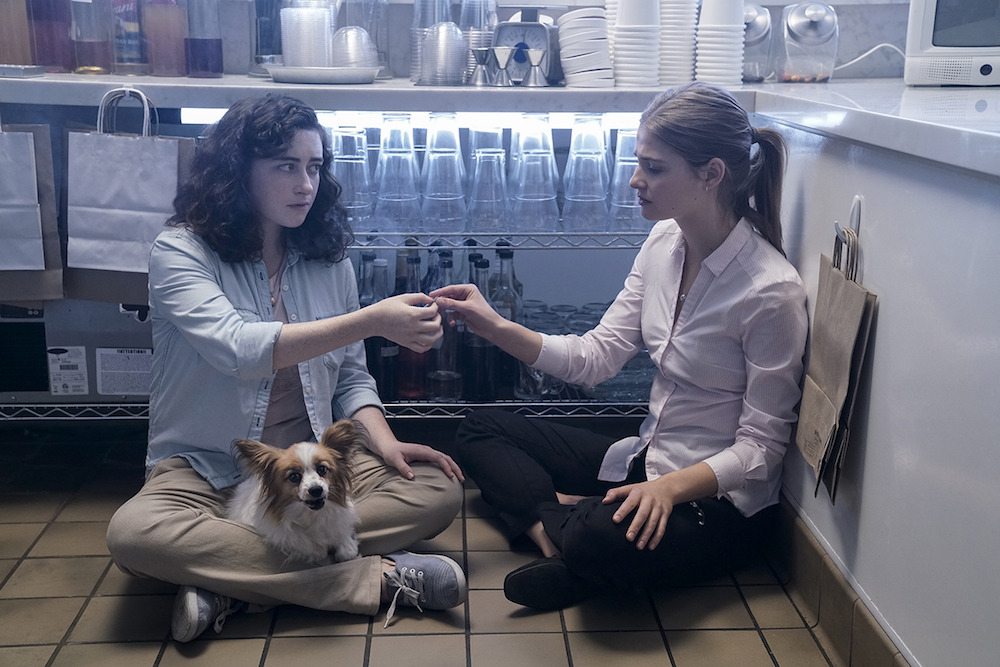
NOVEMBER 8 (in theaters & on DirecTV): Good Girls Get High (dir. Laura Terruso) – Variety’s Los Angeles Film Festival review by Courtney Howard: “For the most part, successful teen comedies follow a tried and true formula. Memorable high school movies typically feature characters who feel like outsiders floundering hilariously en route to the revelation that simply by being themselves, they’ll find what’s eluded them for so long. John Hughes knew it well, as did his imitators, realizing that even small deviations can be enough to refresh the genre for a new generation. Full of charm, humor, and heart, director Laura Terruso’s Good Girls Get High mixes it up, delivering a ‘high’ concept comedy in which the two kids least likely to go astray do exactly that.
“High school senior Sam Jensen (Abby Quinn) and her best friend Danielle Compton (Stefanie Scott) have always lived by the rules. While the rest of their classmates were out doing the crazy, stupid things normal teens do, the two overachieving co-valedictorians were either crushing their extracurriculars, rollerblading around town, or enjoying wholesome activities on Friday nights. However, when the pair discovers they’ve been voted the school’s ‘Biggest Good Girls,’ it sends Danielle into a tailspin. She convinces Sam there’s a ticking clock on their irrational, wild days and if they don’t do something about it now, they’ll be locked into these roles for the rest of their lives. After Sam discovers a joint hidden in her single father’s (Matt Besser) laundry, the two pals start behaving badly with their very on-brand style of pragmatism.
“Working from the blueprint of Sarah Miller’s book, Terruso and co-writer Jennifer Nashorn Blankenship demonstrate a clear understanding of what it takes to craft a finely-tuned, female-forward feature. The gals’ friendship is always at the forefront of the action. Our heroines are smart, funny, capable young women, who, despite their wits being impaired, remain true to themselves. Occasionally the perspective slips into their psyches, showing their world through fuzzy ‘weed cam’ shots, Sam’s daydreamy longings for science teacher Mr. D (Danny Pudi), or Danielle’s slo-mo fantasies about harlequin-romance-haired hunk Jeremy (Booboo Stewart).
“Sam and Danielle’s schoolgirl crushes aren’t their endgame; their reward is the fidelity of their friendship, and the male characters serve to complement that. It even subverts traditional roles: The character who’d usually be written as a ‘mean girl,’ social activist influencer Ashanti (Chanté Adams), is admired and supported by the gals. The character who’d stereotypically be portrayed as the condescending authority figure, pregnant cop Patty (Lauren Lapkus), finds a lovely kinship with the pair.
“The filmmakers also know how to build a highly comedic scenario. The tomfoolery the two find themselves embroiled in is absurdly funny. Though there are raunch-com elements here, the gross-out factor is fairly tame. For instance, instead of getting scatological during an intimate encounter where one character fears her upset stomach will ruin the mood (an operatic aria perfectly captures her anxiety), it’s merely gaseous emanations. An accidental sexting is handled practically. By framing the girls’ shenanigans with Sam’s Harvard admissions confessional, Good Girls delivers the exposition with witty commentary.
“Augmenting the narrative drive, cinematographer Benjamin Rutkowski bathes the protagonists’ world in saturated colors. Sam’s sanctuaries, such as her bedroom and family ice-cream shop, are color-coded in welcoming teals and yellows. Danielle surrounds herself with light pastels. Composer Jay Israelson provides a warm ’80s-inspired synth score that would’ve suited Hughes himself.
“With heartening, encouraging messages that speak to the target audience and beyond, Good Girls Get High doesn’t stray too far from the formula, but manipulates it in such a way that feels fresh.”
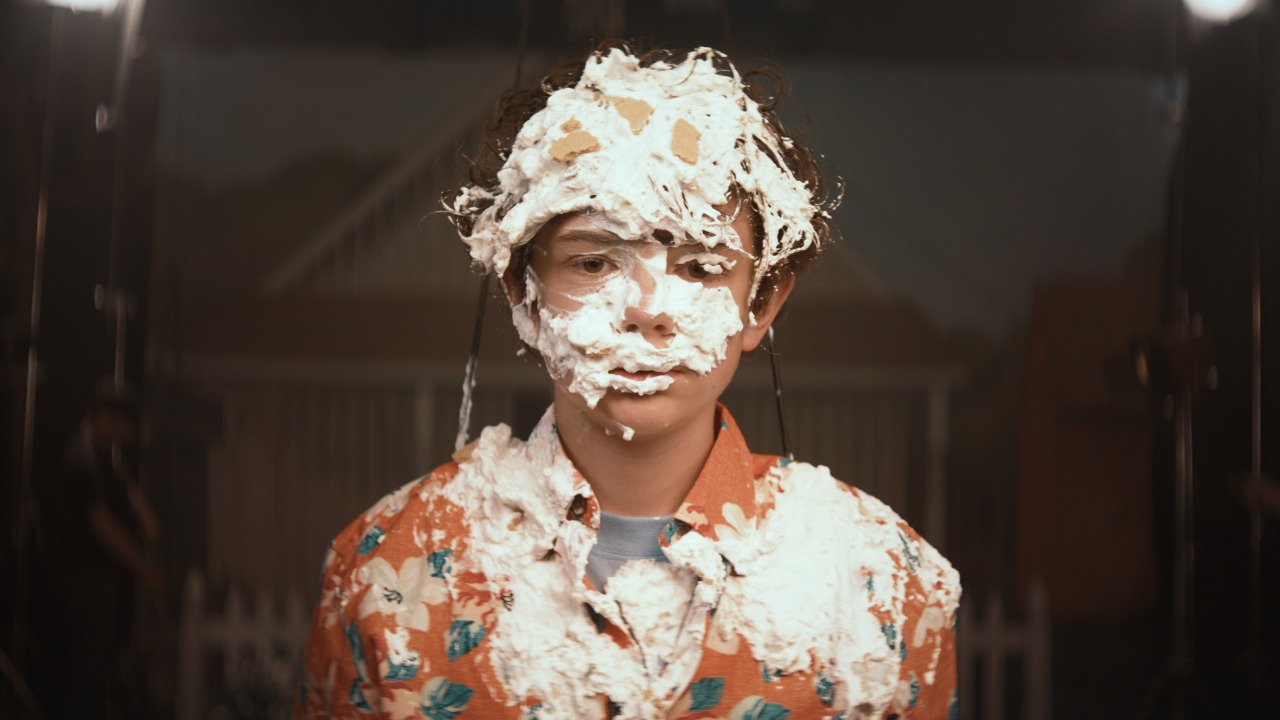
NOVEMBER 8: Honey Boy (dir. Alma Har’el) (DP: Natasha Braier) – Film Comment review by Michael Sragow: “Shia LaBeouf, who peaked commercially in three Transformer films and hit a creative pinnacle as John McEnroe in Borg and McEnroe (2018), has written a raw, brilliant script for Honey Boy. This fictionalized cinematic memoir is unabashed ‘drama therapy’: it grew out of LaBeouf’s writings in rehab after ranting at police while on location for another film in Savannah, Georgia.
“Whether or not it works as therapy, Honey Boy is a wonderful movie, directed confidently and intuitively by documentary-maker Alma Har’el in her first fictional feature. With emotion-charged transitions and elisions, Har’el glides between overgrown, self-destructive Otis Lort (Lucas Hedges), locked into denying his domestic PTSD, and precocious, high-achieving Otis (Noah Jupe), the child actor on the rise who pays his father James (played by LaBeouf himself), a recovering alcoholic/addict, to be his chaperone. Har’el has beautifully braided present-tense action and flashbacks (and fantasies) into this portrait of the artist as an abused son.
“When 22-year-old movie star Otis thanks his rehab supervisor Alec (Martin Starr) for telling him to unleash a primal scream, Alec, no dummy, asks Otis if he’s ‘sincere’ or if he’s ‘acting.’ Otis levels with him: ‘Both.’ What other answer could such a super-intense performer give? Otis is the kind of actor who psychs himself up on the set of a giant, Transformers-like action movie but can’t come down from the high. He carries his thespian prowess like an invisible shield: When a policeman cuffs him off-set, Otis absurdly tells the cop that he’ll be sorry when he learns how good Otis is at what he does.
“Otis’s father occupies the red-hot center of the psychodrama. LaBeouf frees himself of vanity as 45-year-old James, a Vietnam veteran who trained in Commedia dell’arte and entertained crowds as a rodeo clown. James now reads lines with his boy in his own insistent voice and modified New Orleans drawl and coaches him in slapstick farce. Otis appreciates James’s ‘instincts,’ though the boy has been developing a better sense of what works for him comedically. The two have cobbled together a sort-of life between TV-sitcom studios and a seedy motel, where the courtyard is no garden and the neighbors across the way are hookers. While James has been clean for four years, he still can’t tamp down his temper at a 12-step meeting.
“We may fear what he’ll do if he stumbles, since what he does when he’s sober is shocking enough. He’s so unsure of how to act like a father that he won’t hold his son’s hand: he’s afraid people will mistake him for a ‘chicken hawk.’ He’s a registered sex offender because of an outrage he committed during an alcoholic black-out long ago. James is also ruinously jealous. It affronts him that his ex-wife enrolled Otis in the Big Brother program to acquaint him with a positive male role model. James can’t abide the weathered, benign presence of Tom (Clifton Collins Jr.), Otis’s Big Brother. But in one of the film’s many sly, expressive asides, we learn that Tom, a passport specialist for the State Department, would be happy to help the Lorts with their passports even after James curses him out and tosses him into the motel swimming pool.
“At the movie’s volcanic core, James frustrates both 12-year-old Otis’s attempts to communicate with him son-to-father, and 22-year-old Otis’s struggle to reckon with his father’s legacy. (Otis has become an angry addict himself.) LaBeouf describes this film as an exorcism, but he molds and plays James with superb control, in ways that serve the story precisely. LaBeouf makes us believe that this troublesome dad has indeed turned his son into an artist, not merely because of the pain he caused, but also because of his passionate commitment to the boy’s creativity (and also, perhaps, his unconventionality). James tells Otis that his mom has gotten herself a job in case Otis fails as an actor: He insists that he’s Otis’s ‘cheerleader’ as well as his physical trainer. When James teaches Otis how to juggle using balled-up pairs of socks, he makes him do ten pushups if he drops one.
“For viewers to buy this film’s premise, there must be heft to James’s engaging silliness as well as his engulfing fury. And LaBeouf provides it, without going over the top. LaBeouf’s James tucks in his sizable paunch as he mounts his motorcycle and, on the road, covers his mouth with a raggedy bandanna. Wearing oversized circular glasses and a do-rag, he recalls rodeo routines he choreographed with an athletic chicken. As LaBeouf plays him, James is sometimes a human sight gag, sometimes a one-man counterculture. Despite his cruelty, we feel James’s agony when he confesses that it’s humiliating to draw a salary from his son. Otis is sadder and wiser and can be cruel himself: ‘You wouldn’t be here if I didn’t pay you,’ the boy says.
“As movie-star Otis reluctantly grapples with his memories of childhood, Hedges masters shadow boxing: he must spar with LaBeouf’s James, who interacts with him only in flashbacks, nightmares, or reveries. Hedges is a wizard at conveying compacted, often boobytrapped emotions. It helps that Har’el surrounds him with such a smart ensemble. Martin Starr as his group leader Alec and Laura San Giacomo as his psychologist Dr. Moreno defuse his hardboiled skepticism toward therapy with unexpected patience, curiosity, and incisiveness. Byron Bowers provides a relaxed comic counterpoint as Percy, Otis’s roommate, who drifts into treatment as blissfully as he does into sleep. Alec jokes that Percy may be too good—by which he means, too happy—at hugging himself to release hormones. Bowers’s ultra-satisfied face provides the visual punch-line.
“Even in this heady company, young Jupe gives the performance of the movie. He puts his character on a psychic tightrope and never misses a step. He gives Otis at age 12 the elan of a born star and a soulful artist’s face: sometimes his expressions betray baseline feelings; at other times they stress the drama playing out around him. He understands the conflicts between his father and mother (Natasha Lyonne, whom we do not see, just hear over the phone). He knows their fights will go on forever. In the most extraordinary scene, James refuses to get on the phone with his former spouse. Otis hangs on to the handset and relays each parent’s horrific condemnations to the other. Jupe delivers them like a pro.
“Har’el and cinematographer Natasha Braier imbue the film with an empathetic lyricism. The exchanges between Otis and a young hooker referred to in the credits as ‘Shy Girl’ (FKA twigs) redeem the whole notion of contemporary mime. The boy actor and Shy Girl seal their affection in a silent bit that combines elements of sorcery and softball. When they snuggle up in bed, they recover each other’s innocence, even after Otis does what he thinks he should do: he grabs some cash and pays her.
“Har’el and Braier bring a gnarly shimmer to poolside dreams and roadside pipe-dreams. Along with LaBeouf, they bequeath the roughest characters with the tenderest mercies.”
NOVEMBER 8 (NY/LA): The Kingmaker (dir. Lauren Greenfield) (DPs: Shana Hagan and Lars Skree) – The New York Times review by Manohla Dargis: “It was always a little too easy to laugh at Imelda Marcos. The gold and the kitsch, the fine art and the tchotchkes, the rows of bedazzled shoes and the towering dome of shellacked hair — it was all so very much, so very vulgar, so very, very expensive. During the roughly two decades that Marcos was the first lady of the Philippines, she became famous for lavish habits that make the Kardashians seem like skinflints. Even after the Marcos family fled the Philippines in 1986, her extravagance often received more attention than her role in what was called a ‘conjugal dictatorship.’
“In the documentary The Kingmaker, Lauren Greenfield trots out the plunder and of course the shoes — those notorious emblems of Marcos’s excess — but also examines the appalling costs of that luxury. It’s an ugly story shrewdly told, with a sense of humor and also a deeper feeling for history. In the years since Marcos and her husband, Ferdinand (who died in exile, in Hawaii, in 1989), were ousted after the People Power Revolution, too many journalists have called on her to gawk and dish. Greenfield, a fine-art photographer turned filmmaker, has something else in mind, as telegraphed by the aerial shot of ramshackle Manila shanties that starts the movie.
“This opener introduces Greenfield’s dialectic approach, which emerges slowly. Under her scrupulous gaze — the directors of photography are Lars Skree and Shana Hagan — Marcos, a.k.a. the Iron Butterfly, floats through her homes, tended to by anxious aides. She chats under a Picasso, poses before a Michelangelo. She displays reams of legal documents from her many court battles and drifts down memory lane, at one point showing off photos of herself with the woman she calls Mrs. Mao (Jiang Qing) and with Richard M. Nixon. When Marcos accidentally knocks over some photos, shattering the glass in the frames, the moment vibrates with metaphoric force.
“Greenfield doesn’t explain how she secured her remarkable access, though she clearly has a gift for wrangling the self-obsessed. Her documentary The Queen of Versailles (2012) centers on a billionaire couple (primarily its title subject, Jackie Siegel) who planned to build the largest privately owned house in the United States. Perhaps Marcos saw Queen of Versailles and liked what she saw. Or maybe she simply wanted the attention to stoke her political ambitions, specifically from a respected chronicler like Greenfield. It’s hard not to wonder if Marcos regarded the filmmaker as another would-be courtier or even an acquisition (a mistake).
“Whatever the case, as Greenfield quickly reminds you, one way into a narcissist’s heart is to turn on a camera and microphone, and let vanity take over. From the instant that Marcos appears in The Kingmaker — gliding through the streets of Manila in a van as if in a mobile throne — it’s obvious that she remains ravenous for attention, whether from the camera or from the indigent people clamoring outside her window. It’s unsurprising that she rarely appears alone here, though it’s unclear if she needs all her helpers or is simply accustomed to armies of servants. This is, after all, a woman who apparently had a maid whose sole job was to care for her jewelry.
“Despite the early images of conspicuous poverty, Greenfield initially seems to be going somewhat easy on her subject. ‘During my time, there were no beggars,’ Marcos says soon after the movie begins, while cruising past destitute people and rundown streets. Greenfield doesn’t overtly challenge this assertion, perhaps because it’s so ridiculous. Instead, she cinematically builds a case against Marcos by folding in increasingly tough interviews with brutalized anti-Marcos activists and by deploying a surgical attention to detail: images of grasping hands are contrasted with manicured hands holding money; stuffed animals are set against images of real abused wild ones.
“Marcos, who turned 85 in 2014, the year that Greenfield started shooting, continues to look remarkably robust as the years pass by, never more so than in front of the crowds that swell in size and intensity at the political rallies she attends. As the throngs burgeon, the movie’s tone grows ominous. Marcos’s children enter and exit, flexing their own political power. Her son, Bongbong, runs for vice president. An alliance emerges between her daughter Imee (also a politician) and the current president, Rodrigo Duterte, whose violent, so-called war on drugs has resulted in the deaths of an estimated 20,000 people and international condemnation.
“As Greenfield opens The Kingmaker up, the Philippines’ past and present move uneasily into alignment, and the movie becomes more interesting and far more disturbing. Notably, it also becomes less about one woman, her malevolent charms and quirks, and develops into an unsettling look at imperial power. That said, there are moments when you wish that Greenfield had pushed harder in The Kingmaker, say, by taking a closer look at American intervention in the Philippines. But when she interviews an old friend of the Marcoses who chortles about American support for despots, the movie — like his comment — becomes the tragedy it was meant to be.”
NOVEMBER 8 (LA), NOVEMBER 22 (NY): Mr. Toilet: The World’s #2 Man (dir. Lily Zepeda) (many DPs, including Siyan Liu) – Hot Docs Canadian International Documentary Festival synopsis by Gabor Pertic: “The global sanitation crisis finds an unlikely and eccentric hero in 60-year-old Singaporean Jack Sim, also known as Mr. Toilet. By blending a lighthearted sense of humor with some compelling and unnerving statistics, he cuts through the cultural taboos of a topic that tends to make people uncomfortable. That discomfort, however, comes at a deadly cost. Nearly a third of the world’s population is put at risk by lack of access to proper sanitation, be it unsafe outdoor conditions or improper sewage systems. While Jack’s efforts are on a global scale, a major part of his advocacy is focused on India, where 200,000 children die each year from poor sanitation and women are assaulted in public spaces for lack of private bathrooms. Mr. Toilet faces large corporate fights and thinning resources, but his sense of fun and fervor reveal a determined hero that the world needs more than ever.”
NOVEMBER 8: My Home India (dir. Anjali Bhushan) – London Indian Film Festival synopsis: “This inspirational documentary will have you in tears and every Indian glowing with pride. The film essentially uncovers a little-known story of unimaginable humanity, generosity and kindness. Towards the end of WW2 the Polish ambassadorial team in Bombay, led by the determined heroine, Kira Banasińska and supported by local Indian communities including the principalities of Kolhapur, Jamnagar and several others, dispatched a convoy of food relief and other essentials, thousands of miles to Iran, where Polish refugees from Soviet Siberian labor camps had found their way on foot and were suffering, mal-nourished. An expedition was planned with a novel idea, to bring 5,500 women and children back into India in the supplies trucks. This expedition was not so simple. It took Kira’s resilience and indefatigable energy as a Red Cross leader, to create refuge for them and welcome them to a dedicated settlement in India in three critical places, Vallivade, Panchgani and Jamnagar. Over 70 years later a number of now elderly Polish people return to a town, Vallivade, on the outskirts of Kolhapur, Maharashtra and Panchgani, where they were able to find safety and discover the joys of childhood.”

NOVEMBER 8 (streaming on Netflix): Paradise Beach (dir. Xavier Durringer) (DP: Marie Spencer) – WTFilms synopsis: “From Cannes selected director Xavier Durringer comes an intense look at the gangster life in paradisiac Thailand.
“After a heist in Paris, five friends live the good life in Phuket: beautiful girls, swimsuits and Havaianas on their feet every day. They own and run go go bars, beach restaurants, hotels and clubs. They were nothing in France, now they’re kings in Thailand.
Until Mehdi (Sami Bouajila), who was left behind at their last job and considered the meanest of them all, is released from prison after 15 years of silence protecting them.
Now he arrives in Phuket to meet his brother and friends. But mostly to get his long-awaited share. The problem is, there’s no share left. That’s when Mehdi decides to turn their paradise into hell.
“Shot on locations where no cameras were ever allowed before, and boasting some of the biggest French rap stars on the soundtrack and on the screen, Paradise Beach will take you for a ride with a new generation of criminals.”

NOVEMBER 8: Watson (dir. Lesley Chilcott) – Tribeca Film Festival synopsis by Dan Hunt: “Captain Paul Watson has dedicated his life to fighting for one thing; to end the slaughter of the ocean’s wildlife and the destruction of its ecosystems. Co-founder of Greenpeace, Watson is part pirate, part philosopher in this provocative film about a man who will stop at nothing to protect what lies beneath. Director Lesley Chilcott and producer Louise Runge bring us incredible archival footage from decades of Watson’s activism braided with personal stories and beautiful underwater sea life footage to tell the story of a true champion for the environment. Informative, moving, and disturbing, Watson is a must see for anyone who is concerned about the future of our oceans and the planet.”
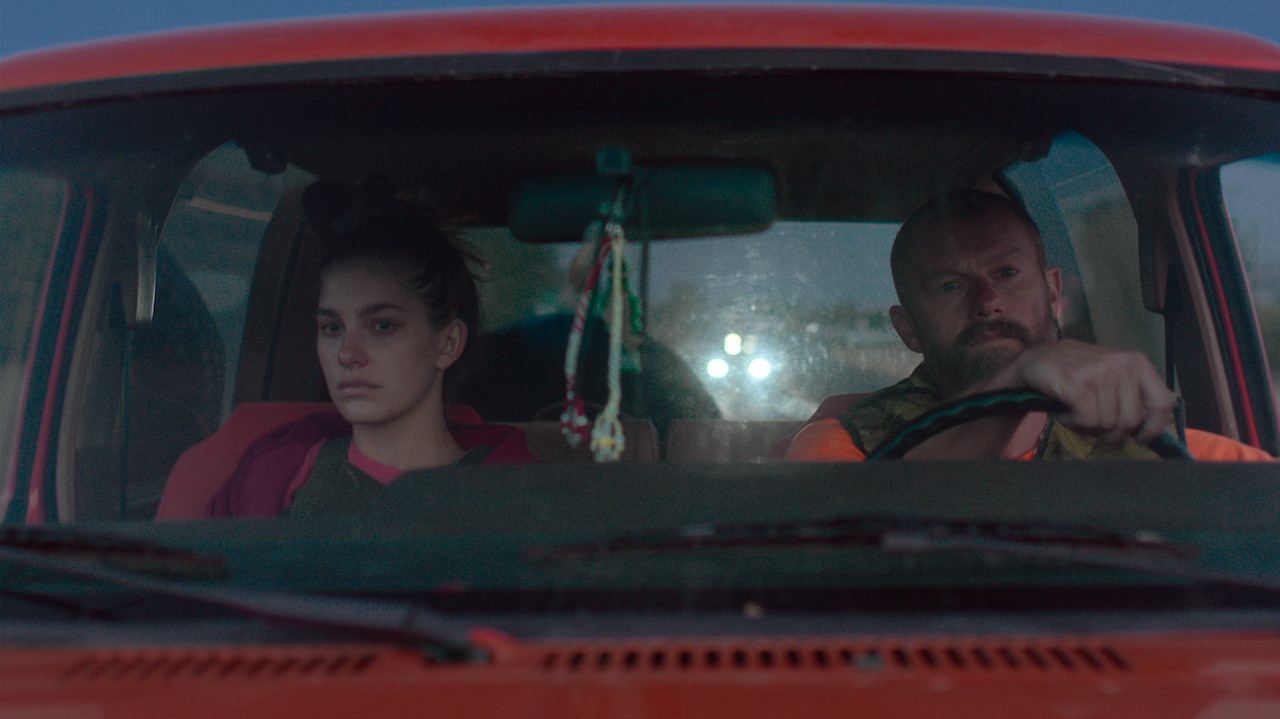
NOVEMBER 13 (NY), NOVEMBER 22 (LA), NOVEMBER 29 (other cities): Mickey and the Bear (dir. Annabelle Attanasio) – Seattle International Film Festival synopsis by Marcus Gorman: “”‘Truth is, one day you’re gonna forget about me; that’s just the way it is.’ Mickey Peck (Camila Morrone, Never Goin’ Back) swears to her father Hank (James Badge Dale, The Standoff at Sparrow Creek) that’ll never happen, but as she approaches her high-school graduation, she realizes he might have a point. Since her mother’s untimely death, Mickey has dedicated her life to taking care of Hank, whose leg injury while serving in Iraq has turned him into an alcoholic and full-blown Oxycontin addict. Even if he does get better, of which there is no guarantee, what’s left for her in the small town of Anaconda, Montana? Maybe the new kid in school (Calvin Demba, Kingsman: The Golden Circle) and the no-nonsense town psychiatrist (Rebecca Henderson, ‘Russian Doll’) can inspire her to follow her dreams of leaving Montana behind forever for the sunny shores of the West Coast. In her feature debut, writer/director Annabelle Attanasio (also an actress best known for her work on Steven Soderbergh’s ‘The Knick’ and CBS’s ‘Bull’) demonstrates extraordinary restraint with a story that could have very easily fallen into garish melodrama, never shifting focus away from Morrone and Dale’s outstanding performances. ‘It wasn’t supposed to be like this, darling,’ Hank drunkenly tells his daughter one night. And it’s not too late to change that.”
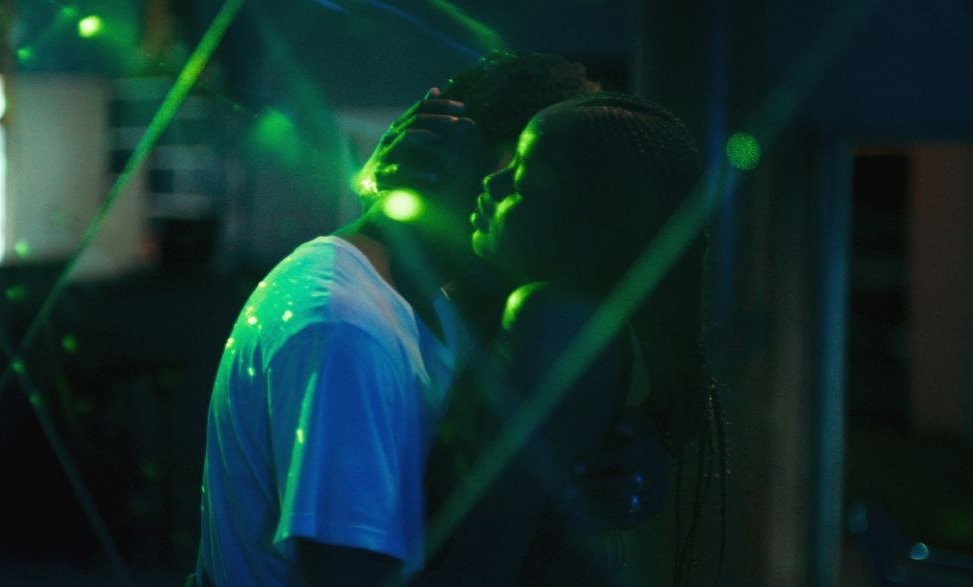
NOVEMBER 15 (in theaters), NOVEMBER 29 (streaming on Netflix): Atlantics (dir. Mati Diop) (DP: Claire Mathon) – IndieWire’s Cannes Film Festival review by Eric Kohn: “Several recent movies have explored the refugee crisis as a deadly proposition, from the documentary Fire at Sea to Mediterranean, both of which focus on dramatic attempts to cross the ocean on rickety boats. The striking distinction of Mati Diop’s Atlantics is the way it magnifies the experiences of those left behind. Diop’s gorgeous, mesmerizing feature directorial debut focuses on the experiences of a young woman named Ada (Mama Sané) stuck in repressive circumstances on the coast of Dakar after her boyfriend vanishes en route to Spain. But it’s less fixated on his departure with other locals than its impact on Ada, and the community around her, as it contends with the eerie specter of the boys who went away.
“An actress and filmmaker whose experimental shorts touch on similar themes, Diop’s first feature doesn’t always fit together from a narrative perspective, but it musters such an absorbing vision of an alienated seaside life that not everything needs to add up for the atmosphere to take hold. Atlantics takes the form of a dazzling Senegelese ghost story in which everyone’s haunted by the desire to escape.
“But the movie begins as a more grounded romance, with Ada and Souleiman (Ibrahima Traoré) roaming around the beach in carefree fashion, even as the young fisherman seems troubled by something he can’t quite express. By the next day, Ada figures it out: Souleiman and some of his peers have escaped to sea, following a route to Spain in a rickety pirogue like so many before them, few of them make it across. That leaves Ada forced to contend with an arranged marriage to Omar (Barbara Sylla), a wealthy immigrant who seems to regard her as little more than a prop. But when the wedding is sabotaged after someone sets Omar’s mattress on fire, Ada begins to suspect that Souleiman has returned in secret.
“So…where is he? Struggling with the emptiness in her life and the traditionalist expectations of her Muslim family, Ada enters into a speculative zone as the movie transforms into a lyrical vision of solitude, with the ubiquitous ocean embodying the entire community’s paradox sitting in their backyard — the portal to entire world stares at them, an expansive blue mirror that suggests potential and peril in equal doses.
“This is familiar turf for the director, whose short of the same name revolved around men sharing stories of their dramatic trips across the wave, as they discussed the allure of escape in near-spiritual terms. Beyond that — and a fleeting image of the vast ocean glimpsed from above — the feature-length Atlantics applies this notion to more traditional narrative beats, at least at first. As a local detective (Ibrahima Mbaye) begins tracking Ada around town in an attempt to solve the mystery of the blaze, Atlantics seems as though it’s heading into noir territory.
“Then it careens into a far more enticing labyrinth of enigmatic developments, including the possession of several local women by men who died at sea. Though it never becomes a horror movie, this ominous twist transforms the movie into dark poetry that exhumes the psychological duress experienced by Ada and the other women left behind by giving it a literal dimension. It’s an ambitious device that manages to inject the drama with an otherworldly urgency.
“Diop is a disciple of Claire Denis (as an actress, she appeared in Denis’ 35 Shots of Rum), and clearly aspires to the visual language at the heart of Denis’ talents. Atlantics is based in snippets of lonely vistas and dreamlike exchanges loaded with emotional ramifications. Cinematographer Claire Mathon (Stranger by the Lake) bathes scenes in heavy shadows and neon-blue hues that intensify the movie’s gripping atmosphere as Ada comes to terms with her missing partner and develops a new kind of empowerment with the women around her.
“With so much extraordinary imagery at every turn, Atlantics doesn’t always fuse its disparate ingredients into a gratifying narrative whole. The detective’s investigation has a forced quality at odds with the more introspective moments surrounding it, and Atlantics falls short of finding the payoff that its puzzle of a story hints at from the start. Instead, Diop lingers in a complex mood with the confidence of a purely cinematic storyteller.
“As it ventures further along its spellbinding path, Atlantics remains a deeply romantic work that magnetized the fears of people trapped by their surroundings and striving for the companionship that can rescue them from despair. It doesn’t quite let them get there, but Diop doesn’t strike a hopeless tone the whole way through. Ultimately, Atlantics shows how that even these bleak circumstances can have empowering ramifications for the women trapped by the shore, and why it’s a portal to a better life even if they stay put.”
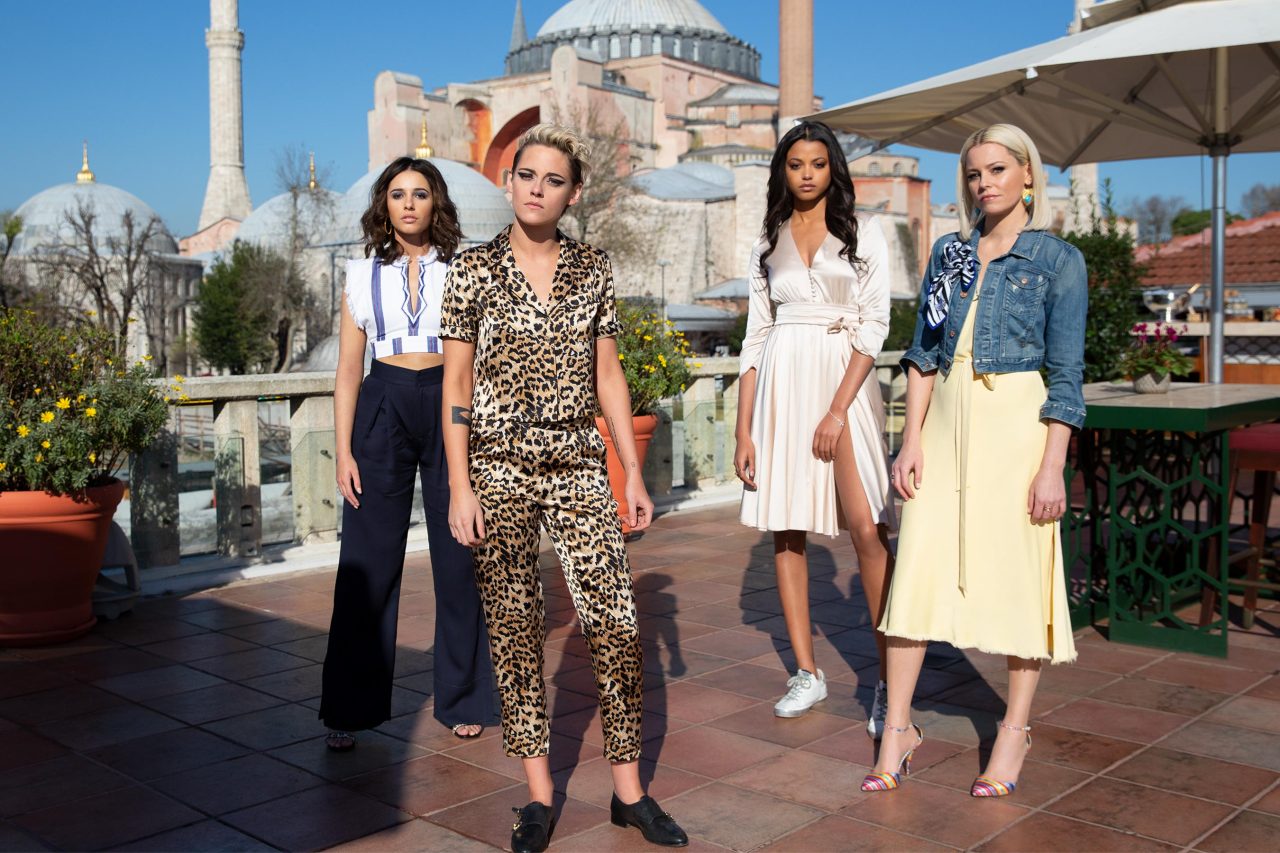
NOVEMBER 15: Charlie’s Angels (dir. Elizabeth Banks) – Synopsis from the film’s official website: “Director Elizabeth Banks takes the helm as the next generation of fearless Charlie’s Angels take flight. In Banks’ bold vision, Sabina Wilson (Kristen Stewart), Elena Houghlin (Naomi Scott), and Jane Kano (Ella Balinska) are working for the mysterious Charles Townsend, whose security and investigative agency has expanded internationally. With the world’s smartest, bravest, and most highly trained women all over the globe, there are now teams of Angels guided by multiple Bosleys (Banks, Patrick Stewart, Djimon Hounsou) taking on the toughest jobs everywhere. The screenplay is by Elizabeth Banks from a story by Evan Spiliotopoulos and David Auburn.”

NOVEMBER 15 (NY/LA), NOVEMBER 19 (airing on HBO at 9:00 PM EST): Ernie & Joe: Crisis Cops (dir. Jenifer McShane) – DOC NYC synopsis: “In confrontations between law enforcement and the mentally ill, the consequences are often traumatic, if not deadly. Recognizing that police officers are frequently the first responders to incidents involving people with mental illness, the San Antonio Police Department has developed an innovative mental health unit to divert the mentally ill away from jail and into proper treatment. Ernie & Joe: Crisis Cops follows two officers in the unit, allowing audiences to witness firsthand how they de-escalate situations to help people in crisis.”
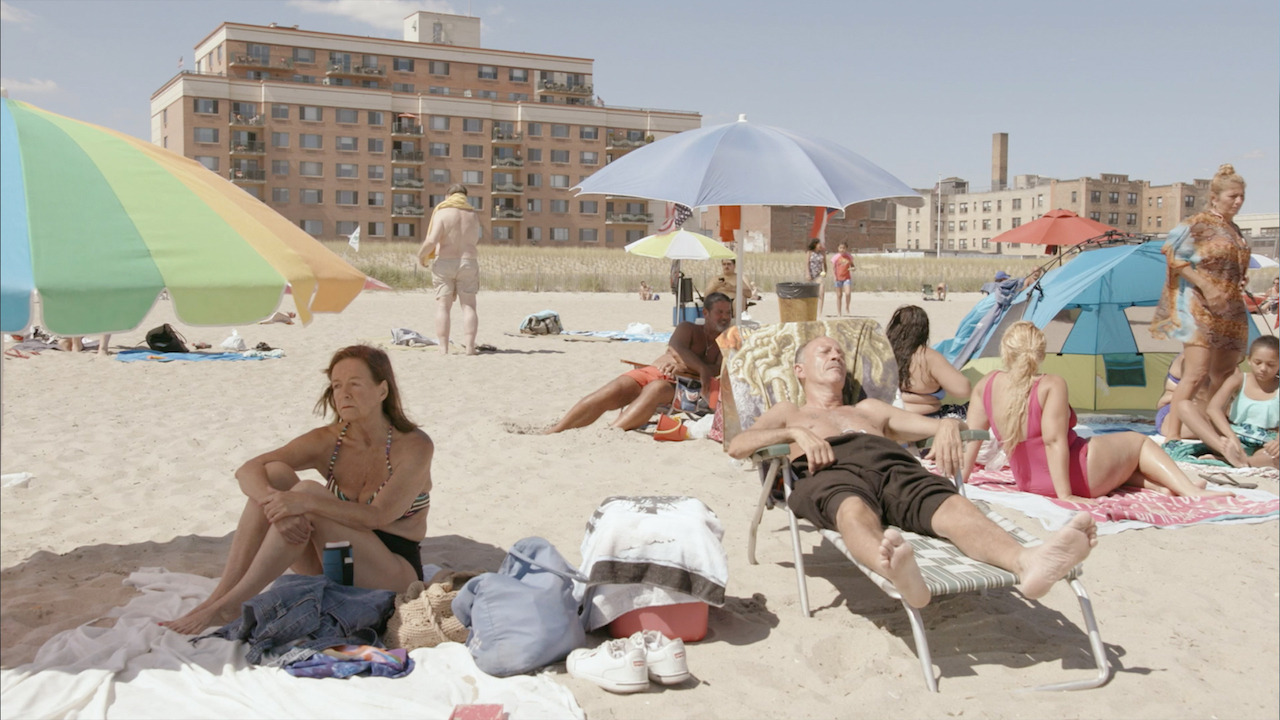
NOVEMBER 15: The Hottest August (dir. Brett Story) – BAM synopsis: “How do you feel about the future? That’s the question filmmaker Brett Story (The Prison in Twelve Landscapes) posed to dozens of New York City residents—from an Afrofuturist performance artist to stoner skateboarders to Hurricane Sandy survivors—during the sweltering summer of 2017. The answers she received reveal the deep-seated insecurities and anxieties underpinning life in an era when global warming and late-stage capitalism have seemingly set us on an apocalyptic path of no return. Balancing the engaging humanity of its subjects with an eerie science-fiction dread, The Hottest August is a funny, urgent, provocative, and visually mesmerizing look into our future as seen from the perilous present.”
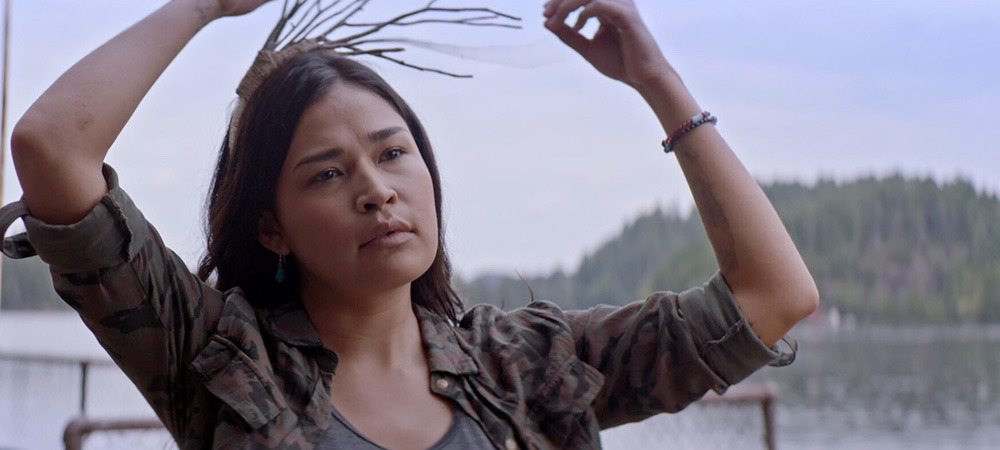
NOVEMBER 15: The Incredible 25th Year of Mitzi Bearclaw (dir. Shelley Niro) – AMC Theatres synopsis: “On Mitzi Bearclaw’s (MorningStar Angeline) 25th birthday, she’s asked to come back home to her reserve from her life designing hats in downtown Toronto to see her sick mother. As Mitzi reconnects with the land, her family and the infinitely quirky residents of Owl Island, she grows from resentful and restless to reconnecting and embracing the charm of her home through encounters with three spirits. When your spiritual guides are space travelers and their enemies are apocalyptic soothsayers, it’s easy to keep your feet on the ground.”

NOVEMBER 15 (NY), DECEMBER 17 (VOD): Sequestrada (aka Arara or Tribe) (dirs. Sabrina McCormick and Soopum Sohn) – City Cinemas Village East Cinema synopsis: “Kamodjara (Kamodjara Xipaia) and her father, Cristiano, are members of an indigenous tribe that resides on an Amazonian reservation. When they leave their reservation to protest a dam that will displace their people, Kamodjara is separated from her family and kidnapped by traffickers. Roberto (Marcelo Olinto), an indigenous agency bureaucrat overseeing a report that could change everything, is under pressure to support dam construction. Thomas (Tim Blake Nelson), an American investor in the dam, makes his way to Brazil to sway Roberto’s opinion. Sequestrada tells the story of how these three lives intertwine in front of a backdrop of geopolitics and environmental disaster.”
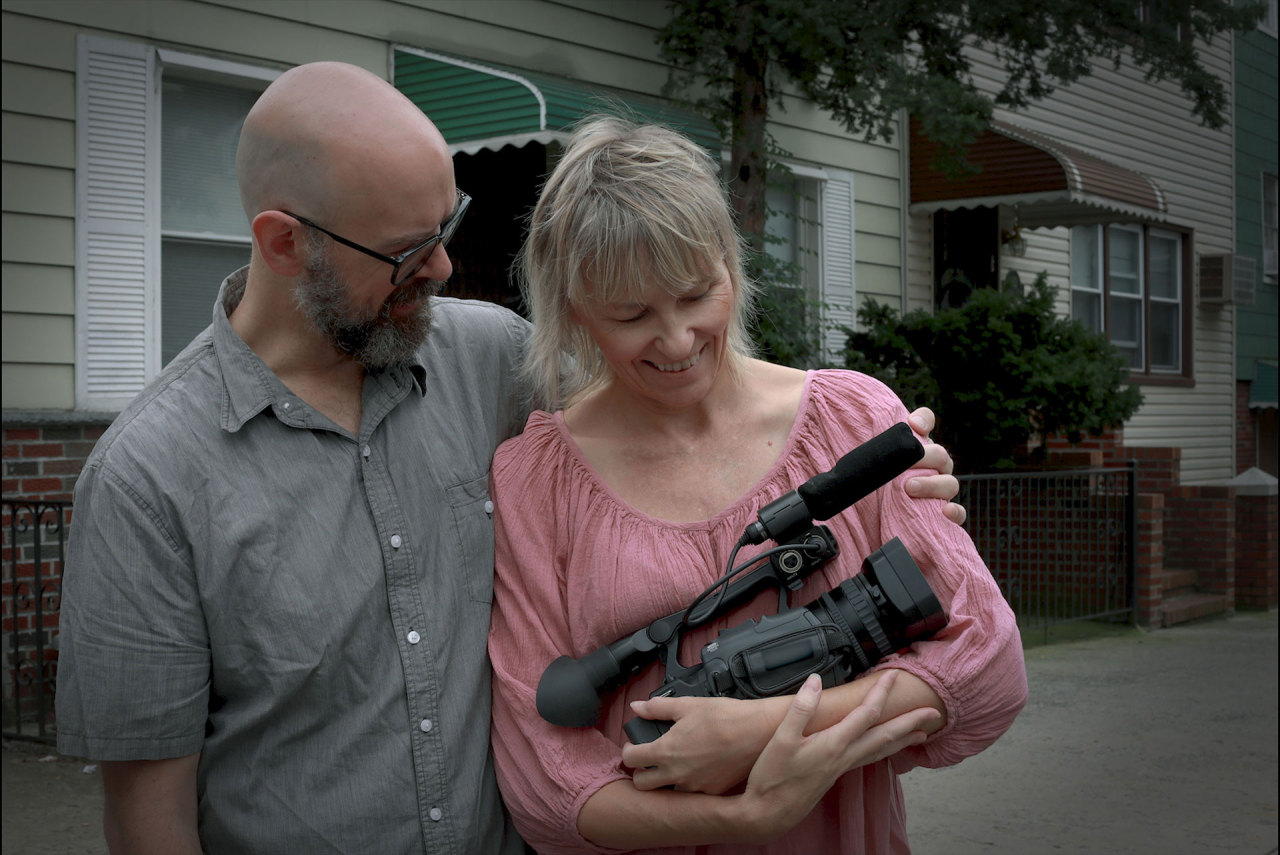
NOVEMBER 15 (NY/LA): To Kid or Not to Kid (dir. Maxine Trump) – Cinema Village synopsis: “Filmmaker Maxine Trump turns the camera on herself and her close circle of family and friends as she confronts the idea of not having kids. While exploring the cultural pressures and harsh criticism childfree women regularly experience, as well as the personal impact this decision may have on her own relationship, Maxine meets other women reckoning with their choice: Megan, who struggles to get medical permission to undergo elective sterilization, and Victoria, who lives with the backlash of publicly acknowledging that she made a mistake when she had a child. To Kid or Not to Kid bravely plunges into an aspect of reproductive choice often misunderstood, mischaracterized, or considered too taboo to discuss. With rising public awareness about climate change, resource scarcity and global population, this timely film asks the question ‘Why can’t we talk about not having children?'”

NOVEMBER 15: The Warrior Queen of Jhansi (dir. Swati Bhise) – AMC Theatres synopsis: “The Warrior Queen of Jhansi tells the true historical story of the Rani (translation: Queen) of Jhansi, a feminist icon in India and a fearless, freedom fighter – a real-life Wonder Woman who earned a reputation as the Joan of Arc of the East when in 1857 India, as a 24-year old General, she led her people into battle against the British Empire. Her insurrection shifted the balance of power in the region and set in motion the demise of the notorious British East India Company and the beginning of the British Raj under Queen Victoria.”

NOVEMBER 19 (streaming on Hulu): Margaret Atwood: A Word After a Word After a Word Is Power (dirs. Nancy Lang and Peter Raymont) – Toronto International Film Festival synopsis: “Margaret Atwood is a household name. Millions of readers worldwide know her books cover to cover, but few know the woman behind these stories. For a year, directors Nancy Lang and Peter Raymont and their film crew kept pace with Atwood and her late partner, Graeme Gibson, as they travelled to speaking engagements, spent time with family, and visited the set of The Handmaid’s Tale, the wildly popular TV series adapted from Atwood’s 1985 novel. Her poetry and prose are brought to life through voiceovers from Tatiana Maslany, revealing the personal and societal factors that inform Atwood’s stories. With personal stories shared by friends, family, and Atwood herself, the film also explores her upbringing in the Canadian wilderness and her early years as a poet, and provides a rare glimpse into the writer’s practice as she completes the final chapters of her latest work, The Testaments.”

NOVEMBER 21 (streaming on Netflix): The Knight Before Christmas (dir. Monika Mitchell) – Polygon synopsis by Petrana Radulovic: “Netflix holiday specials already gave us modern day prince and princess switcheroos. The next logical, totally reasonable step in this progression: roping in some knights. But not just some modern stately officials from an imaginary tiny European country— nay! Netflix has decided to bring-eth a real bonafide medieval knight to bless Vanessa Hudgens’ holiday season.
“Enter The Knight Before Christmas! Because there’s that poem called ‘The Night Before Christmas’ and the guy in this movie is an actual knight? And it happens before and around Christmas? Genius!
“Regular ol’ science teacher Brooke (Vanessa Hudgens) finds a very confused man who talks like he’s a Medieval Times actor. Except, he’s actually from the medieval times. Brooke thinks Cole (Josh Whitehouse from ‘Poldark’) is just a regular amnesia patient, so against the judgement of literally everyone in her life, she decides to take him in for the holidays.
“Because this is a Christmas movie, the two bond, find joy in the holidays, and will most likely fall head over heels for each other by the time Dec. 25 rolls around. Expect wonderful, gooey, marshmallow-y fluff, perfect as an accompaniment to a mug of hot cocoa.”
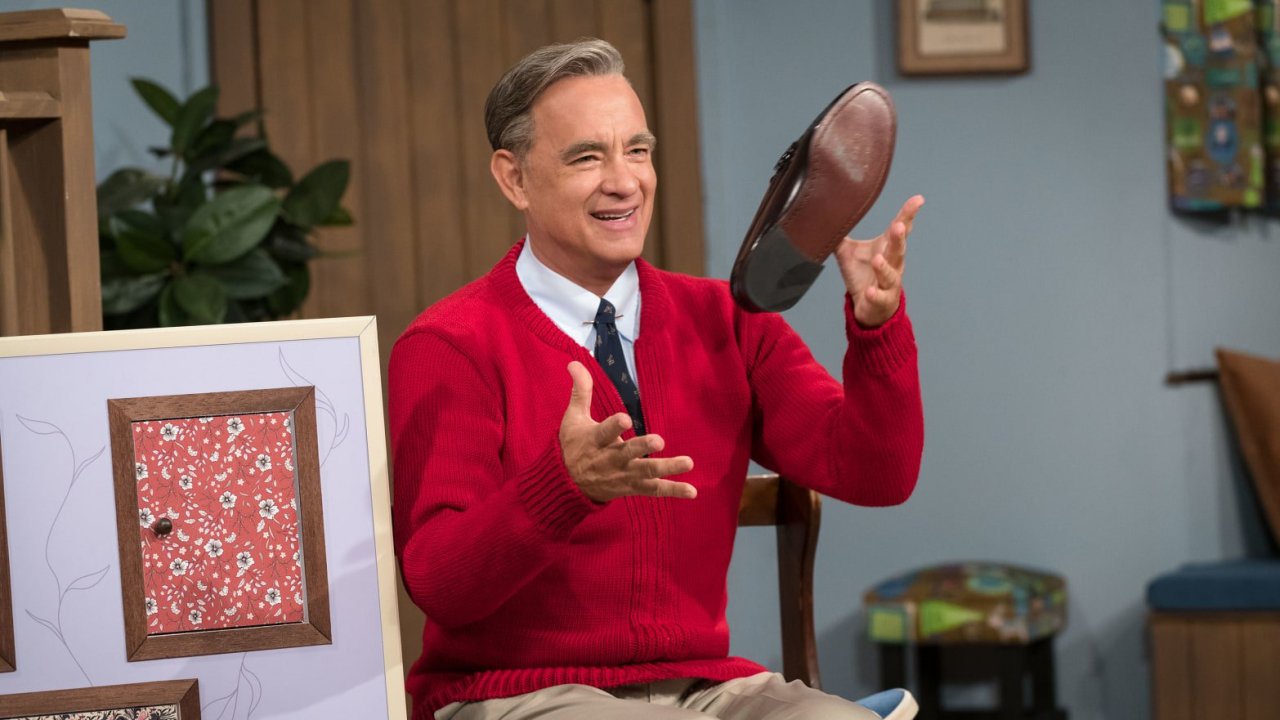
NOVEMBER 22: A Beautiful Day in the Neighborhood (dir. Marielle Heller) – TheWrap’s Toronto International Film Festival review by Steve Pond: “Fred Rogers, a Presbyterian minister from Pittsburgh better known simply as Mr. Rogers, is an unlikely movie star, and also an unlikely guy to be at the center of a movie. Mr. Rogers, after all, was the personification of niceness in a medium that prefers a little tension and conflict, a good guy who refuses to search for bad guys to tangle with.
“But Morgan Neville’s exceptional documentary Won’t You Be My Neighbor? solved the problem last year by finding the doubt and pain at the heart of Mr. Rogers’ niceness, and by showing how much his purposefully cheesy ‘Land of Make Believe’ in his long-running show ‘Mister Rogers’ Neighborhood’ was grappling with real world problems. And Marielle Heller’s A Beautiful Day in the Neighborhood, which had its world premiere on Saturday night at the Toronto International Film Festival, takes the different approach of making Mr. Rogers the balm that helps heal a different troubled person, a magazine journalist badly in need of a shot of kindness.
“It might be the softest, slowest movie to play in Toronto this year — but those are perfectly apt choices to tell this story. A Beautiful Day in the Neighborhood finds a gentle state of grace and shows the courage and smarts to stay in that zone, never rushing things or playing for drama.
“Make no mistake, there’s big drama here, as Matthew Rhys’ Lloyd Vogel — a slightly fictionalized version of Esquire journalist Tom Junod — is spurred by an interview with Fred Rogers to heal a stormy relationship with the philandering father who deserted the family when his wife fell ill.
“But just as Mr. Rogers used his show to talk about big issues with children in a tone that was softer and more halting than you’d expect given the subject matter, so does Heller stick to understatement in a way that threatens to become dull or sappy but never does. What she pulls off here is a small, sweet miracle of sorts.
“In her previous two films, Diary of a Teenage Girl and Can You Ever Forgive Me?, Heller proved to be a remarkably empathetic and understated director, with a knack for comedy in the stories of troubled people.
“And this film is indeed very funny, as investigative journalist Vogel chafes at the idea of a 400-word assignment to write about Rogers for a special issue devoted to heroes. And when his subject refuses to be bothered by tough questions, often as not thanking the writer for his insight, Vogel throws up his hands at the idea of getting a decent article out of it.
“There is, of course, a great article in it, though Vogel has to slowly realize that the real piece is about the way Mr. Rogers changes the life of an angry workaholic writer with a new baby at home and huge unresolved father issues of his own. (And the 400-word limit? Forget about it.)
“Rhys is strong as Vogel, but the attraction will no doubt be Tom Hanks as Mr. Rogers. It’s unlikely any other names were very high on Heller’s wish list, because Hanks is the only movie star with a niceness quotient to approach Mr. Rogers. Maybe that niceness has hurt him in recent years with awards voters (rather amazingly, Hanks, one of only two to win Best Actor Oscars in back-to-back years, hasn’t even been nominated since 2000). But it’s hard to imagine that his pitch-perfect channeling of Rogers’ magnificent and slightly unsettling calm won’t put him in the thick of a supporting-actor race that will probably be full of actors who could easily be considered co-leads, including Brad Pitt in Once Upon a Time… in Hollywood, Matt Damon in Ford v Ferrari and Anthony Hopkins in The Two Popes.
“Suffice it to say that tears were flowing onscreen and off at Roy Thomson Hall in Toronto. Maybe Mr. Rogers will be too soft for some moviegoers, but the box office success of the Won’t You Be My Neighbor? suggests that Sony could have a solid player in this lovely valentine to kindness at a time when that virtue is in desperately short supply around the world.”

NOVEMBER 22: Frozen 2 (dirs. Chris Buck and Jennifer Lee) – Disney Movies synopsis: “Why was Elsa born with magical powers? The answer is calling her and threatening her kingdom. Together with Anna, Kristoff, Olaf and Sven, she’ll set out on a dangerous but remarkable journey. In Frozen, Elsa feared her powers were too much for the world. In Frozen 2, she must hope they are enough. From the Academy Award®-winning team—directors Jennifer Lee and Chris Buck, producer Peter Del Vecho and songwriters Kristen Anderson-Lopez and Robert Lopez—and featuring the voices of Idina Menzel, Kristen Bell, Jonathan Groff and Josh Gad, Walt Disney Animation Studios’ Frozen 2 opens in U.S. theaters on Nov. 22, 2019.”

NOVEMBER 22 (in theaters), DECEMBER 6 (streaming on Apple TV+): Hala (dir. Minhal Baig) (DP: Carolina Costa) – Toronto International Film Festival synopsis by Cameron Bailey: “This breathtakingly assured feature from US writer-director Minhal Baig is about a teenager desperately searching for herself while straddling two very different worlds.
“The only child of Pakistani immigrants to the US, Hala (Geraldine Viswanathan) finds herself poised on the precipice of womanhood with no safety net in sight. Hala’s mother seems stiflingly traditional and overprotective, while her father seems more comfortable with a progressive world, encouraging Hala’s education and conversing with her in English instead of Urdu. The one matter on which both parents agree, however, is boys: Hala should have nothing to do with them until the time comes for her to enter into an arranged marriage.
“Yet Hala is hopelessly drawn to Jesse (Jack Kilmer), a classmate who shares her passion for skateboarding and literature. The two begin secretly meeting and Hala rapidly runs out of convincing alibis. The more Hala’s domestic life and social life clash, the more she begins to see her parents’ roles reverse — to the point where Hala discovers that she and her mother may just be able to empower each other.
“Baig’s maturity as a director is most evident in subtlety: her spare and elegant frames and the ease with which her characters move through them; the muted colour palette that fosters a sense of intimacy in scenes both tender and bracing. The performance Baig draws from Viswanathan is a thing of quiet beauty, awash in vulnerability and wonder. ‘Hala’ means ‘halo’ in Arabic, and while Baig’s heroine is no angel, she approaches her dilemma with something that can best be described as grace.”
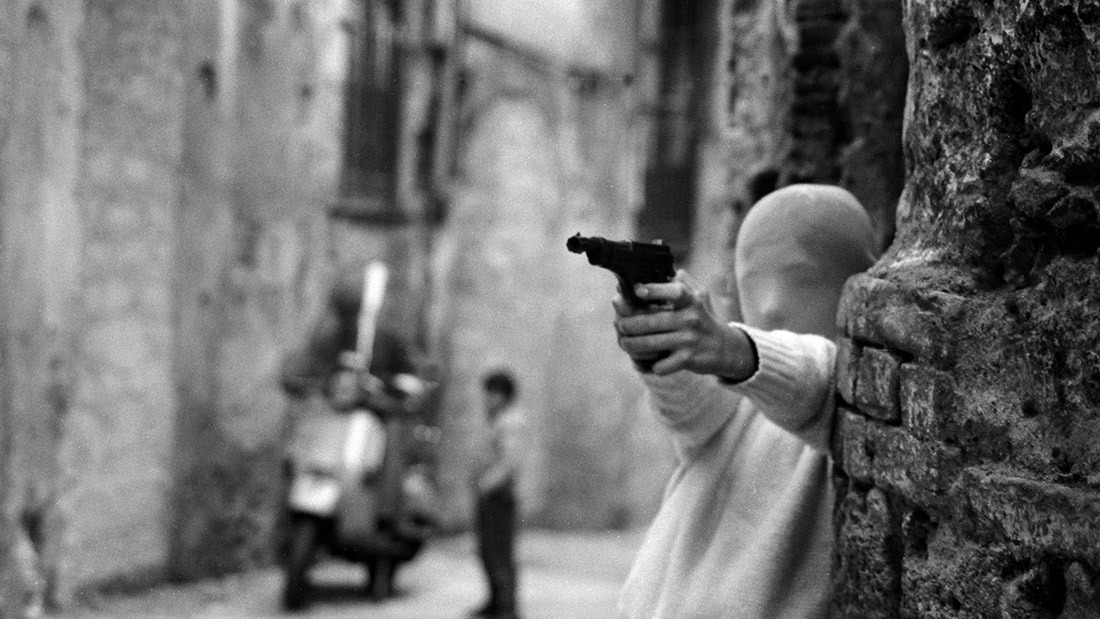
NOVEMBER 22 (NY/LA): Shooting the Mafia (dir. Kim Longinotto) – Quad Cinema synopsis: “Sicilian photographer Letizia Battaglia began a lifelong battle with the Mafia when she first dared to point her camera at a brutally slain victim. A woman whose passions led her to abandon traditional family life and become a photojournalist in the 1970s—the first female photographer to be employed by an Italian daily newspaper—Battaglia found herself on the front lines during one of the bloodiest chapters in Italy’s recent history. She fearlessly and artfully captured everyday Sicilian life—from weddings and funerals to the grisly murders of ordinary citizens—to tell the narrative of how the community she loved in her native Palermo was forced into silence by the Cosa Nostra. Weaving together Battaglia’s striking black-and-white photographs, rare archival footage, classic Italian films, and the now 84-year-old’s own memories, Shooting the Mafia paints a portrait of a remarkable woman whose bravery and defiance helped expose the Mafia’s brutal crimes.”
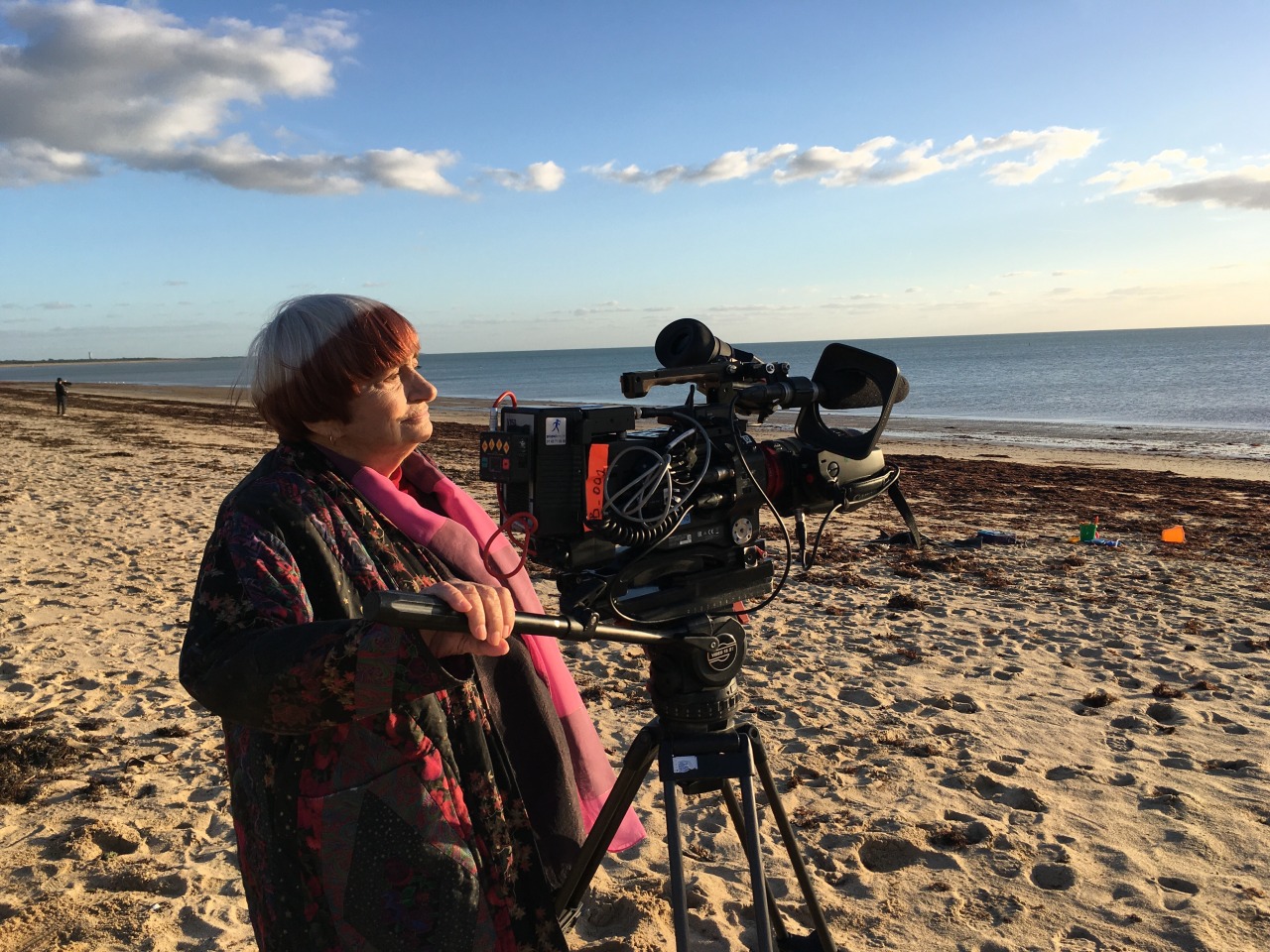
NOVEMBER 22 (NY): Varda by Agnès (dir. Agnès Varda) (DPs: François Décréau, Claire Duguet and Julia Fabry) – Film Forum synopsis: “This final film from the beloved Oscar®-winning Agnès Varda (1928 – 2019) is a characteristically playful, profound, and personal summation of the director’s own brilliant career. At once impish and wise, she acts as our spirit guide on a free-associative tour through her six-decade artistic journey, shedding new light on her films, photography, and recent installation works while offering her one-of-a-kind reflections on everything from filmmaking to feminism to aging. Suffused with the people, places, and things she loved—Jacques Demy, cats, colors, beaches, heart-shaped potatoes—this wonderfully idiosyncratic work of imaginative autobiography is a warmly human, touchingly bittersweet parting gift from one of cinema’s most luminous talents.”
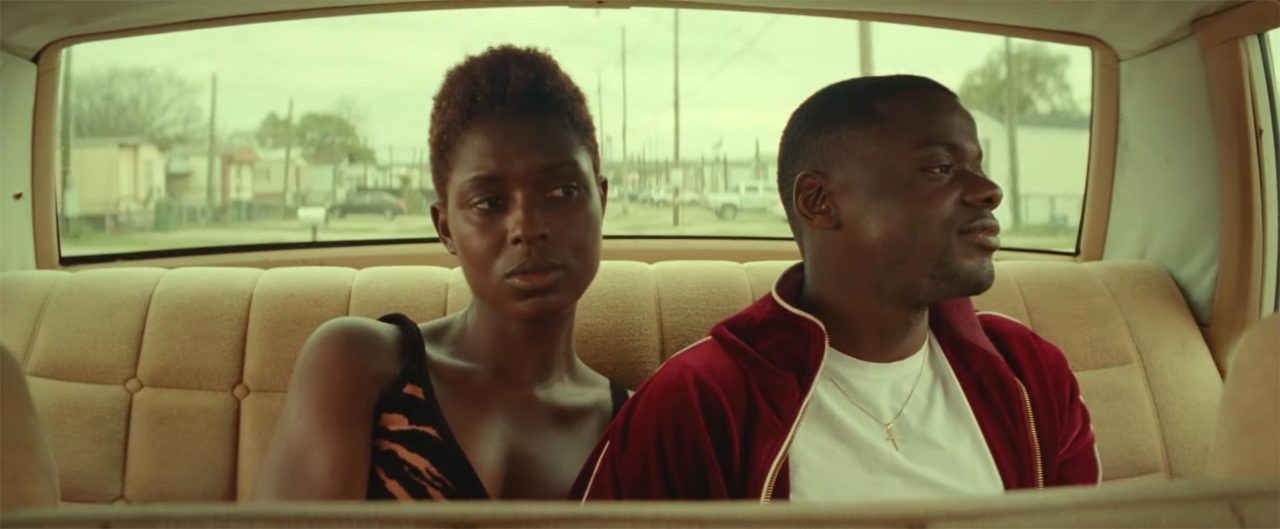
NOVEMBER 27: Queen & Slim (dir. Melina Matsoukas) – Synopsis from the film’s official website: “From two-time Grammy award winning director Melina Matsoukas, the visionary filmmaker behind this generation’s most powerful pop-culture experiences, including HBO’s ‘Insecure,’ the Emmy award-winning ‘Thanksgiving’ episode of Netflix’s ‘Master of None,’ and Beyoncé’s ‘Formation,’ and from trailblazing, Emmy-winning writer Lena Waithe (Netflix’s ‘Master of None’), comes the unflinching new drama, Queen & Slim.
“While on a forgettable first date together in Ohio, a black man (Get Out’s Daniel Kaluuya) and a black woman (Jodie Turner-Smith, in her first starring feature-film role), are pulled over for a minor traffic infraction. The situation escalates, with sudden and tragic results, when the man kills the police officer in self-defense. Terrified and in fear for their lives, the man, a retail employee, and the woman, a criminal defense lawyer, are forced to go on the run. But the incident is captured on video and goes viral, and the couple unwittingly become a symbol of trauma, terror, grief and pain for people across the country.
“As they drive, these two unlikely fugitives will discover themselves and each other in the most dire and desperate of circumstances and will forge a deep and powerful love that will reveal their shared humanity and shape the rest of their lives.
“Joining a legacy of films such Set It Off and Thelma & Louise, Queen & Slim is a powerful, consciousness-raising love story that confronts the staggering human toll of racism and the life-shattering price of violence.”
NOVEMBER 27: 63 Up (dir. Michael Apted) (many DPs, including Shana Hagan) – Film Forum synopsis: “Michael Apted’s landmark longitudinal documentary series, beginning in 1963, has followed the lives of a dozen or so British 7-year-olds, checking in with them every seven years. There’s scrappy Tony, a jockey-turned-cabbie; the terribly posh public school boys who become fox-hunting, aristocratic barristers; three working-class little girls for whom marriage, divorce, and children define much of their lives (one of whom has the temerity to confront Apted for his sexism). The British class system plays a major role, but so too do luck and temperament, romance, religion, mental illness, and race. Apted subtly collages historical footage, allowing his subjects to fast-forward into the person they become, much as flowers bud, bloom and fade — allowing us to consider our own life cycle with startling and poignant clarity.”
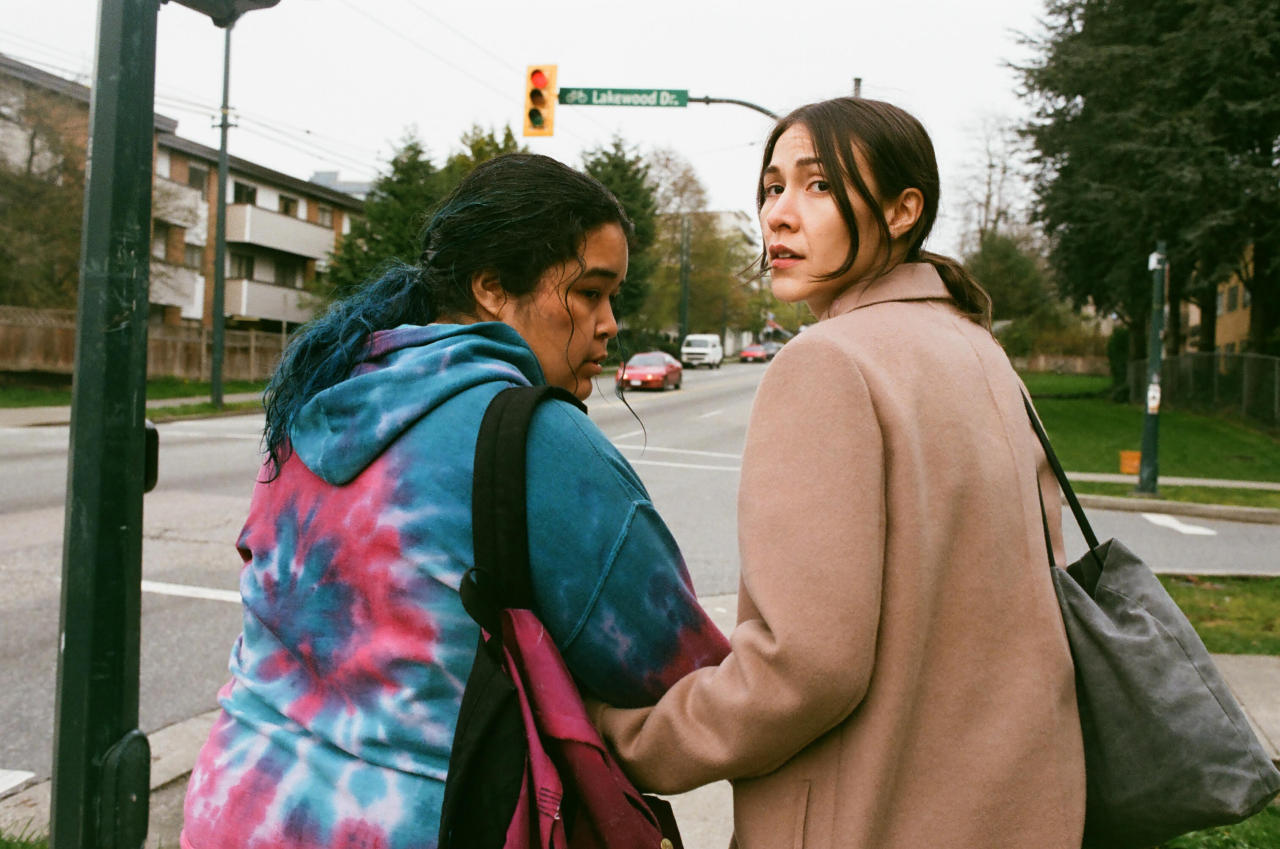
NOVEMBER 29: The Body Remembers When the World Broke Open (dirs. Kathleen Hepburn and Elle-Máijá Tailfeathers) – Another Gaze’s Toronto International Film Festival review by Esmé Hogeveen: “Elle-Máijá Tailfeathers and Kathleen Hepburn’s The Body Remembers When the World Broke Open follows a day in the life of two women: Áila and Rosie. These characters meet on a street in Vancouver, Canada: Áila (Tailfeathers) is on her way home from work when she sees the pregnant Rosie (Violet Nelson), barefoot and bruised, walking away from her abusive partner’s home. Áila offers Rosie support, inviting her back to her apartment for a moment of respite and a change of dry clothes. There the women speak and discover sources of connection and dissonance. Frequent silences and moments of awkwardness underline the challenge of accepting that support may necessarily involve mutual vulnerability.
“A TV Guide summary of The Body Remembers would probably describe it as two women grappling with the complexity of domestic abuse, likely also noting that the protagonists come from different Indigenous backgrounds. This kind of synopsis would be true, yet conjures clichéd narratives of drama, trauma, and racial and cultural identity that the film avoids. Instead, Tailfeathers and Hepburn give us a grounded interrogation of these topics. Their script, along with Norm Li’s cinematography, focuses on the presence of violence as a pervasive aspect of female experience. Tensions arise from day-to-day dilemmas, such as the decision Rosie faces about whether to maintain the fraught stability of partnership, and to continue living with her partner’s mother, versus striking off on her own and facing as-yet unknown difficulties. With refreshing subtlety, Tailfeathers and Hepburn manage to show and not tell trauma. Their nuanced approach is particularly felt in the film’s andante pacing – The Body Remembers is slow. Much of the story is told in real time with scenes and shots alternating between Áila’s and Rosie’s perspectives. As viewers, the stripped-down narrative of The Body Remembers encourages us to feel close to both women, but the absence of a melodramatic arc prevents us from assuming we can fully understand them. In lieu of a smooth catharsis, we are compelled to note the ways in which individuals may protect themselves through shielding secrets and intimacies.
“Taken as a whole, The Body Remembers is a thoughtful illustration of the complex ways in which trauma can educate, undermine, and fortify an individual’s sense of self and her knowledge about the world. In a scene that comes late in the film, Áila halfway convinces Rosie to go to a safe house and the characters ride there together in a cab. At first the atmosphere in the car is tense. Rosie is clearly unsure of the short- and long-term advantages of staying in a shelter. The characters’ hitherto smooth rapport becomes uneasy as Áila shifts from empathetic first-responder to assertively – though never aggressively – suggesting ways for Rosie to alter her circumstances. The viewer is placed in the uncomfortable position of pseudo-arbiter: we observe Rosie’s desire to be independent alongside her difficult position, as well as Áila’s own vulnerability, a force which underlies her desire to support Rosie. Without knowing the entirety of either woman’s situation, judgment seems impossible: throughout the film, would-be assessments about the characters’ decisions flip self-reflexively onto the viewer. Who are we to assess the righteousness of Áila’s advice, or what course of action would best serve Rosie? What is the relationship between receiving support and consenting to it? Rosie never asks Áila for help, at least not verbally, and in a few scenes she wryly queries Áila’s impulse to assist her. In the cab, Rosie somewhat cheekily convinces the driver that she and Áila are sisters and that Áila is en route to alcohol addiction treatment. The cabbie’s fumbling kindliness, including admission of his own addiction struggles, furthers the loose promise of connections between strangers initially presented by Rosie and Áila’s encounter. At the same time, the unlikeliness of these interchanges leading to any sort of systemic change underscores the unstable social realities impacting all the characters’ lives. While the women are paying customers, the driver displays compassion, but would he even notice them, let alone their challenges, outside of a transaction? While Rosie’s sense of humour in this scene has a kind of optimistic potential in that it leads to a sharing of issues, it also serves as a reminder that identifying intersections between social issues doesn’t necessarily bring us any closer to solving the underlying problems.
“When watching The Body Remembers, we are constantly reminded of our limited understanding of the characters. That the women’s backgrounds are relatable, yet widely different – Áila is Blackfoot from the Kainai First Nation (Blood Reserve) in Canada and Sámi from northern Norway, whereas Rosie is Kwakwaka’wakw from British Columbia, Canada – reiterates the difficulty of mapping one experience or perspective onto another. Beyond differences in heritage, Áila and Rosie also occupy disparate class positions: Áila keeps a small, chic apartment, whereas Rosie stays with her boyfriend’s mother in a seemingly less upscale part of Vancouver. We only see the characters for part of a single day, and the script lacks voiceover or other extra-expositional devices. Perhaps this psychic distance is what makes the camera’s intimate physical proximity so affecting. An early scene in a doctor’s office, where Áila changes out of her clothes in preparation for an IUD insertion, is echoed when the camera tracks Rosie as she tugs off a rain-drenched tie-dye sweatshirt and changes into borrowed clothes in Áila’s bathroom. This borderline voyeurism recalls the ambiguous lines between caregiving, advocacy, charity, and presumption. An additional layer of complexity is added to the protagonists’ dynamic through their different relationships to motherhood: whereas Rosie seems relatively calm about her pregnancy, Áila has a more uncertain position on maternity and mentions at one point that her partner may be more interested in parenting than she presently is.
“The Body Remembers is aware of its limits, and this lends a directness to its storytelling. The production is sparse and tactfully avoids fanciful flashback sequences or camera flourishes. I also noted an apt absence of sentimentality about landscape. (Canadian television and film projects about Indigenous characters or topics helmed by non-Indigenous makers seem often to use scenic establishing shots as shorthand for establishing identity and place.) Instead, the film is set in a close and highly contained urban, human sphere. Shots roil with intensity, beckoning the viewer in. There are no moralizing shortcuts or incentives for passing premature judgment. By thoughtfully abstaining from manufactured catharsis or generalisations about womanly bonds or trauma, The Body Remembers centres the vast challenges inherent to interpersonal recognition and support. Read in this light, the film’s andante rhythms make all the more sense. Tailfeathers and Hepburn disavow spectacle to offer humane glimpses, chronicling the insidious presence of trauma.”
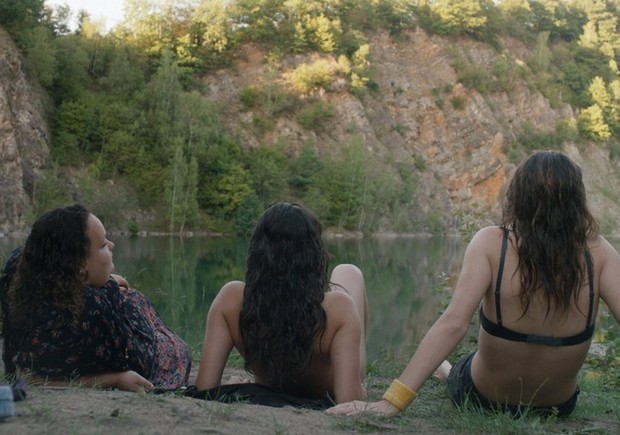
NOVEMBER 29: Cavale (aka Girls on the Run) (dir. Virginie Gourmel) (DP: Juliette Van Dormael) – Cineuropa’s Brussels International Film Festival review by Aurore Engelen (translated from French): “Kathy, a secretive and rebellious teenager, has only one goal in mind: to escape the psychiatric institution where she has been locked up. Soon, she runs away and returns to her father, the only one who can free her from ‘this prison.’ Against all expectations, her roommates Nabila and Carole, crazy and weird in equal measures, invite themselves to her improvised escape. But nothing will happen as planned…
“After Stagman and Aïe, two short films set in worlds of fantasy, Virginie Gourmel has come together with Micha Wald (Horse Thieves, Simon Konianski), who penned the script, to retrace the route of Kathy, a fragile young girl without guidance who seeks to rewrite her own story by all means necessary. On her path, she meets two other lonely girls, Nabila and Carole, just as lost as she is. All three will rely on one another, but what kind of support can they really hope for from such unsteady reinforcements?
“In her first two films, Virginie Gourmel was interested in monsters whose deformity was visible: a vampire and a deer-man, characters on the margins, different, damaged by life. With Cavale, selected in National Competition at the Brussels International Film Festival, she slides into the real by playing with characters whose monstrosity is completely internal: freaks, slightly crazy and heavily medicated young people, agitated adolescents.
“At the hospital, Kathy rebels, refuses her pills, rejects the ‘protection’ decided by the judge. And the girls wonder about their mental health. Once the hospital walls behind them, the film turns into a road movie. A real initiatory journey for Kathy, Nabila and Carole. In a ‘family I hate you’ fashion, the three inseparable girls, by force of circumstance, discover friendship, betrayal, and first love, like an accelerated adolescence — until the slip up. The trio becomes a duo when Kathy crosses the path of her little brother…
“The film, told from the perspective of the young girls, is carried by three young actresses in their first film roles: Lisa Viance, Yamina Zaghouani and Noa Pellizari. Though Cavale does not reinvent the road movie format, nor that of the coming of age film, the film succeeds, in a few gracious scenes, to embody female adolescence. In shooting the relationship to the body of three young girls caught in a moral and hormonal storm, trying clumsily but with great energy to find answers to the questions that torment them, Virginie Gourmel offers a multifaceted portrait of this ever so ephemeral period, all the while questioning our rapport to madness.
“The cinematography is handled by Juliette Van Dormael (Angel), a young woman in high demand these days who has just shot Frédéric Fonteyne’s Filles de Joie (previously known as La Frontière). The work on colours, in particular, and on set-design, gives power to the three young girls’ escape.”

NOVEMBER 29: My Friend the Polish Girl (dirs. Ewa Banaszkiewicz and Mateusz Dymek) – The Guardian review by Peter Bradshaw: “Here is a low-budget experiment in metafiction, or quasi-fiction, with a shimmer of anxiety, shot mostly in black and white with periodic excursions into color and animation – all about a young Polish woman living alone in a London flat, dealing with issues that are never clearly articulated. It often seems like nothing so much as a postmodern, 21st-century version of Polanski’s classic Repulsion.
“The film itself appears to be a faux video diary by a (fictional) independent film-maker, recounting her experiences making a documentary about the life of a migrant worker in London. Emma Friedman-Cohen plays Katie, the director, and Aneta Piotrowska gives a bold and interesting performance as Alicja, the Polish woman and part-time actor Katie finds through an audition process. Alicja allows Katie into her life, at least partly through loneliness, and seems intensely sexual in a compulsive and troubled way. (An actor friend playfully addresses her as ‘Stella!’ from A Streetcar Named Desire.) Katie comes to believe that Alicja might have been abused as a child; she is partly excited by the thought that her film might be on the verge of a revelation but also frightened by the intensity and responsibility that that would entail.
“My Friend the Polish Girl is a fiction about an imagined factual film, and yet it is apparently so rooted in an exploratory, improvisatory process, that it seems almost a real-time documentary about actors immersing themselves in roles inspired by their own feelings. The result is not perfect, but by the end of the film you find yourself caring about Alicja, about what has brought her to this stage and what is to become of her.
“In its indirect way, it casts a compassionate light on London’s migrant workers that a more conventional documentary – or conventional drama – wouldn’t.”
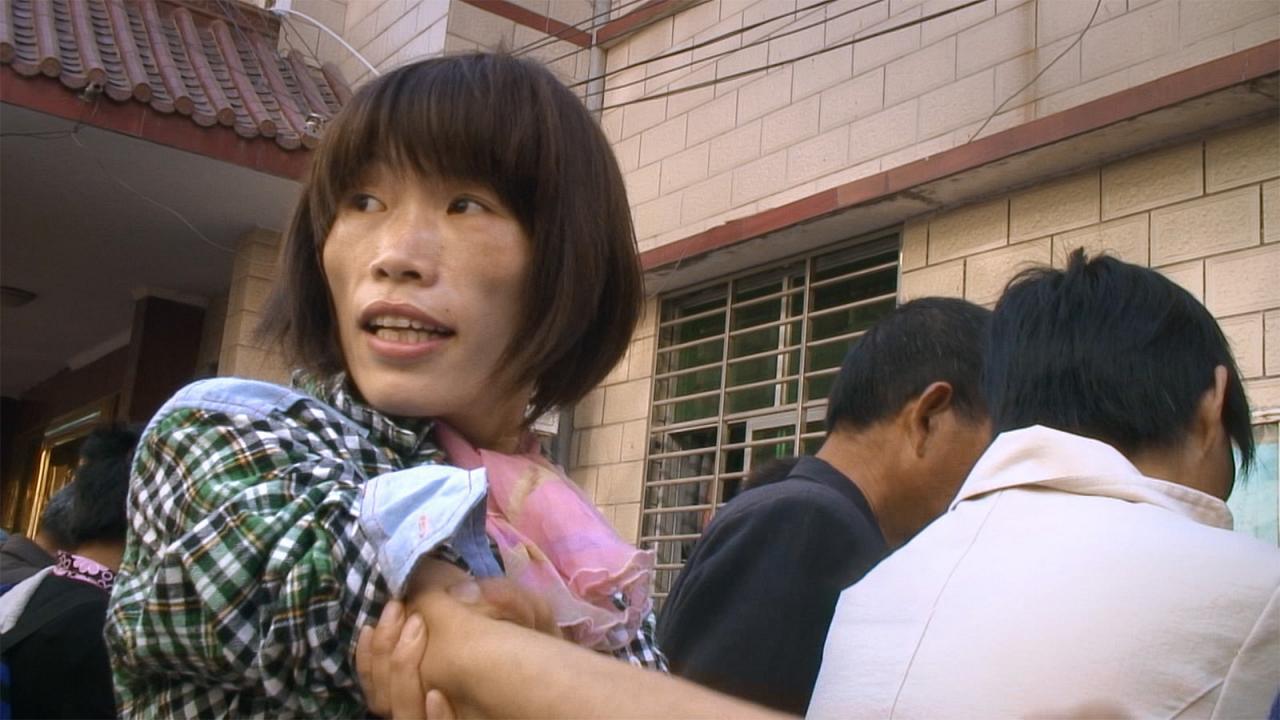
NOVEMBER 29 (NY): Ximei (dirs. Andy Cohen and Gaylen Ross) – Cinema Village synopsis: “Ximei is a young woman from China’s rural Henan Province who contracted AIDS when the government encouraged impoverished villagers in the late 1990’s to sell their blood plasma for money, literally bleeding people for profit. Unsanitary conditions and lack of screening for disease, caused blood infected by the HIV virus to be transmitted to donors and then to the recipients of blood transfusions. A million Chinese citizens were infected with HIV and countless persons died from AIDS. Thousands of peasants still suffer the consequences, their plight hidden from the eyes of the world and strongly censored by Chinese authorities. Ximei has dedicated herself to revealing the desperate conditions that continue to exist among her fellow AIDS patients, the discrimination, and the lack of clinics, and medical treatments available to them. Even now officials try to terrorize Ximei into silence, closing down her halfway house for AIDS patients, while she single-handedly fights for their social and legal rights. Her courageous actions and fiery character transform their tragedy into lives of hope and dignity.”
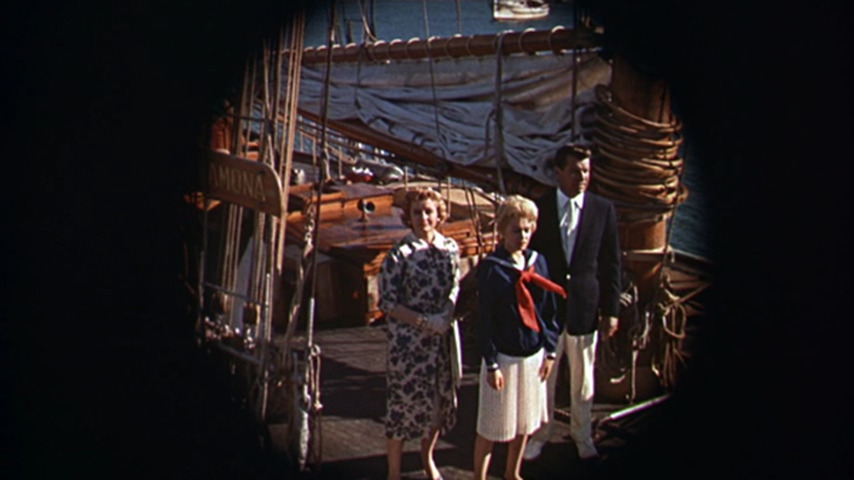
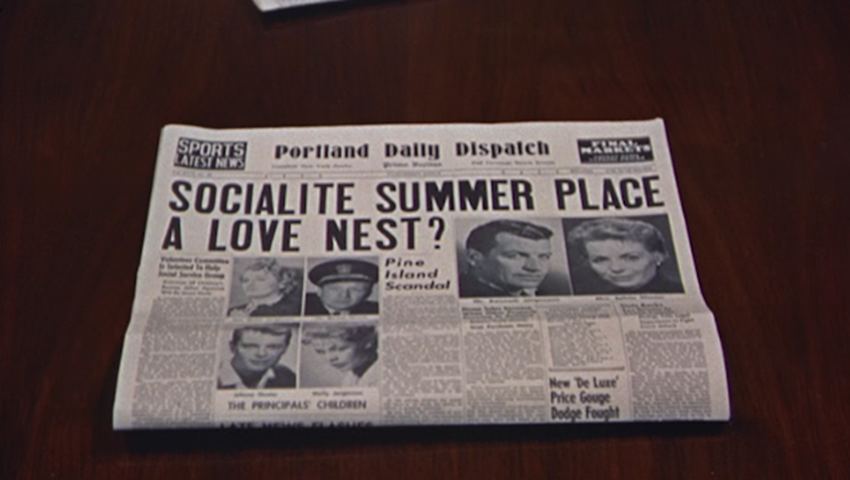
As August came to a close, I eked out some time for a melodrama I had been curious about for years, A Summer Place. I’m not sure what I expected aside from repetitions of the love theme popularized by Percy Faith & His Orchestra, but I was surprisingly moved by the ways that the actors brought their characters to life in a story that, like its contemporaries Gidget (1959) and Where the Boys Are (1960), pushes the boundaries of how sex was discussed in mainstream Hollywood cinema.
Filled with as many tangles as any tale of star-crossed lovers, A Summer Place focuses as much on societal/generational clashes as on the theme of second chances. It all starts when Bart Hunter (Arthur Kennedy), owner and proprietor of a somewhat run-down inn on an island off the coast of Maine, announces to his wife Sylvia (Dorothy McGuire) that their incoming guests for the summer will be a man they grew up with on the island, Ken Jorgenson (Richard Egan), along with his family. Although Sylvia has never told Bart, she and Ken were in love when they were young adults, before class distinctions drove them apart. Now, decades later, Ken is a self-made millionaire stuck in a passionless marriage to Helen (Constance Ford), who is preoccupied with their teenage daughter Molly’s (Sandra Dee) chastity. Upon reaching the inn, both families are immediately tested: Molly is charmed by Bart and Sylvia’s handsome, college-bound son Johnny (Troy Donahue), while Ken and Sylvia are drawn to one another as surely as if they were their kids’ ages once more.
Worry sets in for the older paramours as they watch their children, concerned that Molly and Johnny are doomed to repeat the same mistakes. This is where A Summer Place finds its footing as a romantic drama. Sandra Dee, whose performances in Imitation of Life (1959), the aforementioned Gidget and Portrait in Black (1960) had ranged from “just OK” to “good” in my estimation, does an absolutely fantastic job at articulating Molly’s conflicted emotions in Delmer Daves’ film. I’m not embarrassed to admit that I shed some tears. The same cannot be said of Troy Donahue, who plays Johnny with all the intensity of a block of wood, but at least he adequately conveys the character’s sweetness. In fairness, it’s refreshing to see a teen boy depicted as more sexually inexperienced and unsure of himself than a girl, although she’s hardly worldly; Molly’s history seems to be restricted to making out.
As was the case for the adolescent protagonists of another censorship-pushing 1959 film, Blue Denim, Molly and Johnny’s loss of virginity is followed up with frank conversations about pregnancy and abortion, some of which are beyond dated. But again, Sandra Dee handles Molly’s zigzagging between pursuing desire and bowing to social conventions – trying to combat the burdensome shame of not living up to the expectations of a “good” girl’s behavior – with mature poise. Equally worthy of praise is Constance Ford’s role as Molly’s obsessive mother, who demonizes her daughter with the cruelest tactics she can think of to break up the teen couple, including a first-time gynecological exam to determine whether Molly has had sex (she had not at that point). A Summer Place ultimately hews to Hollywood’s Hays Code edicts about sexuality and marriage, but its sympathetic view of Molly’s journey is as effective now as it must have been sixty years ago.
Furthermore, as a supplemental reading, Sandra Dee’s 1991 essay for People about surviving childhood sexual abuse and subsequently battling anorexia and drug/alcohol addictions (the latter two leading to her eventual death from kidney failure) gave me insight into how she was able to relate to the most serious aspects of what Molly Jorgenson endures. I can’t imagine how difficult it was for Dee – who was only sixteen when A Summer Place was shot – to balance her newfound stardom with her past and present traumas, but the fact that she could so expertly hide that pain (even though she obviously should not have had to) and become a candy-coated icon of teen fun is a testament to her inner strength and acting ability.


In anticipation of the upcoming film Pain and Glory, I took a leap of faith last month and dove into the filmography of Pedro Almodóvar, whose work I had been intrigued by ever since my high school AP English teacher told the class about his limitless admiration for Talk to Her. Thanks to the Criterion Channel app, I started with the film that I had heard was one of the most accessible introductions to the auteur’s style, Women on the Verge of a Nervous Breakdown. Designed as an homage to the Jean Cocteau play The Human Voice, the film is a madcap confection of occasionally surreal humor that moves at the breakneck pace of Hollywood screwball comedies from the 1930s and 40s and is anchored by the incredible actresses whose characters propel the story forward.
The glowing sun at the center of Women’s solar system is Pepa (Carmen Maura, a new favorite for me), an actress who has had some success doing TV commercials and voiceovers for Spanish-language dubs of American films like Nicholas Ray’s 1954 cult classic Johnny Guitar. Pepa is in a state of barely-controlled panic thanks to a bad breakup: her married lover, Iván (Fernando Guillén), has left her for someone new. Even worse, Iván’s long-suffering wife Lucía (Julieta Serrano) is consumed with exacting revenge on Pepa almost as much as Pepa obsesses over getting Iván back. Lucía tries to convince her grown son, Carlos (Antonio Banderas with a haircut best described as “the Lyle Lovett”), of how much she has been hurt by his father’s philandering, but Carlos soon finds himself unexpectedly crossing paths with Pepa when he and his fiancée Marisa (Rossy de Palma) coincidentally answer an ad that Pepa has placed to sell her apartment. Add to the mix Pepa’s friend Candela (María Barranco), who believes that the police are hunting her down as an unwitting accomplice to a potential terrorist attack – don’t ask – and that, like Pepa’s refrigerated pitcher of barbiturate-laced gazpacho, is a recipe for absurd, funny disaster.
The supporting cast includes more recurring faces from Pedro Almodóvar’s oeuvre, like Kiti Mánver, Chus Lampreave and Loles León, as well as Guillermo Montesinos playing the driver of Madrid’s most enthusiastic form of car service, the Mambo Taxi. Almodóvar’s screenplay and direction, the cinematography by José Luis Alcaine, costumes by José María de Cossío and the score composed by Bernardo Bonezzi harmonize to present a colorful cinematic delight, topped off by a great La Lupe song in the end credits. Since watching Women, I have seen (in this order) Tie Me Up! Tie Me Down!, Matador, Law of Desire, What Have I Done to Deserve This?, High Heels, Kika and The Flower of My Secret, all of which have strengthened my newfound affection for Almodóvar’s unique artistry. I don’t know if I’ll have time to make my way through his entire filmography before Pain and Glory opens in New York theaters, but I’ll give it my best shot!
 The Iron Cupcake